Plant swap/stall

10–12 on Saturday 13 May
2–4pm on Sunday 14 May

Outside 36 Coles Lane

Bring some plants you’ve grown and take away something planted by someone else. Even if you don’t have anything to swap, take some plants anyway – leave a donation (collection for Ukraine.)

While the main focus is on veg plants and sustainable food, we won’t turn away flowers!

Organised by OWN & SOW


NEXT SOW MEETING: Electric Bikes on 26 April

Transport accounts for a quarter of the UK’s greenhouse gas emissions. Find out how cycling and electric bikes in particular can help us live more sustainably. Sean Moroney, CEO of Cambridge Electric Transport and Oakington resident, will be talking to us. There will be an e-bike to try out too!

Wednesday 26 April, 7:30pm at the church hall.

And the usual tea, biscuits and exchange of news and views!

Sustainability – Ideas to Make a Difference

SOW members are invited to this event in Landbeach on 20 April.

There is no car park for the church, which right next to the road, and there is no car parking on the road outside the church either. So, for those coming in the car, cars need to be parked on the side of the road of the nearby streets and in the village hall carpark, if there is space.

Cambridge Nature Network

Joint SOW/EAG talk on 22/2/23 by Natalie Lambert of Cambridge Nature Network with 17 attendees.

The UK is one of the most nature deprived countries in the world and Cambridgeshire is one of its most nature deprived counties. The Cambridge Nature Network was set up in 2021 to help nature recover and improve access to it.

Clusters of natural habitat have been identified within a 10km area of Cambridge as five Priority Areas, including the chalk grassland of the Gog Magog hills, the River Cam corridor, and the south of Wicken Fen. The aim is to make these areas bigger, better and more joined up.

A further “Opportunity Area”, Fen-edge Orchards & Droves, has been identified to the north of Cambridge (light brown in the map above), and it’s this area we are in – strictly, Westwick is in it and its western boundary is the guided busway but projects in Oakington would be included. (“Opportunity” rather than “priority” because of lack of funding at the time for surveys.) This area could form a stepping stone for wildlife towards the richer nature of the Ouse valley/washes and the Great Fen further north.

Cambridge Nature Network involves farming and other landowners, local planning authorities, businesses, parishes and individuals. It has pressed for nature-supportive policies to be included in the Local Plan, encouraged nature friendly farming, and has secured funding for 25 nature recovery projects. The most local to us was organised by Histon & Impington Green Spaces and included hedge laying and habitat creation such as insect boxes and reptile refuges.

Natalie encouraged us to use the Nature Recovery Toolkit to map the existing quality of habitats in Oakington & Westwick, which can lead into a project to improve them – we could then apply for funding from Cambridge Nature Network. We have decided we will look at this toolkit in the May SOW meeting (31st May).

  1. Make a simple map of wildlife habitats in your area.
  2. Decide the objectives for your nature recovery plan.
  3. Develop a nature recovery map that illustrates where you want to create new habitats and the existing habitats that can be improved.
  4. Develop a timeline for habitat creation or improvement.
  5. Develop a plan for maintaining and monitoring these habitats and the wildlife that lives there.

There were lots of questions and discussions following the talk – here are some of the points raised:

  • What are “droves”? A fenland word for long tracks used for cattle. Many local villages have droves.
  • The fen-edge orchards and droves opportunity area is now a focus for the Cambridge Nature Network.
  • Wildlife corridors – data shows that these are crucial even if not huge. Maybe the busway verges form one.
  • Working with farmers? Cambridge Nature Network soon found that farmers did not want to be told what to do, and that it was best to work with them through a committed “lead” farmer.
  • Our village survey – rather than starting with who owns what land, the toolkit will help us work out what’s already there and what we want to achieve. If a formal project is begin the Wildlife Trust may be able to help with surveying.
  • Natalie suggested we talked to people who have done projects in John Clare County (a nature priority area by the Nene Valley.)
  • A14 trees (planted by Highways but uncared for and so mostly dead.) Would have formed not only a buffer but pockets and corridors for wildlife. Natalie encouraged us to make a project proposal. Other community groups have worked with the Highways department. eg. Histon Abbey People for biodiverse verges.
  • Biodiversity Net Gain (BNG) – Natalie said the details of this have not been finalised but it is something developers will need to consider in future.

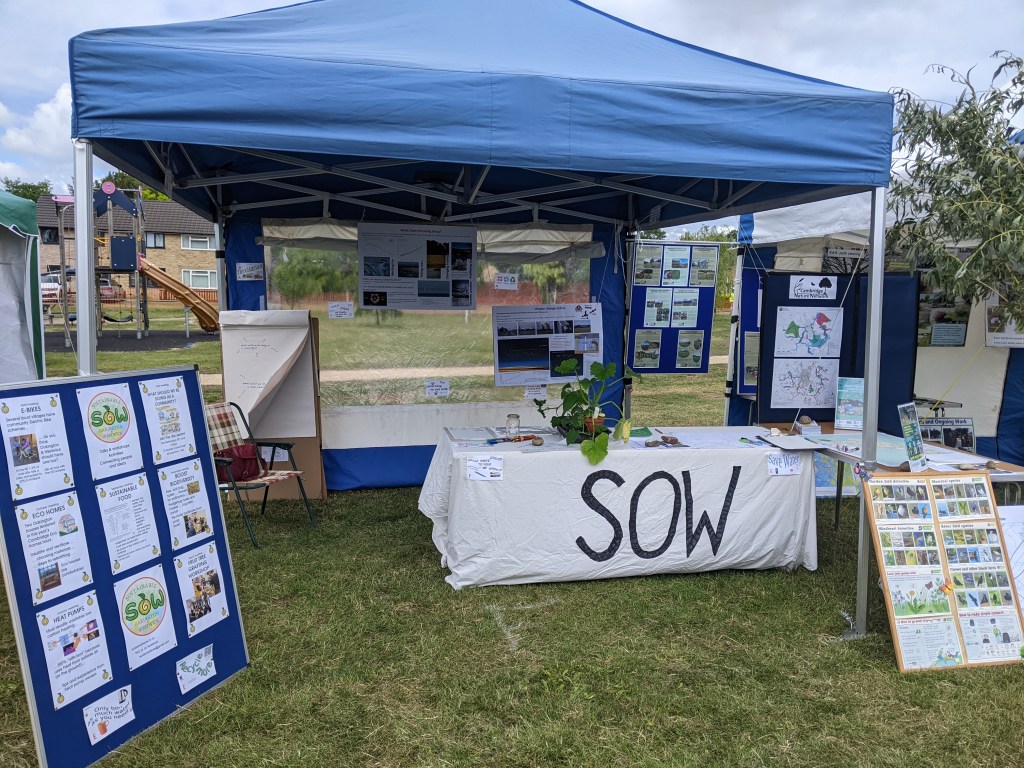
It was suggested that EAG/SOW have a joint stall at the Village Day showing the mapping and inviting participation.

Next SOW meeting: Nature around Oakington & Westwick

Join SOW and the village Environment Action Group (EAG) for a meeting focussed on local biodiversity. We will be welcoming Natalie Lambert from the Cambridge Nature Network to describe the work of that organisation and what funding and tools might be available.

Wednesday 22 February, 7:30pm at the church hall.

Also at the meeting: seed swap/share – bring along any veg/flower/etc seed you have spare – and the opportunity to order wild flower seed.

Heat Pumps

SOW talk on 25/1/23 by Paul, Philip and Jim. Here are links to Philip’s slides and Paul’s case study handout. Below are some notes from the talk and the long and far-ranging discussion!

Why consider it?

  • The UK’s legally binding climate change targets won’t be met unless we can eliminate carbon emissions from buildings – and faster than we currently are doing. The UK has the worst housing stock in western Europe.
  • A lot of alarm currently because of energy costs but need to think longer-term: electricity will become cheaper when decoupled from gas prices, and is becoming lower-carbon
  • Heating installers and users have become lazy because gas is cheap, so systems tend not to be well designed. Modern combi boilers are designed to work at 55º but often are left set unnecessarily higher. (For condensing to work, water has to come back at less than 54º)
  • Heat pumps are the most readily available low carbon solution.

What is a heat pump?

See the slides!

Why a heat pump?

Most other heating systems essentially burn fuel so are less than 100% efficient. A heat pump’s “efficiency” (energy out over electricity in) is almost always more than 100%, ideally at least 300%. Worse for bigger temperature differences, eg. 700% on a hot summer’s day (heating hot water), but 150% on a freezing winter’s day. (It still works if it’s freezing outside – it can still make cold air colder.)

Won’t necessarily save you money – see slides. Currently costs about the same as a modern gas boiler to run. (Note that wood burning – in the chart on the slides – is low carbon but an emitter of polluting particles.)

Insulate and draughtproof first – for Philip’s house this was responsible for 93% of energy savings.

Ground source heat pumps

Jim has one of these – uses heat from the soil surrounding a 100m borehole (NOT geothermal energy), instead of heat from the air. More efficient although more expensive than air source pumps (his was £15K 10 years ago. There is a £6K grant) and better when it’s cold. (Although new air source heat pumps may be on a par with ground source.) Jim’s unit is about the size of a large fridge freezer.

Air-air heat pumps

  • (Work without radiators – by blowing hot air – or cool air in summer.) Good for short quick bursts of heat.
  • Can also get water source heat pumps, if you live by a river…

Radiators

Underfloor heating goes well with heat pumps because it’s effective at lower temperatures. But big radiators can heat well at 35º-45º. If have decent modern radiators they may not need changing. You can get tall upright radiators.

What temperature?

  • Jim’s house: 20º downstairs, 17º upstairs, 24 hours a day. Flow temperature is 30 – 35º. Water at 50º.
  • Philip’s house: flow temperature of heat pump is 30º. Hot water is stored at 45º/50º (with weekly automatic boost to 65º to prevent legionella.) Thermostat set to 20º downstairs (18º at night) and 18º upstairs.
  • Paul’s house: flow temperature is 40º.
  • More comfortable and efficient to keep heating on 24 hours with a setback of only 2-3º, so it doesn’t struggle to heat the house back up in the morning.
  • Jim notices that they start to feel cold after sitting still a couple of hours even though the temperature has not changed, maybe because there isn’t the focus of the fierce heat of a hot radiator or fire. (Radiators run at 30-35º, lower than body temperature.)

Noise & location

You can hear the compressor when it’s working slowly, but mostly the fan is the loudest part. The fan is a constant low white noise. Next to a hard surface will be noisier, and noisiest in winter (when windows tend to be closed.) Best sited away from bedrooms.

Paul currently getting a lot of noise (rattly from the compressor, so needs looking at) – it’s near bedrooms and echoes off a brick wall. Philip: it depends. From 4m away, his is overpowered by road traffic noise.

Where to locate beside house – ideally a sunny position, but needs to be next to tanks/relevant plumbing inside. If it’s in front of the house and visible from the road, need planning application.

Cost

Cost about £10K to install. A government grant of £5K is available if you get rid of your gas boiler. Octopus are installing heat pumps cheaply by picking the easiest properties. NB heat pumps are more expensive than gas boilers (£1.5K) but are designed to last 20 years instead of 10-15. We are at an inflection point, like there was with electric cars – costs will come down over the next few years.

Paul: don’t do things just because a grant is available – you might end up paying more.

Finding an installer

Shortage of well trained competent installers. Paul: Recommend someone who has been on a Heat Geek training course, not just a gas plumber who’s been on a two-day course. (Closest such installer is in Bedford.) Philip: do a lot of research, best if you know as much as they do.

Heat pumps in new houses, flats and districts

  • Houses being built now don’t always have heat pumps! But will be mandatory in new houses from 2025. After 2035(?) combi boilers will not be replaceable.
  • We had some discussion on how heat pumps can be used in blocks of flats. Ideally in a communal system but there are individual flat-sized solutions.
  • Swaffham Bulbeck has a community ground source heat pump but there has apparently not been a large uptake.

Pollution?

The air “used” is not polluted, just cooled. The electricity, if non-renewable, is polluting. Older heat pumps use a fluid which is a greenhouse gas much more potent than carbon dioxide if it escapes.

Air conditioning

Air source heat pumps can in theory run backwards but not recommended because condensation would cause problems. Some new ones may be purpose built to cool as well as heat.

Freezing conditions

Freezing fog would cause ice to form where the air source heat pump blows cold air, but they are designed to reverse cycle or have a small heater to prevent this. But performance drops as you get within a few degrees of zero. NB Scandinavia has lots of heat pumps but winters are dryer as well as colder there.

Careful with sizing heat pump

Too big – inefficient. Too small – can’t heat well enough when it’s cold.

Philip: a slightly bigger heat pump would heat up faster and might possibly be less noisy? Paul: never oversize!

You could intentionally undersize and accept that you would need extra electric heaters to top up in the coldest weather – this approach is taken in Scandinavia. (Paul showed us some infra-red heating wallpaper!)

Hybrid or transition heat pumps

This is when you install a small air source heat pump to run alongside the existing gas boiler, to take over the heating needs for the majority of the year. Then over the years you can insulate, improve glazing etc until the heat pump can cope on its own.

Worth getting batteries?

Philip: no (especially now battery costs have gone up) – store excess heat in the floor mass. Get insulation first!

Paul: yes – use a timed tariff to charge them with cheap, low-carbon overnight electricity in winter. Even without very good insulation, because heat pumps are so efficient.

Octopus have a heat pump time-of-use tariff, and others will follow suit.

Heat Pumps

Heat pumps are a low-carbon alternative to gas boilers, but are a new and unfamiliar technology to a lot of us. Come to the SOW talk on Wednesday 25th January to find out more about air source and ground source heat pumps from three village residents who have installed them.

Hear how they work – what to consider before getting one – what the advantages and disadvantages are – where to start if you want to install one.

7:30pm at the church hall, Wednesday 25th January, all welcome, just turn up.

Boost Biodiversity

Boost Biodiversity, with or without the kids!

Kate began by showing us the introduction from Dave Goulson’s book, “Silent Earth” (full talk available on YouTube and book on Audible.)

In the UK, we have lost 97% of our flower-rich grassland over the last 100 years, mostly due to monoculture farming, and with pesticides in the mix, insects are in serious decline. Being at the bottom of the food chain, we need to help EVERYTHING connected to insects to mitigate collapsing populations of wildlife.

Here are some simple ideas, most of which are nice little projects that you could do with children (or not!):

Flowers

The debate about native vs non-native persists… just be aware of what you buy to plant. In particular, a huge proportion of plants in garden centres that claim to be bee friendly, are actually laced with pesticides! D Goulson recommends seeds from Emorsgate. As a group we may be buying some in bulk to save £. More to follow on that.

Butterflies

They were scarce this summer 😞. Here’s a list of what to plant to encourage butterflies.

Bug Hotels

There are LOT of ideas online and kids can get really creative with these. (I have an old bookcase I my garden stuffed with bug-friendly things!) Put them in a damp, shady spot.

Bee Hotel

Drilling holes into a log is simple! 2-10mm wide, 2cm apart, 7-15cm deep. Place it in the sun, keep it dry and at eye-level. Using natural stems is nice too – see the Wildlife Trusts website.

Stag Beetles

These beauties are endangered. Build them a simple log pile! See People’s Trust for Endangered Species page or this video.

Hedgehogs

Can roam up to 2km a night! Put a hole in your fence 13 x 13cm. Make (or buy) a house for them out of solid material, not sticks/willow (they can get stuck in those).

Wildlife in/around rivers

If you are swimming, use reef-safe suncream. Avoid putting pollutants in water that kill fish and other wildlife – use eco washing liquid etc.

Flea treatments for dogs (and cats) are a neonicotinoid insecticide – 1 dose kills 60,000,000 honey bees! – avoid prophylactic treatment and waterways after treatment.

Ponds

Where there’s water, there’s life! Even a tiny pond will bring wildlife to you. (I think this needs to be another talk on it’s own… )

Amphibians/reptiles

How to build a hibernaculum.

Put water out when it’s dry/defrost when frozen

This can be a life-saver. A shallow dish with pebbles in is also great for insects.

Invasive species

They should be controlled (and they taste good!) Grey squirrel, muntjac deer, signal crayfish (we have LOTS of these in the brook 🧐), for example, are all damaging to native wildlife.

Birds

Feed them and give them somewhere to live!

There are countless templates online for boxes, so lots of fun can be had with that. Put your box about 2m high, facing N or E. More information on the BTO site.

We had fun making some in the session, re-using pallet wood (pre-cut by Kate!)

« Older Entries Recent Entries »