SOW talk on 25/1/23 by Paul, Philip and Jim. Here are links to Philip’s slides and Paul’s case study handout. Below are some notes from the talk and the long and far-ranging discussion!
Why consider it?
- The UK’s legally binding climate change targets won’t be met unless we can eliminate carbon emissions from buildings – and faster than we currently are doing. The UK has the worst housing stock in western Europe.
- A lot of alarm currently because of energy costs but need to think longer-term: electricity will become cheaper when decoupled from gas prices, and is becoming lower-carbon
- Heating installers and users have become lazy because gas is cheap, so systems tend not to be well designed. Modern combi boilers are designed to work at 55º but often are left set unnecessarily higher. (For condensing to work, water has to come back at less than 54º)
- Heat pumps are the most readily available low carbon solution.
What is a heat pump?
See the slides!
Why a heat pump?
Most other heating systems essentially burn fuel so are less than 100% efficient. A heat pump’s “efficiency” (energy out over electricity in) is almost always more than 100%, ideally at least 300%. Worse for bigger temperature differences, eg. 700% on a hot summer’s day (heating hot water), but 150% on a freezing winter’s day. (It still works if it’s freezing outside – it can still make cold air colder.)
Won’t necessarily save you money – see slides. Currently costs about the same as a modern gas boiler to run. (Note that wood burning – in the chart on the slides – is low carbon but an emitter of polluting particles.)
Insulate and draughtproof first – for Philip’s house this was responsible for 93% of energy savings.
Ground source heat pumps
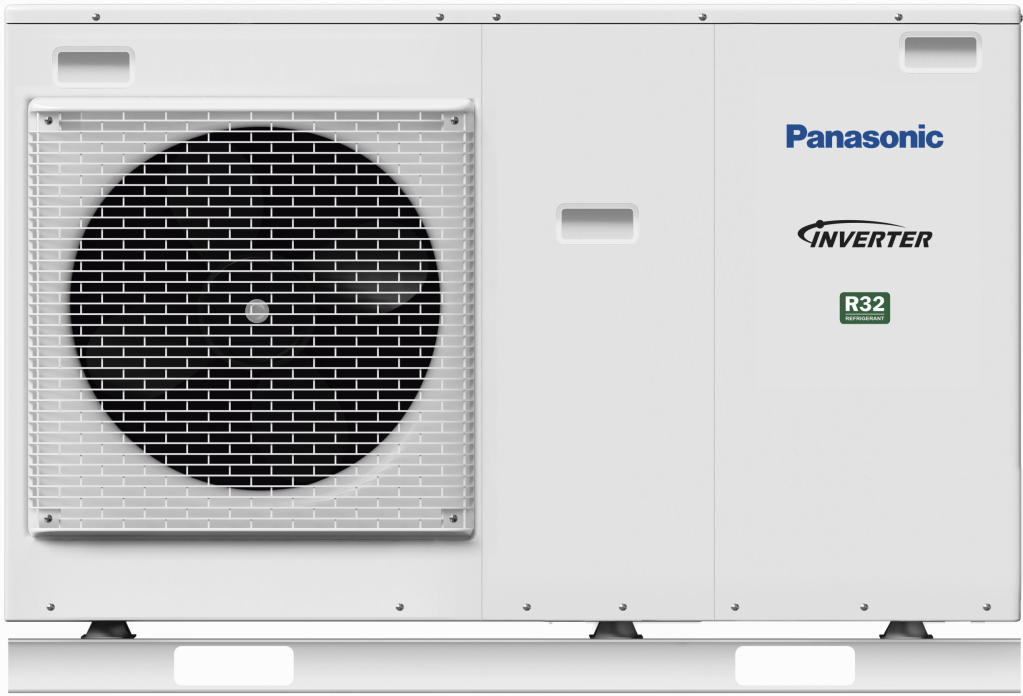
Jim has one of these – uses heat from the soil surrounding a 100m borehole (NOT geothermal energy), instead of heat from the air. More efficient although more expensive than air source pumps (his was £15K 10 years ago. There is a £6K grant) and better when it’s cold. (Although new air source heat pumps may be on a par with ground source.) Jim’s unit is about the size of a large fridge freezer.
Air-air heat pumps
- (Work without radiators – by blowing hot air – or cool air in summer.) Good for short quick bursts of heat.
- Can also get water source heat pumps, if you live by a river…
Radiators
Underfloor heating goes well with heat pumps because it’s effective at lower temperatures. But big radiators can heat well at 35º-45º. If have decent modern radiators they may not need changing. You can get tall upright radiators.
What temperature?
- Jim’s house: 20º downstairs, 17º upstairs, 24 hours a day. Flow temperature is 30 – 35º. Water at 50º.
- Philip’s house: flow temperature of heat pump is 30º. Hot water is stored at 45º/50º (with weekly automatic boost to 65º to prevent legionella.) Thermostat set to 20º downstairs (18º at night) and 18º upstairs.
- Paul’s house: flow temperature is 40º.
- More comfortable and efficient to keep heating on 24 hours with a setback of only 2-3º, so it doesn’t struggle to heat the house back up in the morning.
- Jim notices that they start to feel cold after sitting still a couple of hours even though the temperature has not changed, maybe because there isn’t the focus of the fierce heat of a hot radiator or fire. (Radiators run at 30-35º, lower than body temperature.)
Noise & location
You can hear the compressor when it’s working slowly, but mostly the fan is the loudest part. The fan is a constant low white noise. Next to a hard surface will be noisier, and noisiest in winter (when windows tend to be closed.) Best sited away from bedrooms.
Paul currently getting a lot of noise (rattly from the compressor, so needs looking at) – it’s near bedrooms and echoes off a brick wall. Philip: it depends. From 4m away, his is overpowered by road traffic noise.
Where to locate beside house – ideally a sunny position, but needs to be next to tanks/relevant plumbing inside. If it’s in front of the house and visible from the road, need planning application.
Cost
Cost about £10K to install. A government grant of £5K is available if you get rid of your gas boiler. Octopus are installing heat pumps cheaply by picking the easiest properties. NB heat pumps are more expensive than gas boilers (£1.5K) but are designed to last 20 years instead of 10-15. We are at an inflection point, like there was with electric cars – costs will come down over the next few years.
Paul: don’t do things just because a grant is available – you might end up paying more.
Finding an installer
Shortage of well trained competent installers. Paul: Recommend someone who has been on a Heat Geek training course, not just a gas plumber who’s been on a two-day course. (Closest such installer is in Bedford.) Philip: do a lot of research, best if you know as much as they do.
Heat pumps in new houses, flats and districts
- Houses being built now don’t always have heat pumps! But will be mandatory in new houses from 2025. After 2035(?) combi boilers will not be replaceable.
- We had some discussion on how heat pumps can be used in blocks of flats. Ideally in a communal system but there are individual flat-sized solutions.
- Swaffham Bulbeck has a community ground source heat pump but there has apparently not been a large uptake.
Pollution?
The air “used” is not polluted, just cooled. The electricity, if non-renewable, is polluting. Older heat pumps use a fluid which is a greenhouse gas much more potent than carbon dioxide if it escapes.
Air conditioning
Air source heat pumps can in theory run backwards but not recommended because condensation would cause problems. Some new ones may be purpose built to cool as well as heat.
Freezing conditions
Freezing fog would cause ice to form where the air source heat pump blows cold air, but they are designed to reverse cycle or have a small heater to prevent this. But performance drops as you get within a few degrees of zero. NB Scandinavia has lots of heat pumps but winters are dryer as well as colder there.
Careful with sizing heat pump
Too big – inefficient. Too small – can’t heat well enough when it’s cold.
Philip: a slightly bigger heat pump would heat up faster and might possibly be less noisy? Paul: never oversize!
You could intentionally undersize and accept that you would need extra electric heaters to top up in the coldest weather – this approach is taken in Scandinavia. (Paul showed us some infra-red heating wallpaper!)
Hybrid or transition heat pumps
This is when you install a small air source heat pump to run alongside the existing gas boiler, to take over the heating needs for the majority of the year. Then over the years you can insulate, improve glazing etc until the heat pump can cope on its own.
Worth getting batteries?
Philip: no (especially now battery costs have gone up) – store excess heat in the floor mass. Get insulation first!
Paul: yes – use a timed tariff to charge them with cheap, low-carbon overnight electricity in winter. Even without very good insulation, because heat pumps are so efficient.
Octopus have a heat pump time-of-use tariff, and others will follow suit.