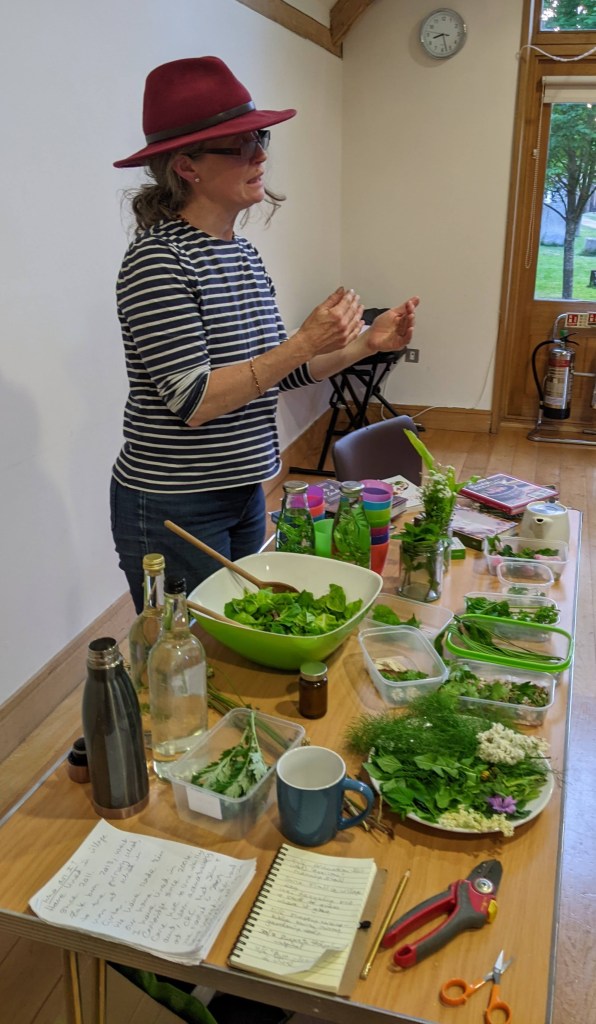
Miria explained that learning about foraging had been a lockdown project, something to do with her son out of doors. An extension of her interest in gardening, gardens and being a qualified aromatherapist. Various useful books came her way; she particularly recommends The Forager’s Calendar by John Wright.
Principles
Foraging can be seen as part of a wider approach to life. It’s about connecting to the land (and we’re all custodians of the land), to nature and to the old ways. It’s a truly seasonal activity, and one that is as old as time. Wild food is “more than organic.”
It’s practical and easy – you don’t have to go out into the wilderness, start in your own garden. And it’s natural and normal – not a new fad or something exotic.
Foraging includes fruit, flowers, foliage and fungi. Once everything we needed to live came from nature, including cleaning, fuels, decoration, medicines and more. The talk focused on food and drink, but foraging can also be for tonics, for example.
Tips
You have to decide: What do you like, what do you need, what do you have time for and what can you cope with? For example, Miria currently draws the line at roadkill, mushrooms, ants and snails. (Paul said he’d once eaten citrus ants, in South America!) She also avoids anything like celery or parsley, because of the danger of confusion with hemlock, which is very poisonous.
You have to actually use what you pick! And you might only end up with a small amount you can actually eat of some things.
Have a wishlist – both things that are easy to find/identify and longer term desires. Learn in advance what things you seek look like, so that you recognise them at the “moment of abundance.”
Avoid the “dog pee zone” (eg pineappleweed is delicious but often in this zone)
Use a good (OS?) map, stick to paths, avoid cliff edges!
If on the side of a road – consider how busy the road is, how low down
Kit: long trousers, maybe wellies; scissors, secateurs, Swiss Army knife; plastic bags and boxes. Remember though that often you make your most significant finds when you aren’t expecting them and don’t have these with you!
Laws & codes
The countryside code says leave only footprints, take only litter. So this is modified by the foragers’ code and which includes some of the following.
Take only what you need for your own personal use. (Foragers often won’t tell others where they found things.)
Only pick something you’re 100% sure you’ve identified correctly
Harvest only in abundant areas (which does depend on the season and weather)
Don’t trample on other plants to get to the one you want
Must have permission from landowner when relevant
You may only take wild food; scrumping apples from a farm doesn’t count as foraging!
Never carry a lockable blade or fixed knife – a small Swiss army knife is legal as it is under 3 inches and does not lock.
It’s not food for free – there is no such thing. We need to give gratitude by treading lightly on the earth; eg composting, donating to nature charities
Murphy’s Law – if you go looking for something you probably won’t find it!
Examples
Some of the foraged foods mentioned were:
Jelly ear and scarlet elf cap – distinctive, identifiable edible fungi
Dewberry – like a grey-blue blackberry, taste OK, but hard to pick enough
Seaweed – but there are complexities
Nettles – Miria hasn’t tried, but nettle soup is popular
Wild garlic – one of the most rewarding and popular but (so far!) hard to find in quantity in Cambridgeshire
Fat hen and marjoram are often found in the garden.
Miria’s top targets for foraging are: garlic mustard, ground ivy, three-cornered leek, wild garlic, and chickweed.
Tasting!
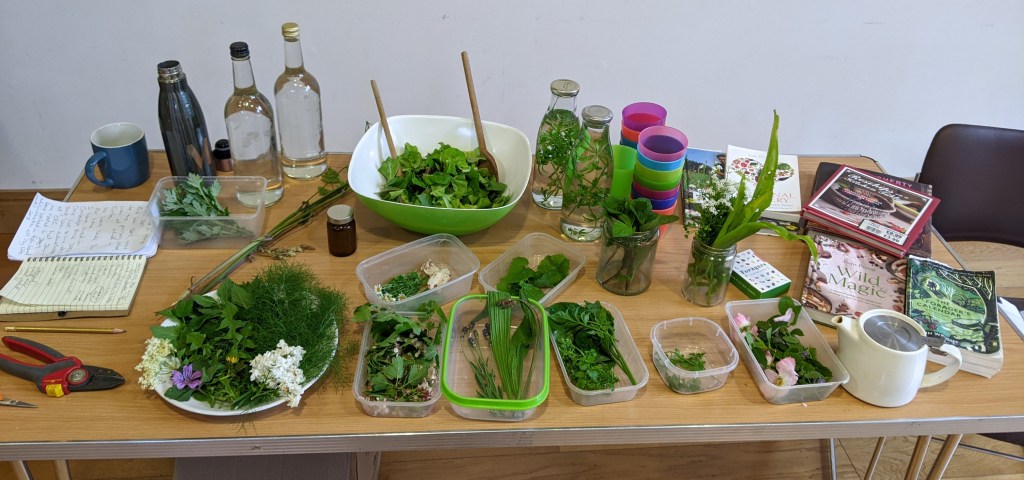
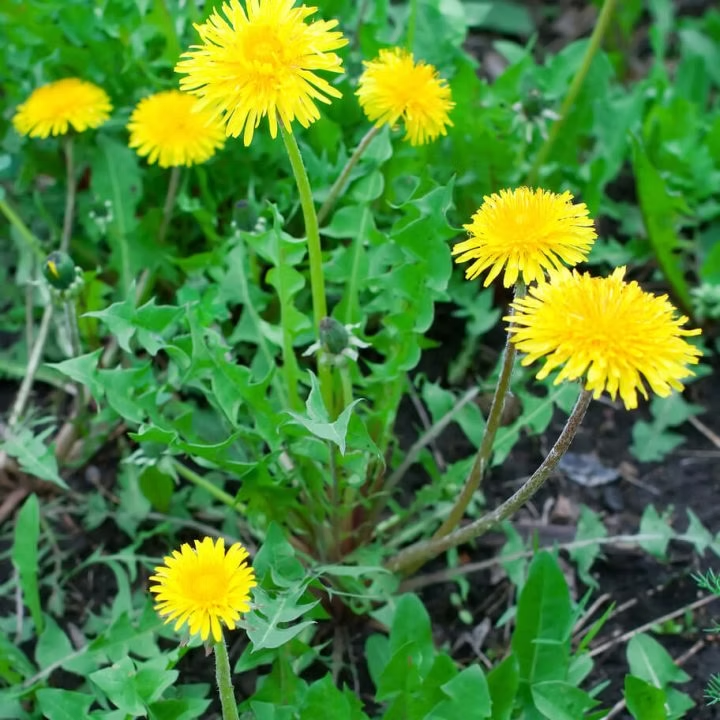
Miria had brought many examples, all but one from around the village and two-thirds from her own garden; including garlic mustard (aka Jack-in-the-hedge), dandelion, lilac flowers, mallow, feverfew, hawthorn (leaves and flowers), magnolia petals, chickweed, sweet woodruff, fennel, lemon balm, elder, dog rose, water mint and lavender. We sampled a lot of thes
We tried spring water with goosegrass (cleavers) steeped in it, and hawthorn flower tea.
She had made a salad which included some of these ingredients – salads are one of her favourite ways to use foraged food. Tear the leaves for a salad rather than using metal implements.
If you would like to borrow the SOW sharpening equipment, please email SOW (sustainableow@gmail.com) or put a message on the WhatsApp group.
Nikki who sharpens at Repair Cafes, including ours, led a workshop on 25 June. The focus was on sharpening unserrated blades.
SOW has used some of the surplus from the Repair Cafe to buy the tools asterisked below to share around the group (better for the environment and everyone’s wallets!)
How to tell if a blade is sharp
It’ll have no dinks and divots, and be very thin. It will catch at your fingernail stroked across the blade. Note that secateurs usually have a blade only on one side.
Kitchen knives and scissors
Foil – cutting through aluminium foil with scissors will sharpen them a bit – this trick works with pinking shears (serrated scissors) too.
Anysharp – there are lots of kitchen knife sharpeners but this is the only brand/type Nikki has found that works. (Available from Lakeland.) You just pull the knife through. It will maintain an already mostly sharp knife but won’t rescue a blunt one.
For the rest of the sharpening tools you need to get the angle right: always sharpen at an angle of 22.5 degrees (half and half again a right angle). HOWEVER: consistency is more important than accuracy. Keep the angle the same. Pull/push the knife away from you, for safety. (Note: You will find sharper and blunter portions along a blade.)
If you want sharpening tools to last, use them wet.
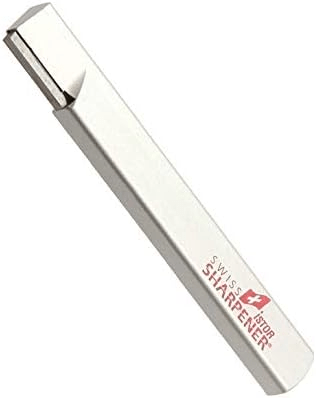
Swiss sharpener* – will work better on slightly blunter knives and on scissors, to knock off burrs.
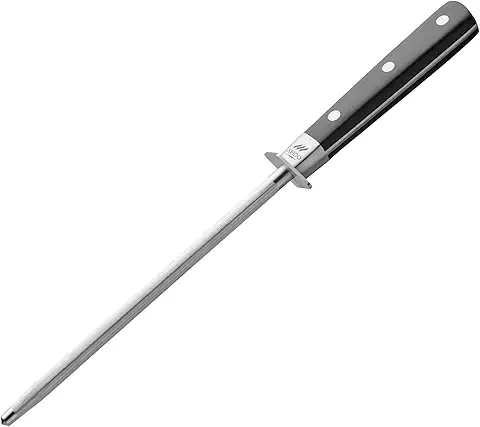
Kitchen steel – works well if you can get the angle right.
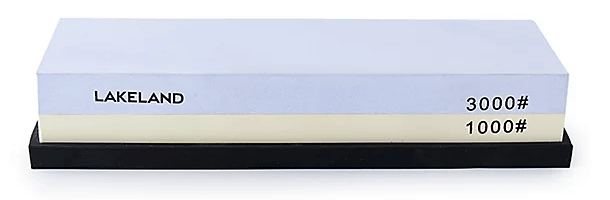
Sharpening stone (whetstone)* – Must soak in water first – won’t work if not wet. The numbers refer to the grit (like sandpaper) – the higher the number the finer the grit. Start with the coarser side. (Use the rubber foot to hold it to the table, and an old tea-towel to mop up splashes!) Push the knife along the stone – doesn’t need to be fast, but apply gentle pressure.
Care of knives
Kitchen knives – use a wooden or plastic chopping board (not glass, not a plate) and use the back of the knife to scrape pieces off the board.
Sheath knife – oil it before putting it away (wipe with a little sunflower or rapeseed oil on a kitchen towel.) Then it should stay sharp while stored.
Garden tools and draw knives
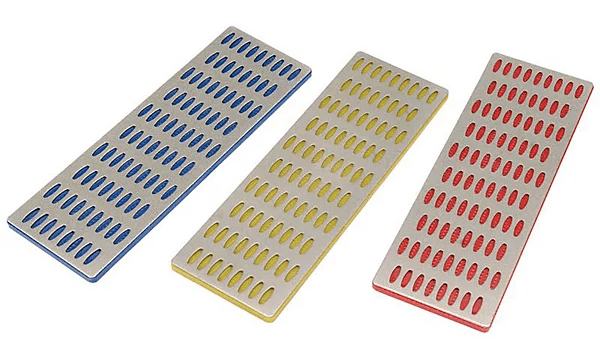
Diamond sharpeners* – Nikki’s mainstay at Repair Cafes. Wet first (they will work dry but won’t last as long.) They have grit numbers on the back, 150, 300, 400 – start with lowest and work up – when you see a silver edge on your blade you can go up from the lowest.
You can take secateurs apart to sharpen them (carefully keeping track of screws!). One or both sides of the cutting edge may be bevelled. Sharpen the bevelled edge first, then draw the tool flat across the flat edge to remove burrs.
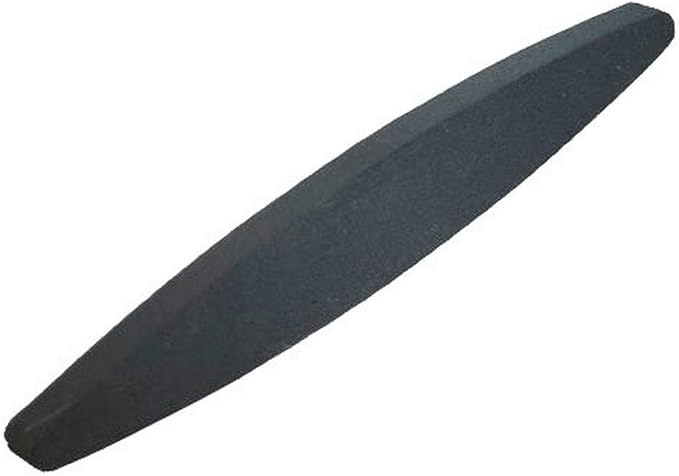
Boatstone – curved, very coarse stone, better for curved blades like lawnmower blades.
Care of gardening tools
Wipe off any plant material, dirt or moisture with a clean dry rag before storing in a dry place.
SOW will be there in the afternoon at Oakington & Westwick Village Day, at the Rec on Saturday 28th June, from 12:30. Come along and say hello, take the recycling sorting challenge and find out more about helping pollinators through the APollOW project.
Lots of events coming up, put the dates in your diary and hopefully see you there! Everyone welcome.
Wednesday 21 May: Foraging etc
SOW meeting (note NOT the last Wednesday in the month), 7:30pm at the church hall
In search of wild food and other useful stuff. Come and find out another side to the “weeds” and wild plants around us.
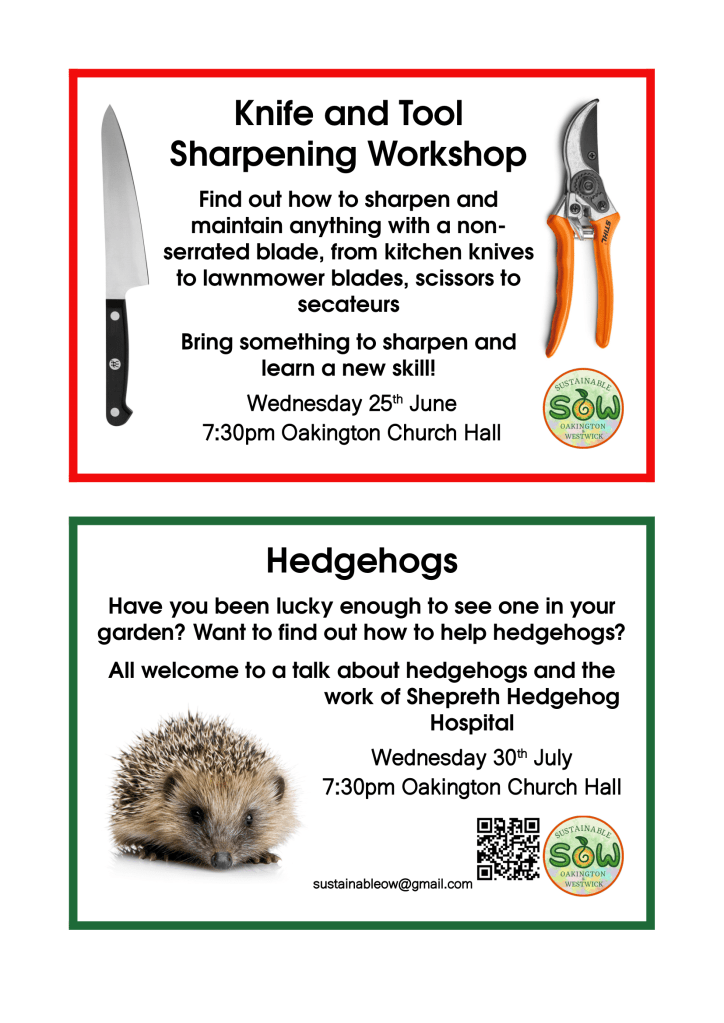
Wednesday 25th June: Tool and knife sharpening workshop
7:30pm at Oakington church hall
Learn how to sharpen knives and garden tools from Nikki, our expert from the Repair Cafe! Extend the life and effectiveness of your tools. SOW will be buying some sharpening tools for community use going forward.
Wednesday 30th July: Hedgehogs!
7:30pm at Oakington church hall
We have a speaker from Shepreth Hedgehog Hospital coming to tell us about their work and all about these engaging animals which seem to be making a comeback in Oakington & Westwick.
If you’ve been lucky enough to see a hedgehog please log it on the Big Hedgehog Map!
There will be a few small items of merchandise connected to the hedgehog hospital available to buy to support the hospital, such as keyrings and notebooks, so please bring a little cash.
SOW/EAG will have a stall – come and find out more about the APollOW project and how help pollinators by doing a pollinator count.
Saturday 28th June: Village Day
12:30pm onwards, Recreation Ground, Oakington
If you missed the stall at the Pollination Festival, a second chance here – plus how to recycle everything!
Sustainable Rampton Open Gardens & Wild flower event
Sunday 18th May, 2pm, Rampton Village Hall. Another chance to find out how to help pollinators. Be inspired by wildlife-friendly gardens. More details here.
Grey Box Recycling
Following the talk at SOW earlier this year, we have set up as a trial scheme a grey recycling box in the village shop. At the moment we are just collecting marigold rubber gloves but hope to extend the range of hard-to-recycle items we could collect in the village. If you use marigold gloves, please take them (clean) to the box when they get holey! More details here.
Tool Share – volunteers needed
Oakington & Westwick have a tool share, kept at Crossways on the crossroads. It’s a really environmentally friendly idea, saving resources (and money) – but it needs a little TLC to help it realise its potential. If we could get it a bit better organised it would be better used, and if it was better used we might be able to get some funding. It would be fantastic if someone – or a couple of someones – would be willing to volunteer as tool share champions, spending a little time (perhaps even one-off) starting this virtuous circle! Please get in touch if you might be interested to know more.
Everyone – whether or not you usually come to SOW meetings – is very welcome to this special session focussing on pollinators and including “training” on how to take part in the APollOW scheme – a pollinator survey of Oakington & Westwick. Whether you could spare 15 minutes once a week or just occasionally, you can help – come and find out how.
Recycling: the list of where to recycle various things is in the April/May O&W Journal. We are still trying to find a location for boxes to collect certain items which can’t be recycled in the blue bin, as described at the January meeting. Several useful Terracycle schemes have just ended so at the moment the thought is to trial Marigold gloves and beauty product packaging.
Tool Share: this could be a great village resource-saving scheme but needs a bit of TLC. Looking for SOW volunteers to help Jess at Crossways who administers it.
Several of us had counted plastic packaging this week, and had brought it to the meeting. The vast majority of the packaging was from food, especially snacks and bread.
We weren’t very clear on exactly what the blue bin takes – everyone had a different idea! (See this webpage– in fact the blue bins take all soft (including scrunchable, crinkly) plastic bags/film/wrappers except:
plastic/foil pouches or wrappers (eg pet food pouches or baby food pouches and tea bag or chocolate wrappers
and crisp packets (with metallic inside)
Why isn’t plastic packaging OK even when you can recycle it? Recycling is an energy intensive process. It’s sometimes incinerated instead. Soon our recycling will be transported to Northern Ireland instead of Waterbeach for processing (adding to transport emissions) (although a UK facility is promised soon.) And making packaging uses energy, even for eg. cardboard packaging.
Often the most over-packaged food is also the most ultra-processed, so less good for us anyway.
How to avoid packaging? Dry cat food instead of pet food pouches. Shampoo etc refills at the Lush shop or with Green Blue You, or soap bars. Buy less stuff (eat less food!?)/re-use. Being selective about what you buy – but it’s difficult when you’re busy and short of time!
We talked about biodegradable plastic – you can’t put it in the green bin (takes too long to break down for the fast composting process used for our green bins) and it contaminates the recyclable plastic if put in the blue bin. Takes ages to home-compost (but cutting it up helps.)
Leo explained his dilemma in packaging their cider: glass is actually worse than plastic in terms of overall energy used. Metal cans would be best of all but the equipment for canning is not accessible for a small cidery.
Vicky explained how recent legislation for simplifying recycling requires her small business to dispose (recycle) food waste separately – it means they all have to take their apple cores and tea-bags home because it’s too expensive to have commercial green bin recycling.
We heard about a recent investigation tracking supermarket soft plastic waste. Some went to Poland where it was turned into black bin bags. But some went to Turkey, notorious for dumping rather than recycling foreign waste.
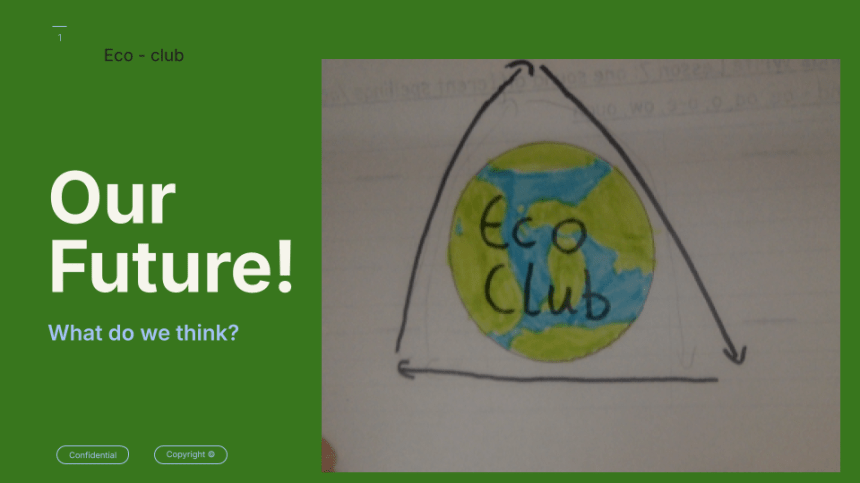
Eco-Club presentation: Our Future!
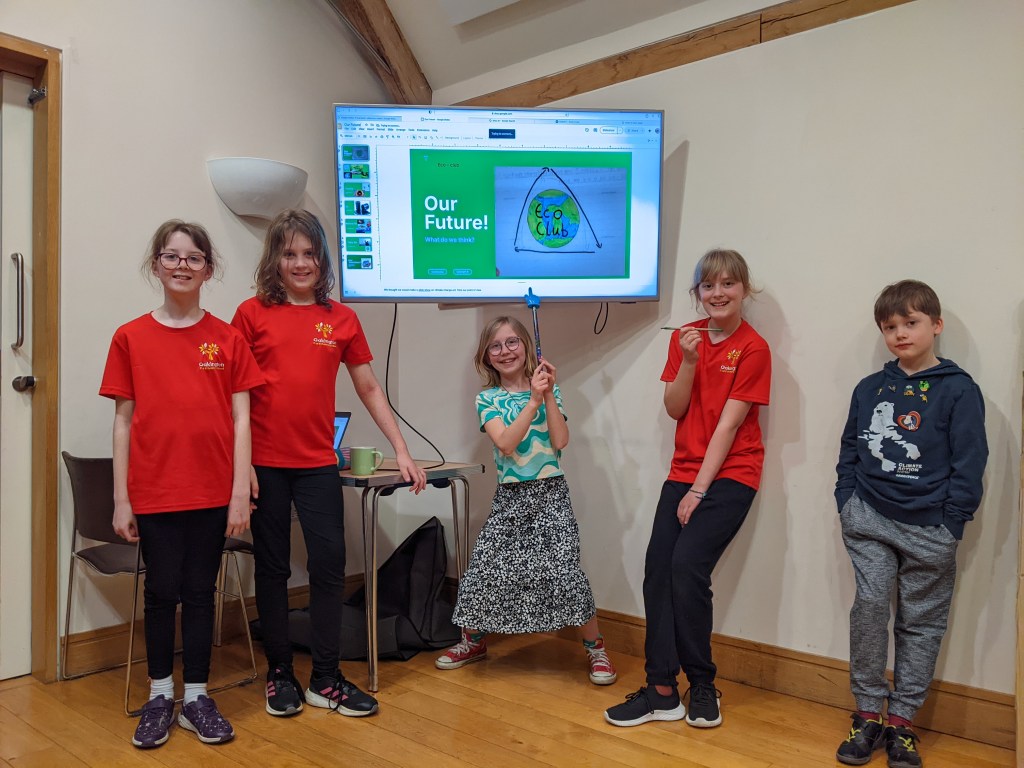
Five members of the kids’ Eco Club gave everyone a presentation – see below – which they had prepared about the environmental issues they are really concerned about. It was really good and a lot of work had gone into it, and it very much brought home how much the environmental crisis impacts young people now as well as in the future.
Ideas for action which came out of the discussion included an Oakington event to celebrate our planet – perhaps fundraising for spring bulbs to help pollinators – and writing to our MP.
Thank you very much to the Eco Club for leading this part of the meeting!
Our Future!
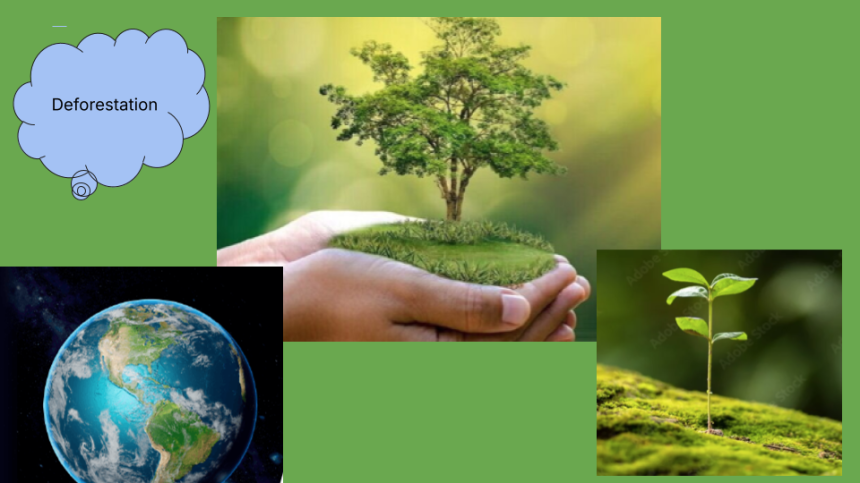
80% of animals live in forests but every year 1000s of square kilometers of forests get cut down every year wich is making animals lose their home also every time someone cuts down a tree you should plant a new one or two well most people plant the type of tree that is good for paper and wood but bad for animal homes.
Lots of people would squash insects if they see one, now thats like a giant just swatting you just because your tiny and different. I think many people forget that they are living animals, I also think we forget how important bugs are. They are at the bottom of the food change we would die. The total mass of insects is falling by a precipitous 2.5% a year, according to the best data available, suggesting they could vanish within a century.
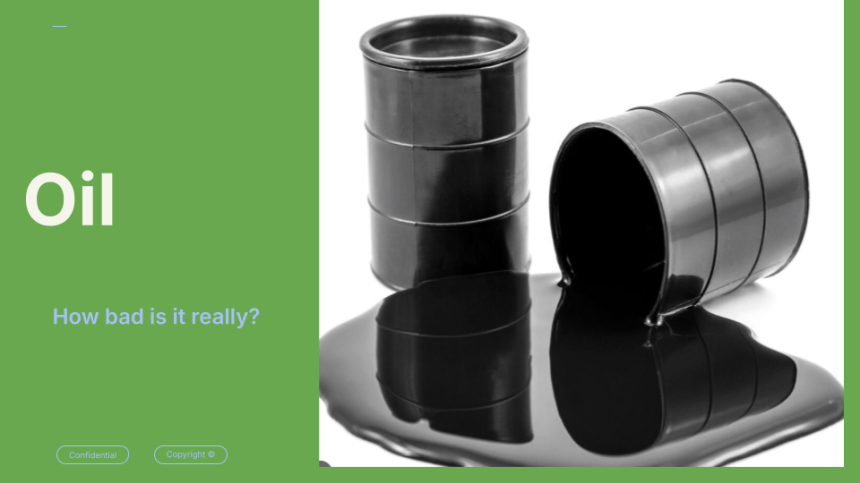
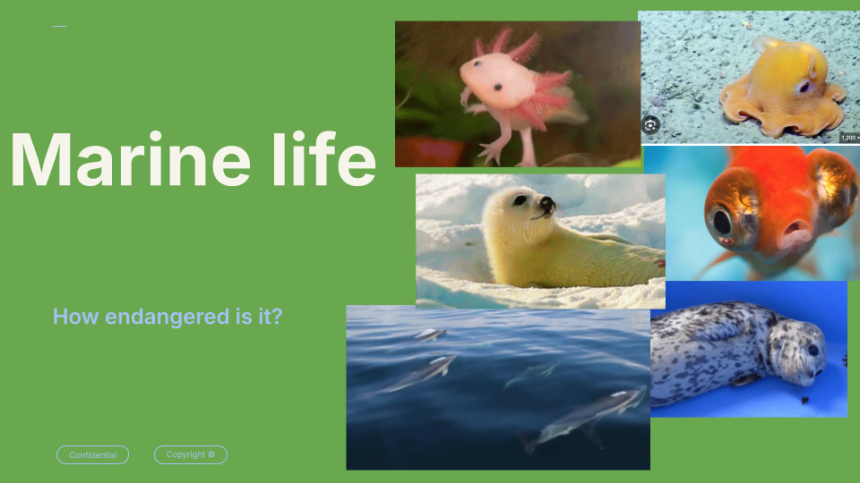
Oil is so harmful as we know to all of our planet it poisons rivers and hurts kills marine life as lizzie will explain.last year there was a massive oil spill in ireland this happened on the 22nd of january 2024 at 19:25. Oil is bad in many ways and not onley is it bad for the planet but it is also bad for our health.
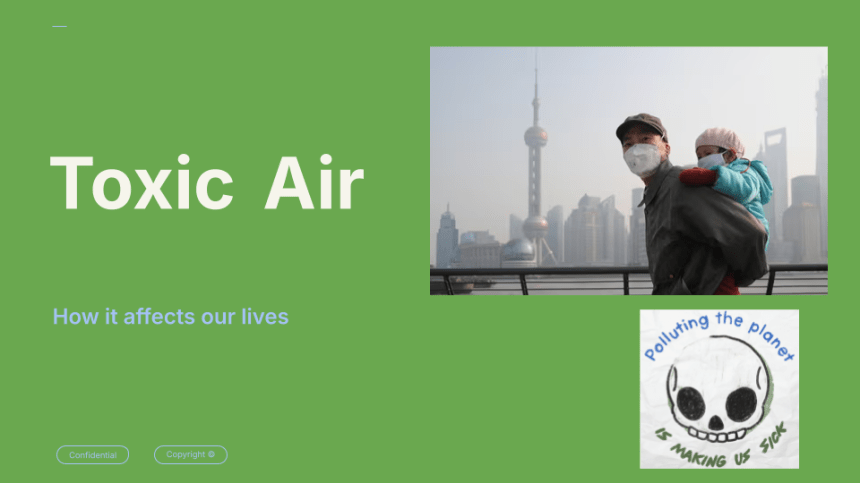
93% of children breathe in toxic air every day. What is really sad and worrying about air pollution is that 600,000 children under 15 die respiratory infection because of air pollution.we as a village obviously can’t stop climate change but in long term I think this is one of our biggest problems as well as sound pollution and light pollution the worst thing about toxic air is that innocent people animals with weak lungs are dying because weak lungs
In the week leading up to the March SOW meeting, you are invited to count your plastics!
Print out the tally sheet below, stick it up near your bins/recycling bins and encourage your household to keep count of the plastic packaging you throw away or recycle in the week leading up to the SOW meeting (19-26 March.) Include plastic packaging from when you are out and about too! Full instructions on the sheet.
AND/OR collect up the soft crinkly plastics you use in that week, which you can’t put in the blue bin, and bring them along (clean!) to the SOW meeting
Both of these will help in our discussion about what we can do to cut down on/replace plastics.
The fantastic Eco Kids will also be leading part of the March meeting!
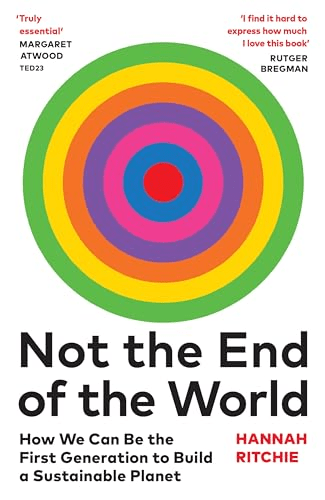
Here are some notes from the February meeting planning SOW activities for the rest of the year. There was also a talk on “Not the End of the World”.
Plans for monthly meetings
March 26: Eco Kids will lead the session, plus we’ll do the Big Plastic Count and talk about the results. Plus terracycling/recycling actions.
April 30: provisional – Leo will talk about bees and bee-keeping. May not be a whole session so could we find someone to tell us about eg butterflies too?
May 28 or May 21 (avoiding half term): Provisionally foraging talk or blossom walk
June 25: Garden tool/knife sharpening workshop, plus advice on maintaining/mending garden tools
July 30: no plans yet. In the school holidays
Sep 24: possibly foraging talk
Oct 29: community vegetarian meal
Nov 26: (provisional) wreath making workshop
Other ideas included asking Shepreth if they could come and speak to us about hedgehogs; someone from allotments talk to us, or show us round their plots to inspire; a speaker from a local sustainable business such as Daily Bread.
Other activities
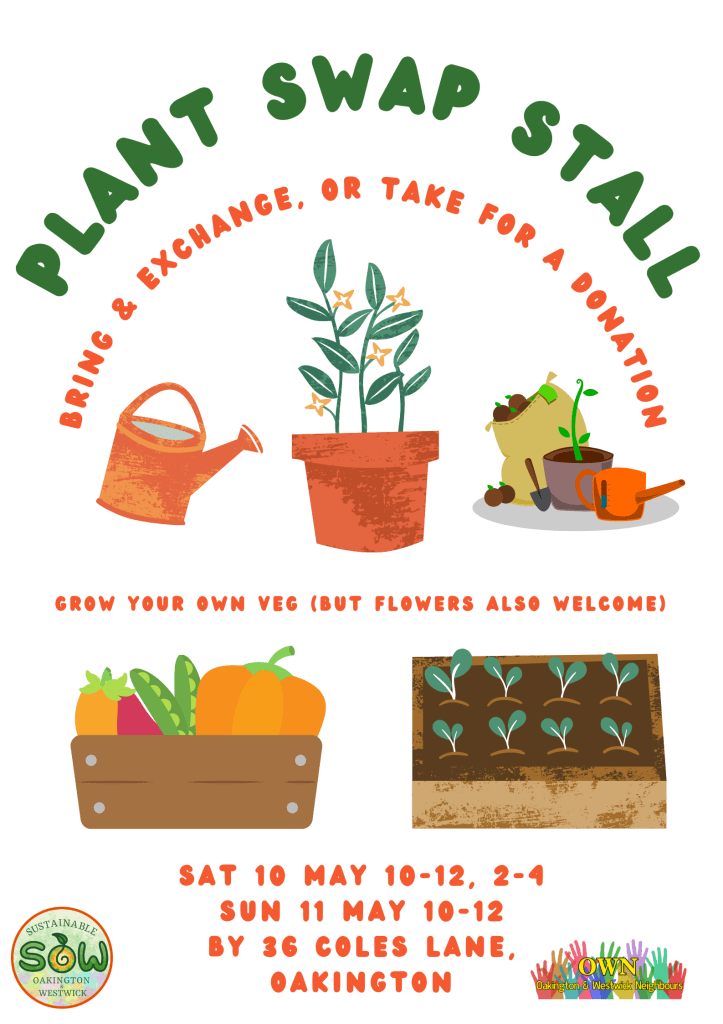
10 May – plant swap (to be confirmed)
October – apple pressing
Nature Recovery Project
Other ideas included: sustainable/no-mow garden visits, litter pick.
Green space around the village
There has been another planning application for development of the land behind Manor Farm Close. Especially with Northstowe planned to be built right up to Oakington, there is a desire to somehow safeguard green space around/within Oakington & Westwick. Landowners might possibly consider setting aside land for the community’s future generations. (We’re also inspired by Histon & Impington Green Spaces while recognising they are a bigger parish.) Please get in touch if you have any ideas or suggestions.
The Eco Kids reported back from the Parish Council meeting on Monday night about the solar farm.
Tree planting at the school on Saturday 8th March, 1-4pm. Bring a spade/shovel. Also general garden tidying if there are more than enough to plant the trees.
Notes from a talk based on the book by data scientist Hannah Ritchie. You can’t do justice to it in a short talk so if you can, do read it. It covers a lot of subjects including air pollution, biodiversity loss, deforestation, plastic pollution, and over-fishing, but here are some of the most striking ideas. (Some of the graphs/data in the book are available online.)
How optimistic do you feel about the environment?
(on a scale of 0 = totally pessimistic, we’re doomed to 10 = sure it’ll be fine)
Humans used to live in harmony with nature, but not in the last 200 years. And our generation is destroying the environment faster than ever before. Nothing is being done and we are rapidly passing all tipping points, soon it will be too late.
This pretty much sums up the situation we’re in, right?
But it’s not really true.
So is it all fine, nothing too much to worry about?
That’s not true either!
Ten Surprises
But first, a common definition of sustainability: “Meeting the needs of the present without preventing future generations from meeting their own needs”.
When was the world sustainable? Pre-industrial revolution? Medieval times? Iron Age or neolithic times, early farming communities? Hunter-gatherer tribes?
Surprise #1: The world has never been sustainable
Since the beginning of their time on earth, humans have hunted animals to extinction. They have burned wood (then coal, gas, oil) – whenever anything is burned, air pollution (and greenhouse gases) result. Forests have been cut down since the earliest times.
Small communities such as indigenous peoples have sometimes achieved balance with the environment and other species – but only because they stayed small, and that’s because of child mortality. Half died before reaching adulthood. That’s not meeting the needs of the present so it isn’t sustainable.
First half of sustainability: meeting the needs of the present
Thinking about the whole world including the poorest countries: what percentage
of children globally die before their 5th birthday?
of people get enough to eat?
of girls in low-income countries finish primary school?
Have a guess before reading on… here are some answers.
4% (compared to 43% in 1800)
13% (2013) – was 35% in 1970s. Even less now.
64% (2020)
Not as bad as you thought maybe? These are still not good, of course! – but we have to keep in mind that it’s possible for a things to be simultaneously: much improved, still not good enough, and able to improve further – true for many other aspects of sustainability too.
Surprise #2: Have made good progress on first half of “sustainability”
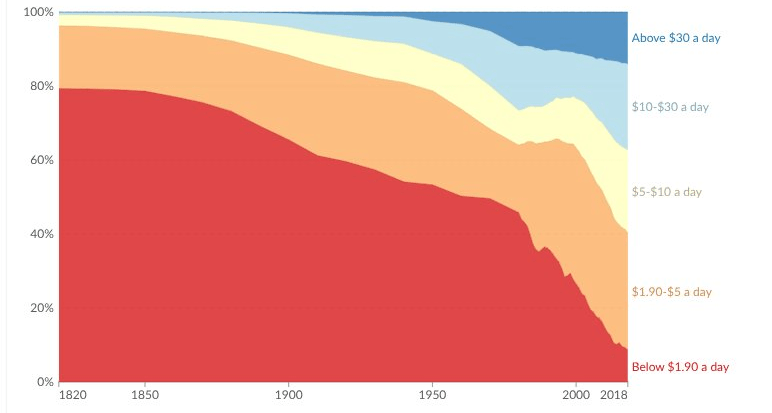
Distribution of population between different poverty thresholds, World, 1820 to 2018. Source: Our World in Data
You can see from this graph, showing the percentage of the world population below various poverty thresholds, that there has been recent very good progress at reducing poverty (NB data adjusted for inflation and different prices in different countries.) “There has never been a better time to be alive.” This may come as a surprise to those who grew up in the Band Aid/Live Aid era! Good news doesn’t make the headlines, but there could have been a headline that “The number of people living in extreme poverty has reduced by 128,000 since yesterday” every day for the last 25 years.
Now let’s look at the second half of the sustainability definition. In lots of ways, we are preventing future generations from being able to enjoy and use the earth as we do. There are two fundamental reasons often given for this…
Surprise #3: Depopulation isn’t the solution
It’s often said the basic problem is there are too many people on the planet.
Population growth is not exponential – the rate of population growth peaked at 2% in 1960s, and has now more than halved to 0.8% in 2022 – more children survive but globally the number of children per mother is now less. (Often a side-effect of reduced poverty and better education.)
When do you think the number of children on the planet will peak?
It’s already happened. In 2017 there were more under-fives on the planet than there ever were or will be. Global population is projected to peak in the 2080s. (UN projections.)
More importantly, the goal is to reduce environmental impact per person to zero, or very close to zero, or even negative (reduce historical impacts). Then it doesn’t matter if it’s 7 billion or 10 billion people. A large number x zero is still zero.
Surprise #4: Degrowth isn’t the solution
A relentless focus on economic growth is also often blamed, because eicher people use more resources and have a higher environmental footprint. However as we’ll see, that’s not always true.
The first reason why degrowth isn’t a solution is that we need economic growth to end poverty, even with lots of redistribution.
Denmark is one of the most equal countries in the world. Nearly everyone lives above the $30 a day poverty level. For every country to be like Denmark, we need to grow the world economy five-fold.
For everyone to be on exactly $30 a day, the world economy would have to double. NB In 2018 70% of Europeans lived above $30 a day.
But there’s an even more striking reason!
Historically economic growth was linked with more resource intensive lifestyles – being richer meant people burned more fossil fuels, used more land, ate more meat, had a higher carbon footprint. But new technology means the environmental footprint reduces while continuing to get richer.
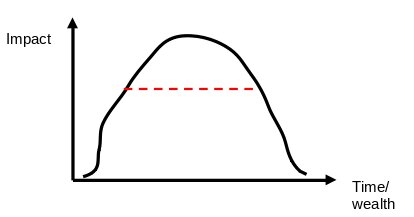
We often see this upside-down-U shaped graph. An example is air pollution – in the UK it got worse as we industrialised but is now much better than in the 1940s or 1880s (although still not as good as it needs to be.) We can decouple economic growth from environmental destruction.
However the graph shows it can get worse before it gets better – but wait, notice the red dotted shortcut line…
Developing your low-income country
It’s 2009 and you’re the prime minister of a low-income country and need to build a power plant. Here are the costs per unit of electricity:
Solar PV: $359
Onshore wind: $135
Nuclear: $123
Coal: $111
Gas: $83
You want to prevent global warming, but you have which are you going to have to choose?
Now it’s 2019, and these are the costs per unit of electricity:
Solar PV: $40
Onshore wind: $41
Nuclear: $155
Coal: $109
Gas: $56
In ten years it’s changed completely. Technology can shortcut the hump of the upside-down U.
You probably drive more, have a lot more gadgets to power, maybe take one or more aeroplane flights a year, buy more stuff, probably waste more food.
Surprise #5: you!
In 1965 the average person in the UK emitted 11.5 tonnes of CO2-equivalent per year. Now it’s 5 tonnes or less.
Why? Our energy supply then was almost entirely from coal. And cars, appliances etc have become more energy efficient.
But what about other countries? Eg the USA. In the last 15 years (which included the last Trump presidency) do you think per capita emissions have gone up by 20% or more, or by 10%, or stayed the same?
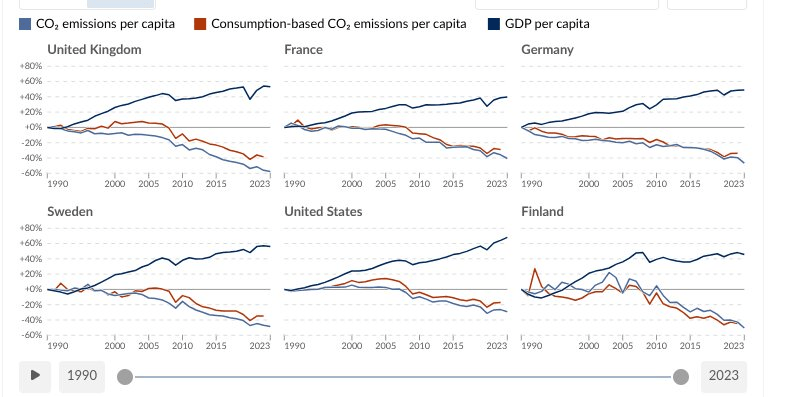
Per capita emissions in the USA have fallen by 20%. Similar for other developed economies – even if you take account of “offshoring” (ie even if you account for industrial production moving to eg China. That’s the “consumption-based emissions” red line in the graphs above.)
Global emissions per person peaked 2012. But there’s still a race between the rising number of people and falling per person emissions. They aren’t falling fast enough but this shows it’s possible they can – it’s already on the right track.
Focus on food…
Because food on its own uses three times the total 1.5° carbon “budget”, it’s a leading cause of deforestation, and of biodiversity loss (through land use.) But we need all that to feed the world… or do we?
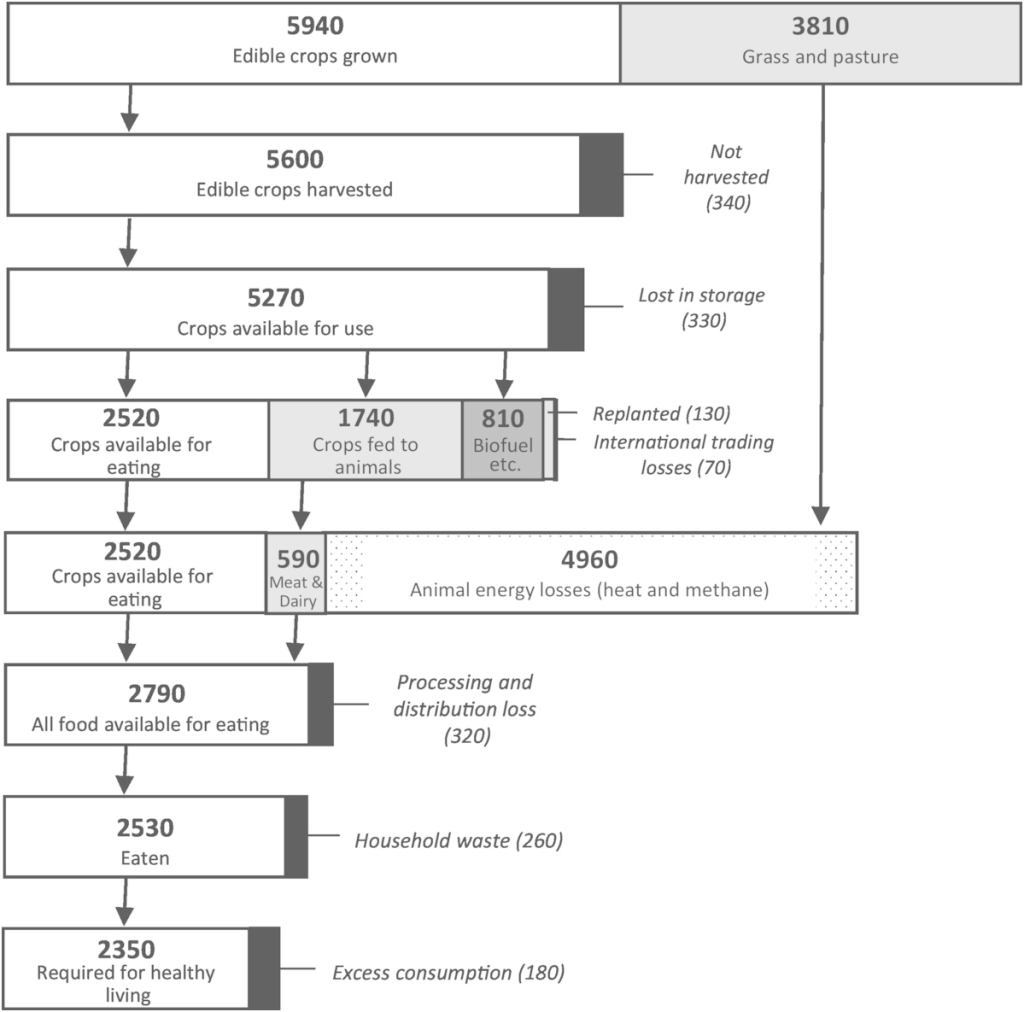
Surprise #6: the world produces twice as much food as it needs
The average person needs 2000-2500 calories. But if we were to split the world’s food production equally among the world’s population, each person would get 5000 calories! Why?
Source: There is No Planet B, by Mike Berners-Lee
The main reasons are growing crops to feed livestock is a very inefficient use of food; food grown as biofuels; also waste and over-consumption. If we used less land to grow food, more land would be available for wildlife.
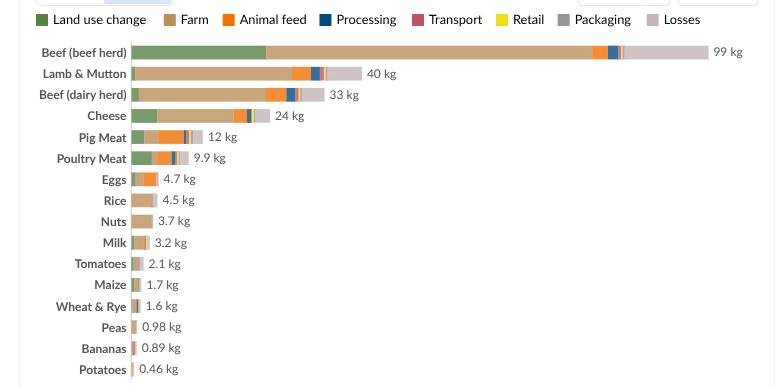
You can see from the above that beef is particularly bad for the climate (and deforestation) but following that are other meat and dairy products.
Uncomfortable surprises #7
Here were some conclusions about food that challenged my presumptions:
Cheese is as bad as meat
Transport is a small part of the carbon footprint. “Eat local” less important to think about than “Eat seasonal”?
Packaging is a small part of the carbon footprint
Is it better to reduce the total land taken for food growing with careful fertiliser use than to go organic everywhere?
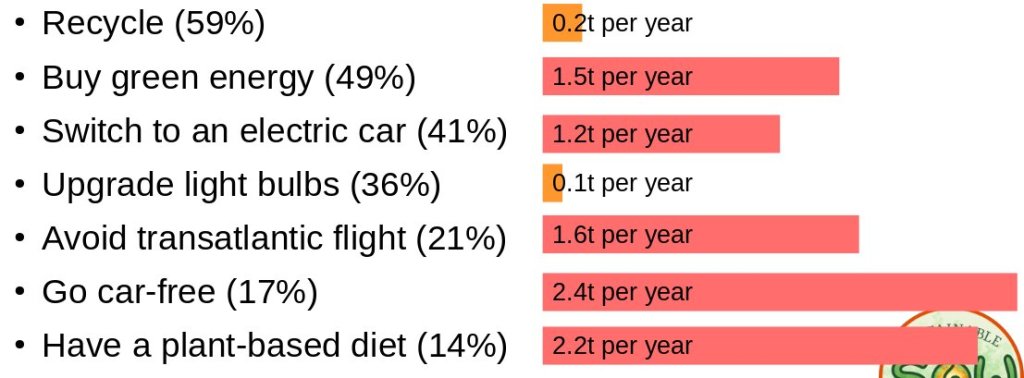
Surprise #8: The most effective ways to cut our carbon footprints often isn’t what people think they are
21,000 adults across 30 countries were asked what are the most effective actions. Here are their answers compared to the tonnes of CO2-equivalent typically saved per year by doing them.
The problem isn’t that we do the lower-impact actions, it’s when we do them instead of the higher-impact ones – or stress over the little things.
Is change possible?
Last two questions to ponder over!
In Covid, when everything around the world shut down, how much did global CO2 emissions fall by?
Name the first international convention to be ratified by every country in the world
Here are the answers:
5% … that’s all the difference that almost all of us not driving, not consuming, etc made. Discouraging? But…
The answer is the the Montreal Protocol (1987) – every country had signed up by 2009 …
Surprise #9: Systemic change is necessary AND possible
Remember the Montreal Protocol? It was to phase out ozone depleting gases. The hole in the ozone layer and acid rain were two big environmental issues of the 1980s. Now that CFCs are no longer used, the ozone hole is closing up and in due course won’t be a problem any more. Acid rain has likewise almost disappeared across N America & Europe. Even in China sulphur dioxide emissions have fallen by two-thirds while coal use doubled in the last decade.
It shows that if we have a technical solution to a problem, and political will and investment, then we can act very quickly to change at a system level.
Summary of surprises
Environmental damage is not a recent thing – don’t hark back to a perfect (all-natural) past
You don’t always hear about the good news
You can’t just blame too many babies
Sustainability can (and in practice does eventually or sooner) increase with GDP
“More sustainable than Grandma” – progress is happening, not quickly enough but it is happening
We could feed the world with less land. Food is an example of how environmental problems are interconnected – means one solution can solve several problems at once
My environmentally friendly instincts may be misguided or out of date (eat local etc)
Don’t have to worry equally about everything we do. Some things matter more than others
High level change is needed – and is possible, it’s already happened
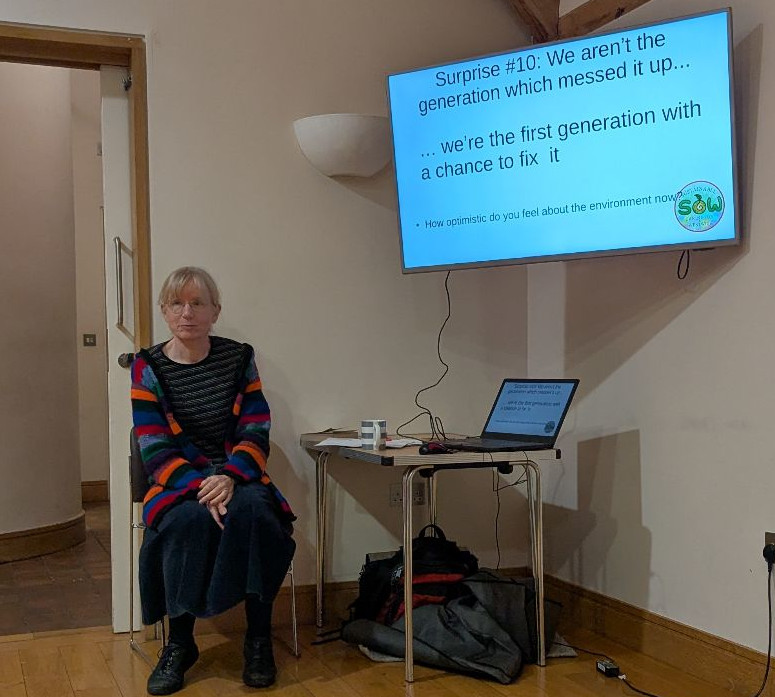
Surprise #10: We aren’t the generation which messed it up…
… we’re the first generation with a chance to fix it
How optimistic do you feel about the environment now?