
Climate Change Gardening
13 May 2026
25-30 attendees from Oakington & Westwick and beyond welcomed Clive and Sue Boase – two of the trustees of the charity Climate Change Gardening.
Their presentation began by explaining that the charity’s aim is to encourage and inspire gardeners to use their gardens to help mitigate not only the impacts of climate change, but also climate change itself. This is achieved through their website, giving talks, attending events, workshops, and running community projects. Full details of the charity’s mission can be found on their website at www.climatechangegardening.org.
The presentation initially summarised the RHS’s information on climate change and gardens:
- Temperature: gradually increasing in all seasons (eg “tender” plants now surviving winter, spring flowers bloom 1 month earlier than in 80s/90s).
- Rainfall: drier summers, wetter winters.
Gardens are important in the response to climate change. In England, private gardens make up the third largest land use (after agriculture and open land like moorland and the New Forest) and 20+million people enjoy gardening. Gardens are a “massive but overlooked asset, that buffers the effects of climate change” (RHS).
Climate Change Gardening’s approach defines four different ways in which gardeners can respond to climate change:
1 . Accept and adapt (roll with it)
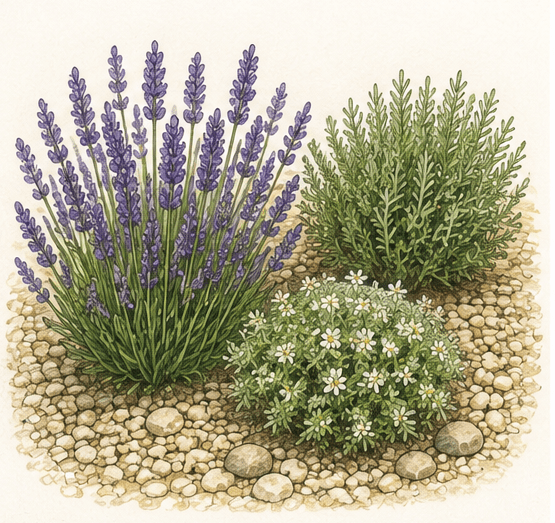
- Drought-tolerant planting, eg Mediterranean gravel gardens. Good example at Cambridge Botanic Garden.
- Raised beds to avoid winter waterlogging.
- Plant in autumn, not spring.
- Adapt crops, eg sweet potato ‘Beauregard Improved’ doesn’t need as much water as conventional potatoes. (RHS Wisley have moved several national collections (eg rhubarb, some soft fruit) to the cooler/wetter north.)
2. Soften the impacts
Water shortage
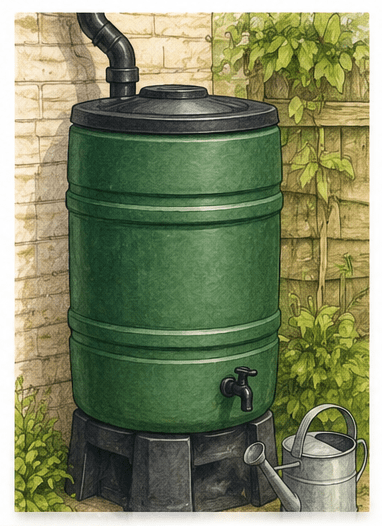
Reduce pressure on aquifers and chalk streams by collecting as much rainwater and grey water as possible. Collect and store winter rain, to use in the summer.
Shade, esp in heatwaves
Plant trees (dwarfing rootstocks suitable for small gardens) for shade, or use pergolas (with climbing plants, or a cloth cover until they grow).
Plants also cool the air through the evaporation of moisture, eg a tree-lined street reduces the temperature in the street and houses by up to 5-8 deg C.
Effects on wildlife
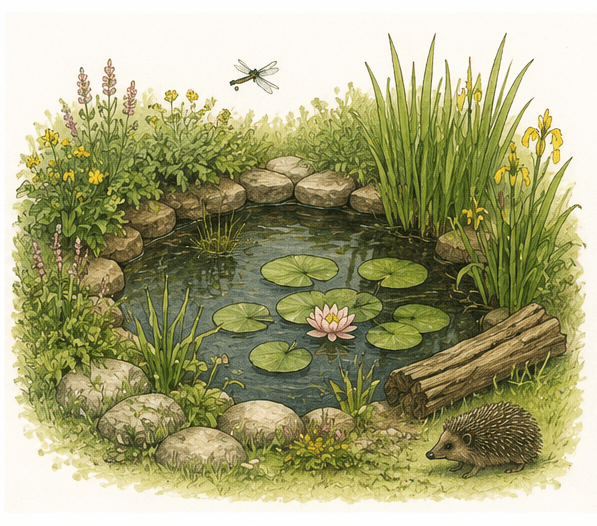
(87% adults want to attract more wildlife to their gardens, and 37% say wildlife is the best part of their garden)
- Ensure nectar is available from early spring to late autumn, eg ivy.
- “No Mow May” – leave longer for more of summer. Diversity of wild flowers will gradually increase. Biomass of “bugs” is 25x greater in long grass than in a short lawn.
- Garden ponds, even small ones, support wildlife and in some parts of the country wildlife is more dependent on garden ponds than vanishing ponds in the countryside.
- Trees support a range of wildlife.
More is better – talk to neighbours, raise awareness, involve the community to create connectivity and diversity. Several gardens together doesn’t simply multiply the number of small creatures like spiders, but make it possible for bigger animals like hedgehogs to be sustained.
3. Reduce CO2 emissions
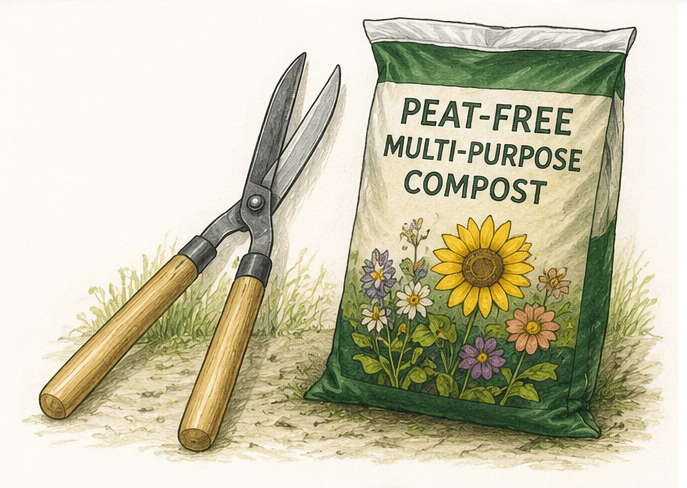
- Tools. Switch from petrol to electric or manual tools, share where possible. Eg cutting a hedge possible with sharp shears, although might take 25% l onger.
- Go peat-free. Billions of tonnes of carbon are stored in UK’s peat bogs, once extracted lost to atmosphere as CO2. Peat-free products have improved a lot since the first ones
- Minimise digging. Whenever soil is dug, carbon is oxidised into the air.
- Grow fewer annual/bedding plants, more perennials.
- No-dig vegetable beds – apply 3” organic mulch annually, which also helps ground stay damp, suppresses weeds and keeps carbon in the ground.
4. Carbon capture
Leave carbon in soil:
Undisturbed soil naturally contains carbon, from decomposed plant material. However, in some parts of the UK, 40-60% of soil carbon has now been lost to the air, and this is a major driver of climate change.
Capture carbon with plants:
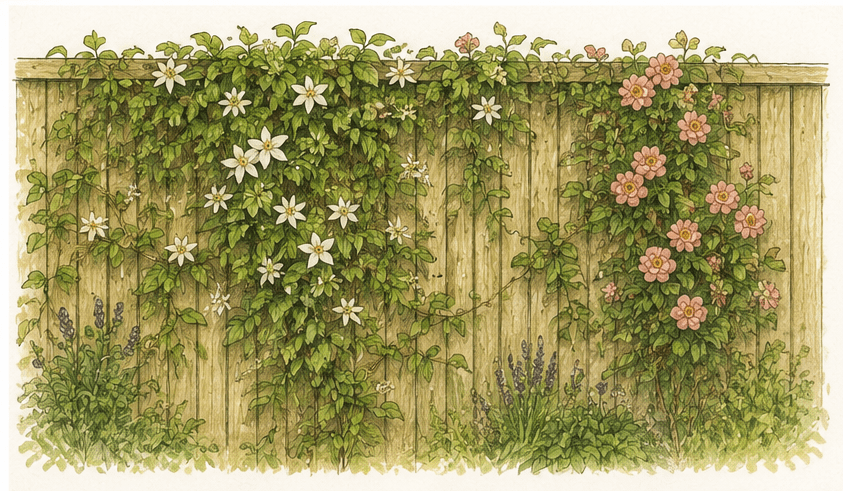
All foliage captures carbon during daylight (photosynthesis). Plant more perennials and trees which are better at locking up carbon than annual plants.
Turn hard surfaces green, including vertical surfaces like fences and walls, eg wisteria. Also helps wildlife and cooling.
Remove paving where not needed.
Use compost and mulch to return carbon to soil
Don’t be overwhelmed!
You don’t have to do it all, straight away. Start with something quick and easy. Even small changes can make a difference. It’s not the case that every garden has to turn back to jungle – many of these changes can be put into neat gardens. But with so many gardens/gardeners, together we really can make a difference to climate change.
There was then a lively Q&A, covering points including:
- No-dig: also has the advantage that soil structure is maintained. Works particularly well for plants that can be raised as seedlings then planted out, eg beans, courgettes, kohl rabi. Harder with root crops. Read Charles Dowding’s books, try it in one bit of your veg patch. Many people who go no-dig say they wish they had started with it years ago.
- What’s the best mulch? Your own compost is good, if you have enough. Or leaf mould, even conifer chippings. Basically any organic shredded material.
- Don’t put mulch down on dry ground, but pick the right time of year – Jan/Feb, and it will keep the water in the ground.
- Chop & drop (cutting down spent plants, weeds, or cover crops, and leaving on the soil to decompose naturally) – try it in an area
- What about trees close to houses? Shallow-rooted trees like birches and cherries don’t threaten house foundations, esp if modest sized.
- Are there plants that help other plants? Yes, yellow rattle weakens the growth of vigorous dominant grasses in meadows, so making space for wildflowers.
There is a lot more information on the Climate Change Gardening website https://climatechangegardening.org/ and you can sign up for a newsletter there too.


Pingback: Coming up – plastic picking in Centenary Wood, and other events | Sustainable Oakington and Westwick