
Putting the Rain Back in the Ground
Notes from a Talk by Water Sensitive Cambridge, at the SOW meeting on 25 September 2024
We welcomed Clara and Yair who explained that WSC is a a not-for-profit social enterprise founded a year ago by people concerned and passionate about turning surface water flooding hazards into assets.
The problems
Climate change is bringing both increasingly heavy rainfalls and increasing drought. More building makes the situation worse because of more hard surfaces. The problems are pollution and property damage by flooding.

There are two kinds of system for rain run-off (on roads etc.) In combined systems sewage is mixed with rainfall, which dilutes the sewage but means that in very heavy rain treatment plants get overwhelmed, and overflow by design into rivers.
The other system takes run-off and releases it directly into rivers – also not good because road run-off contains oils, micro-plastics, bits of rubber, rubbish and other pollutants including forever chemicals which damage fish and invertebrates. Road run-off above a certain amount is supposed to be filtered but hardly ever is.
Even where more sustainable solutions are applied large-scale, there is a worry that attenuation ponds have not been maintained. Eg the ones along the M25 are now contaminated.
Ironically we also have a water scarcity problem. When water is drained away it isn’t supporting trees and life in the soil. We need to find ways of welcoming water, for plants and to fill the aquifer.
Solutions
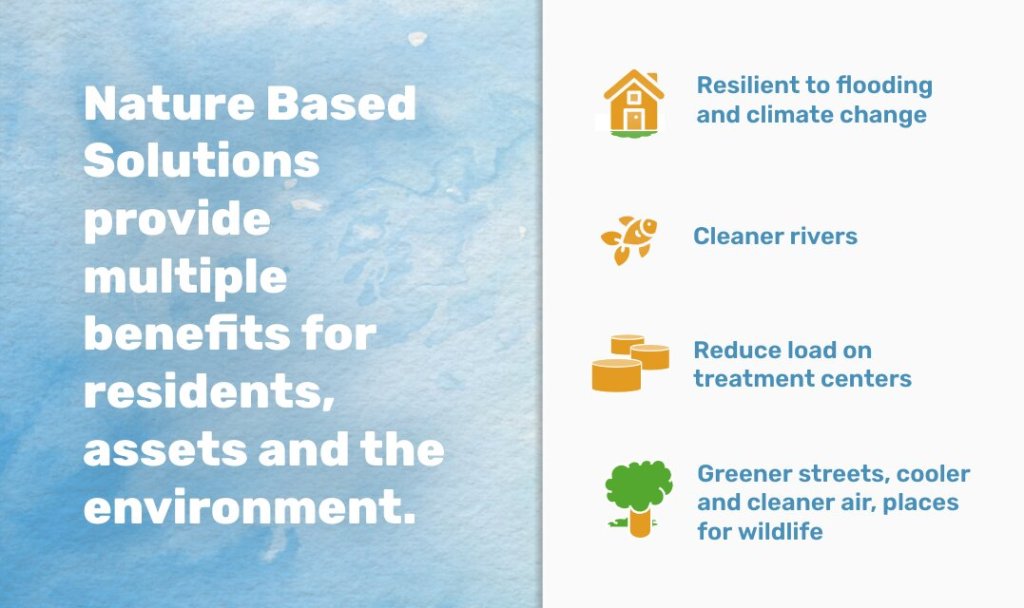
Pressure is being put onto water companies to invest in preventing sewage spills. However just putting in bigger pipes does not help for long – with climate-change rainfall, any size pipe will eventually be overwhelmed – and solves flooding problems only. Applying water sensitive principles, like putting stormwater into the ground instead of the drain, also gives cleaner rivers, nicer neighbourhoods and builds resilience to changing rainfall patterns.
The government is hopefully, belatedly, passing a law to demand sustainable drainage for any new development, but there is no requirement for retrofit, which costs a lot. So where do we start? With very local, simple solutions. Little interventions can nudge the bigger system and can make a big difference locally.

Principles
- Put rain back into the ground as close as possible to where it falls
- Get rid of hard surfaces, let water in
- Lower the curve (like in Covid) – slow the flow – fill up butts and rain gardens. This is the catchment approach – on the large-scale, allow fields to flood before a village floods
- Want water to go into soil and stay there, preventing later drought
Rain gardens
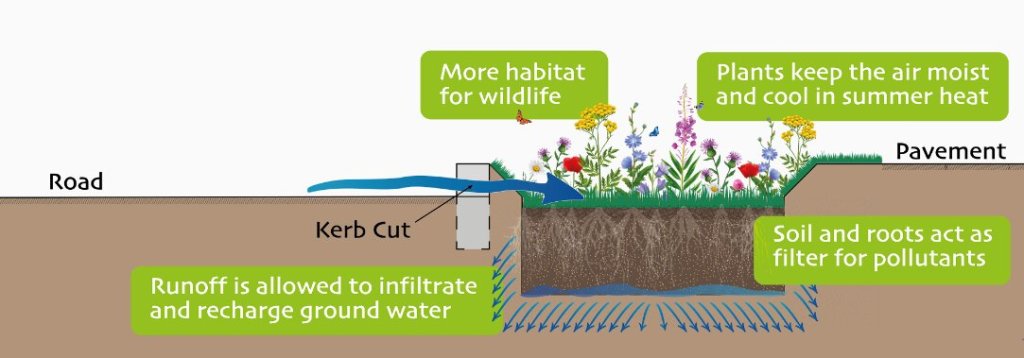
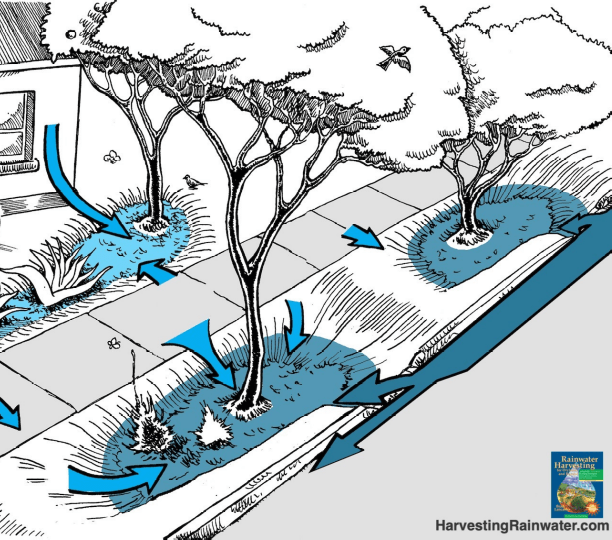
Earlier this year WSC did a pilot project in Fallowfield, Cambridge, a junction which is under water for half a day after very heavy rain. This was low cost, low effort – the kerb was cut in three places and the verge dug. Compost-rich soil was put into the holes, and neighbours helped plant perennials (which have bigger root systems and can survive drought) and sow wild flowers. Water fills up one pool at a time then runs on to fill the next. Compost makes the soil more absorbent :the soil’s capacity to hold moisture goes up exponentially with the amount of organic matter. Plant root systems bring micro-organisms which break down pollutants so the water is cleaner when it enters the water table.
It has worked well – after an hour or two there is now no standing water – and there has been a really good reaction from neighbours.
Rain planters
These are essentially rain gardens in a box. Lots of water enters but it only slowly drains away. The boxes are made (from recycled materials) by the brilliant Phoenix Trust in Milton. You can buy these from WSC for around £400 (which also supports Phoenix), a bit more if delivered and filled, or you can make them yourself. It’s a competitive price because WSC are not-for-profit and want to gather data on their use. They can be connected to water butts.
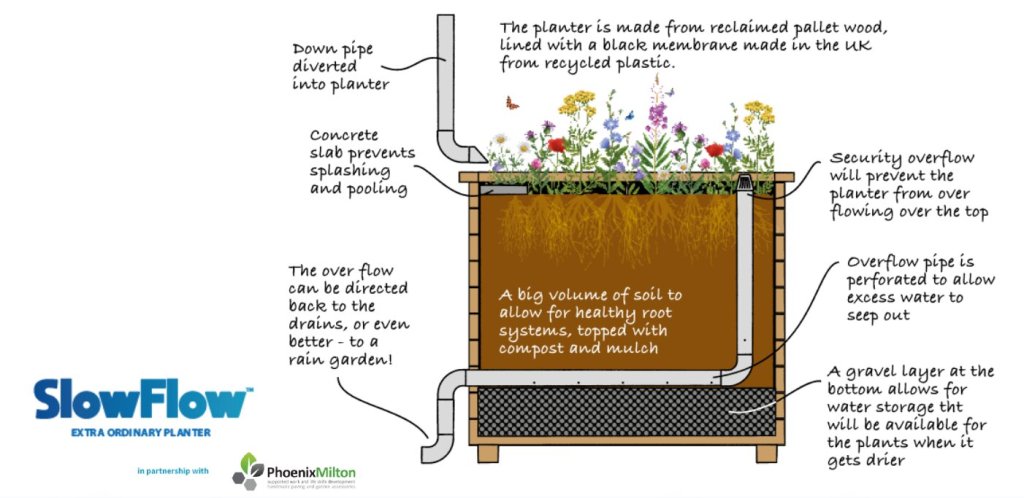
https://www.watersencam.co.uk/projects/slowflow-rain-planters
Water butts
If the purpose is to “lower the curve” (stop sewers getting overwhelmed and causing flooding and sewage spills) empty them before the storm comes. The water then gets held back by the water butt, and doesn’t just go in the overflow and drain.
To do this, turn on your tap so it dribbles put slowly, You can use a piece of old gutter to direct the water from the tap into somewhere useful in your garden.
How and where to implement nature-based solutions
You need to know the area to know where the problems are. They can be very localised – eg a puddle which prevents people from crossing a road. Look for easy ways. You can do what you want on your own property. Cutting into the kerb needs Highways approval!
In Oakington & Westwick
We had a good discussion, including:
- Celine described how in Meadow Farm Close they got rid of the concrete round the foot of the tree, and all the neighbours added plants.
- David explained that when Bar Hill was built in the late 60s, attenuation ponds were included but have not been maintained so we get surface water run-off from there.
- There are 19 wells in our village including 4 in the vicarage!
- Westwick has septic tanks instead of mains drainage. They can be a big source of river pollution, but if you’re not seeing water come out the soakaway is probably working OK.
- 2014 floods – 53 houses had to have property-level protection but the flood overwhelmed them (or happened before training.) In some houses water came up through the floor anyway.
- Trees are good but what to do if their roots are affecting pipes? If a tree has enough water that directs the roots down, and you can control the extent of roots by controlling the size of the canopy.
- Asked about the moving of the sewage plant in Cambridge, Clara explained it’s motivated by releasing building land; it now has the capacity to serve the projected growth in the area.
- The run-off from our community buildings (eg. pavilion) goes straight into drainage pipes, and Rachel suggested looking into more nature-based solutions for these. David said he’d put it on the Parish Council agenda.
- David explained the PC has access to drainage system plans and that a rolling programme of maintenance has been established.
- Grants are available for village projects.
 Sustainable Oakington and Westwick
Comprehensive and informative report. The main problem during previous periods of heavy on Cambridge Road arises from the sewer which runs under the centre of the road which then backup down individual sewers from the adjacent properties.
LikeLike
It’s true – but one way of avoiding this, without having to lift all the tarmac and placing bigger pipes, is to start diverting rain water from the drains, to reduce the load on the system. We discussed a few ways of doing this, described above.
Happy to answer any further questions.
LikeLike
Pingback: Notes and Notices from September 2024 SOW meeting | Sustainable Oakington and Westwick