Tag Archives: sustainability

Composting for Sustainability and Wildlife

Notes from the SOW talk on 26/6/24 by Lou Ellis. Here is a link to her slides.

23 people present.

Lou started by saying she has changed how she gardens in the last few years. She started gardening at the age of six, helping her grandfather. Having witnessed the “Percy Thrower” era of peat and pesticides she’s seeing gardening practice come full circle to some of her grandfather’s old-school methods.

Why is composting important?

Composting is a way growers mimic natural processes to sustain or improve production.

It increases biodiversity – Lou had noticed a drop-off in bugs over the years but has seen an improvement since using new practices. Soil ecology is overlooked – above ground we only see 40% of the biodiversity around us. Soil life underpins the food web.

It enables closed-circle sustainable gardening by reducing resource use – she does not buy bagged compost any more

It also increases your awareness of garden ecology and helps adapt to changing conditions resulting from climate change

Soil

Soil is a mixture of inorganic molecules (eg sand, silt) and organic matter: bacteria, fungi, animals, decomposed plants plus water which binds to the minerals to create soil crumb. The soil crumb can persist for 50 years but is damaged by walking over it and by agricultural machinery. The organic matter is important to prevent soil erosion, which is a serious problem globally.

What is compost?

  • Biomass:
    • Carbon/Brown: dry leaves, woody material, cardboard
    • Nitrogen/Green: grass, soft materials, food (?!), eggshells, coffee grounds
    • ideally 1 part N: 2 parts C but don’t worry too much
  • Fungi and moulds
  • Bacteria, nematodes and other micro-organisms
  • Macro-organisms such as woodlice and red branding worms (not the same as earthworms. Like a richer environment. They will just come up from the soil by themselves provided the compost bin is open directly on the ground.)

The composting process needs water and air. Fungi and moulds need it damper, cooler and dark; once the biomass has started to break down, the bacteria like it drier and a little warmer. We just need to create the conditions to help them “do their thing”.

How can we make compost?

“Ambient” bins

For this you just need a container, eg one made of pallets, or a commercial plastic bin. Create warm and dry conditions by covering the top and sides (eg with old compost bags; Lou re-used some black plastic sheeting.) The bigger the bin the better (but you need at least two.) To aerate, start the bin with large woody material in the base. Traditionally you speed up the process by turning the compost but this is time-consuming and not great for the wildlife in it so Lou doesn’t do it.
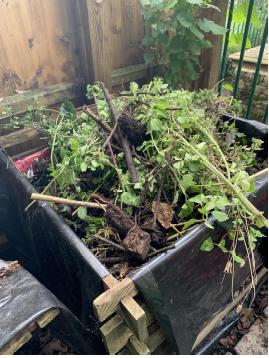
After being closed for 12-18 months:
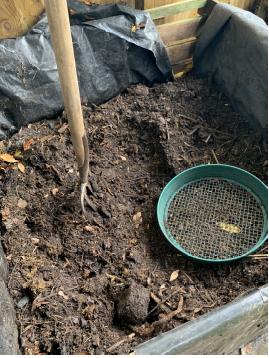
Lou then sieves it. What goes through she uses instead of bought compost, and what doesn’t she uses as mulch.

Hot bins

An ambient bin on steroids! Lou had hers as a Christmas present. It composts more efficiently (90 days in summer) and you include food and kitchen leftovers (“it chomps chicken bones and beef ribs”) in a mixture with other green biomass, shredded unprinted paper, thin cardboard packaging and hollow woody stems (instead of woodchip), adding material three times a week. Some guinea pig bedding. Not grass clippings as these block air flow. She’s kept hers going two years (it runs down a bit in winter.) It smells faintly cabbagy when working aerobically as it should be, if it goes anaerobic it smells more.
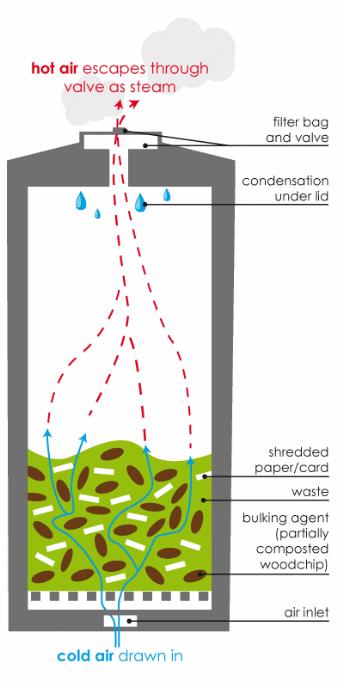
This is what it looks like at the end:
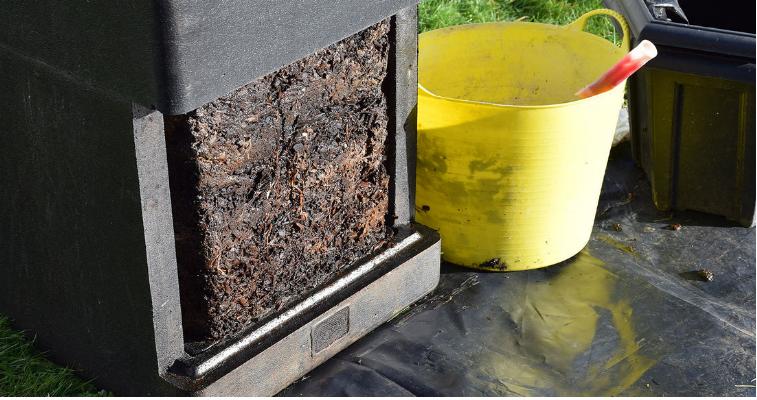
Lou uses the results as rich compost, eg instead of growbags for tomatoes.

It also produces a leachate (a “compost tea”) – about a litre a week – which can be diluted 1:10 to use as a liquid fertiliser. It’s best used immediately and can be hard to get just right, but you can tell by the smell -will be OK if it smells OK!

What can compost be used for?

Some examples of how Lou uses compost:

  • sieved spent compost – seed mix
  • sieved green compost – potting mix (add gravel, perlite etc)
  • large bits re-composted or added to vegetable garden
  • sieved vegetable plot soil – lawn regeneration
  • Hot bin compost – rich spot fertilisation & tomatoes

Wildlife value

Adding compost increases soil biodiversity. The compost heap itself contains lots of wildlife (eg Lou has seen bumblebees nesting in it) so Lou advocates leaving bins/heaps untouched until Autumn – as you would hedging and ponds.

Other sustainable gardening practices

Mulching: Lou says this has been the single most impactful change in her gardening. It’s essentially direct composting by putting leaves, moss, twigs, and broken-up dry material directly on the ground. It benefits wildlife, retains moisture, adds nutrients, warms and protects soil and is less work too! (But if you want to grow wildflowers you need bare soil for the seed to germinate.)

No dig versus low dig (ie digging as little as possible): Traditionally vegetable plots were double digged but this is not good for soil or wildlife. Instead with a fork just turn the top layers (spades chop earthworms.) But her front garden is no-dig and is working well.

Another example of reduced-resource sustainable gardening is bedding: a lot of things sold by garden centres as annual bedding are actually perennials which can be kept going for years and propagated on by cuttings.

Lou has ongoing experiments testing other improvements, “it’s really fun.” Eg. which tomato varieties are best outside, discovering that French beans tolerate hot, dry conditions better than runners.

As a result of her improved practices Lou has seen more wildlife in her garden including foxes, hedgehogs and grass snakes.

Lou showed this video about using compost and trench composting and recommends GrowVeg generally for good straightforward advice if anyone wants more information.

Garden Tour

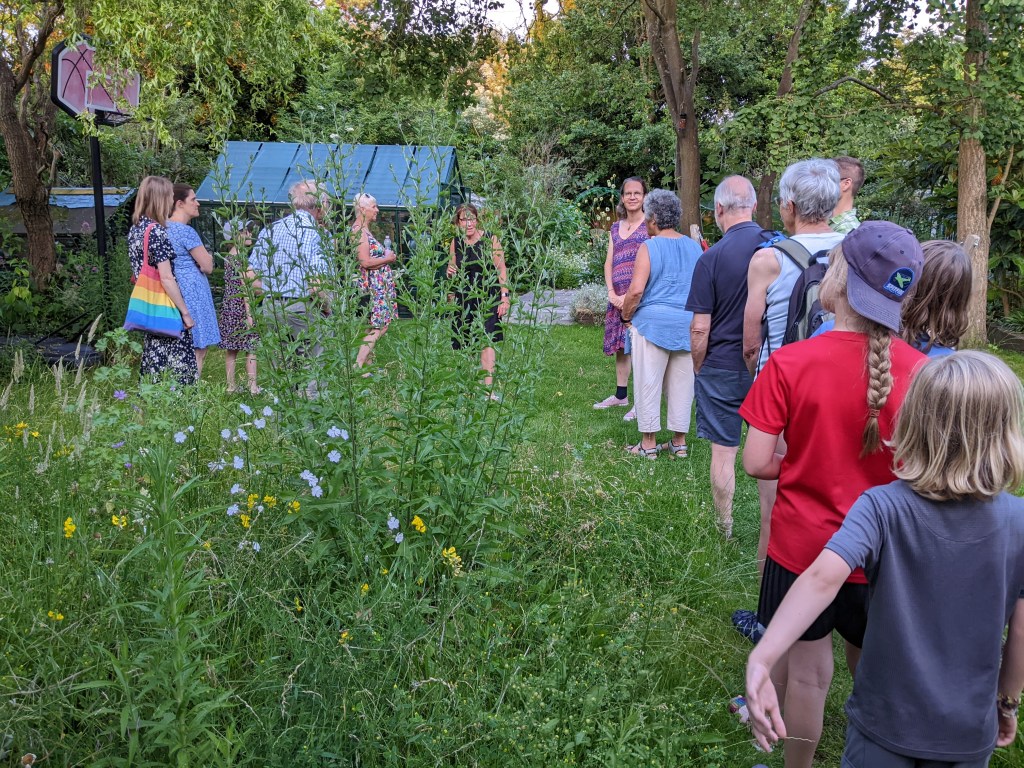
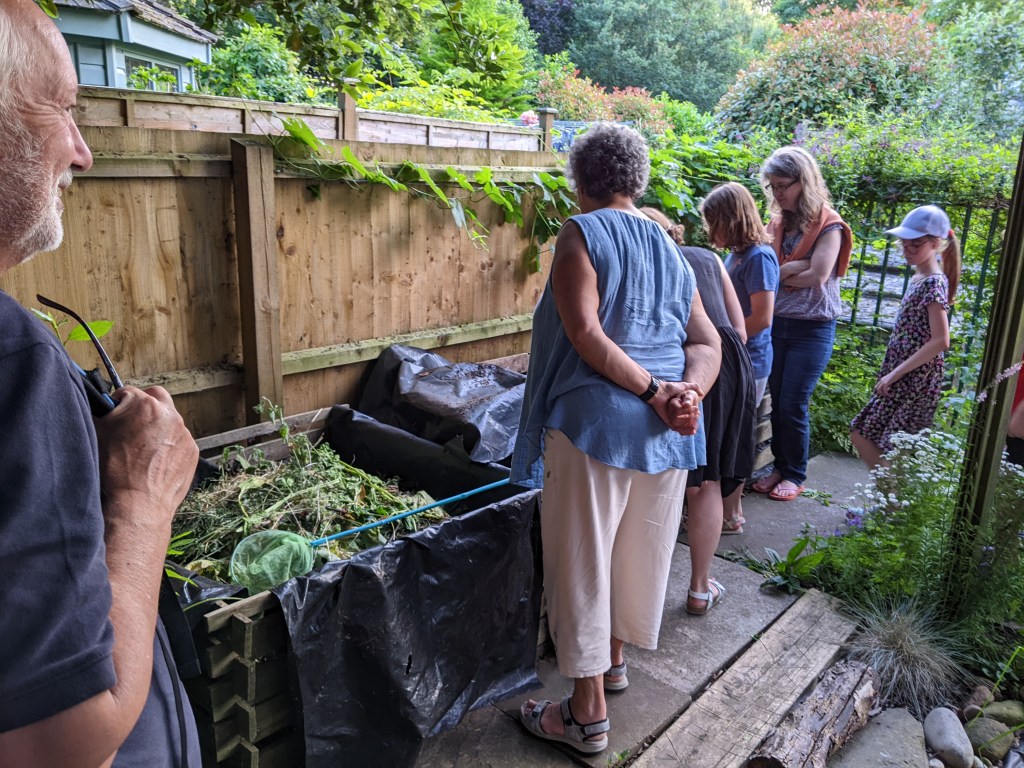
Lou showed us round her lovely and interesting garden where we could see for ourselves ambient and hotbins in action.
Communicating Climate Change

Notes from the SOW meeting on 24 April 2024. 15 people present including 3 children.

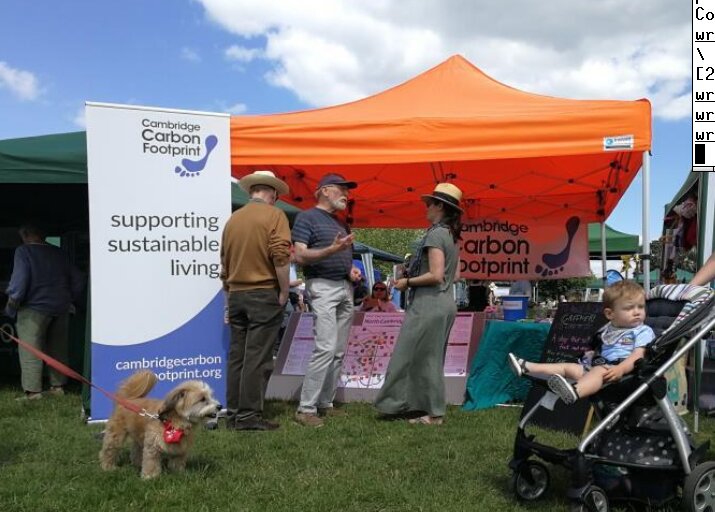
The speaker was Alana Sinclair of Cambridge Carbon Footprint, whose activities include Open Eco Homes, supporting Repair Cafes, and the Net Zero Now training course which inspired SOW.

She told us about some techniques to use when discussing Climate Change, following lots of research and her own experience. People often feel uncomfortable about the subject because they can feel judged.

Do people care?

She began by asking: In general how concerned about climate change do you think people in the UK are? And how about in Oakington and Westwick specifically?

The answers surprised some of us. 74% adults reported feeling (very or somewhat) worried about climate change. When asked about a range of issues, climate change was the second biggest concern facing adults in Great Britain (74%), with the rising cost of living being the main concern (79%). (ONS 2022).

Globally, 89% would like their governments to do more to tackle warming, and 69% say they would be willing to contribute 1% of their income to addressing climate change.

But, Alana explained, humans are “conditional co-operators” who are more likely to contribute to public good if they see that others are doing the same. So one important motivating message is to let people know that most of the population, like them, cares about climate change and wants something to be done to stop it.

Britain Talks Climate 2024 is research which reveals what people think about climate policy. It shows that only 15% want to see a slow down in Net Zero efforts. Most people think that reaching Net Zero will be good for the UK – even those in the lowest income groups. There is near universal support for protecting nature and wildlife, and reducing pollution and increasing renewables are next highest priorities.

In rural areas like ours, climate change is a concern to 87% of people – ie higher than the national average, and rural citizens are more engaged with environmental concerns in general than urban citizens (although the actions they take may be different.)

Nationally, 75% said they made a lot or some lifestyle changes to help tackle climate change. So a useful engagement strategy is to recognise the efforts people are already making.

How to be effective when speaking to others about Climate Change

Alana had lots of tips, including:

  • Know your audience (their values and attitudes) and connect with what matters to them. (Eg locally this might be reducing waste, community pulling together, a sense of stewardship and shared responsibility to protect the environment)
  • Help your audience realise what they can do, and what are the key, most important actions. People don’t always realise what are the next steps
  • Recognise the scale of the problems we face, but emphasise how to overcome them. A sense of desperation will be counter-productive. Need to bridge the gap between anxiety and action. Avoid fear, doom and gloom.
  • Use captivating visuals, stories, narrative, humour and other creative forms of engagement.
  • Avoid the information trap. Facts and figures won’t change people’s minds. And avoid preaching. Instead, ask people for their tips, quiz them on what they already know. A smattering of facts will make things tangible however.
  • Listen and show empathy. The more people feel understood and respected, the more open they are to changing their behaviour. Even if you don’t agree, find common ground. Learn from one another.
  • Speak personally. Use stories and case studies (and don’t gloss over difficult bits.)
  • You have to roll with resistance. Don’t argue/retaliate or oppose directly – you won’t get very far. Sometimes it’s best to just walk away; or it may be a signal to ask more questions, show more empathy.
  • Climate change can feel distant so use anything that connects it to everyday life – eg weather (have they noticed any changes), gardening, the future for our children/grandchildren
  • Don’t talk in terms of radical change, hardship and sacrifice, or use language which evokes political divide eg left/right
  • Ask people what they are already doing for nature.
  • Maybe talk in terms of “reducing carbon emissions” rather than “net zero” which can mean different things to different people?
  • Trust that others are already concerned and taking action. We’re not in a place where we have to get a mandate for climate change action. We just need to convince people that we have that mandate and give them the tools to crack on.
  • Encourage people to consider climate change when they vote.

Alana gave some specific examples of engagements:

  • Imaginarium – a lecture theatre that was gradually transformed into a rainforest over a day with all comers joining in writing/drawing/crafts. Including sound effects! CCF are producing (maybe in June.=) a toolkit to support people.
  • World War ration books – showing that the diet of the past is also a sustainable diet for the future. (Used in Cottenham Sustainable Food Festival.)
  • Cambridge Climate Map – a map of local shops/businesses/other resources that can help people reduce their footprint. CCF have done a stall in which people added their own suggestions to this.

What next?

We had a lively discussion, and the conclusion at the end was that we would postpone the planned May 29th meeting (“Composing for Sustainability and Wildlife” followed by a visit to Lou’s garden) until June (26th) and use the May meeting to discuss what we learned tonight and use those insights to prepare a stall for the Village Day (29th June) – in collaboration with the village Environment Action Group.

Here’s a link to the results of the survey we did last Village Day which may be useful in our discussions.

Email us if you’d like to ask to see the slides for the full presentation, which included a lot more than in these notes.

(Thank you to John whose notes these are based on.)

Notices

Don’t forget the Plant Swap on Sat 18 May 10-12 and Sun 19 May 2-4pm, in Coles Lane.

Cambridge Nature Festival runs 25th May – 30th June. Events and activities for all ages, abilities and interests – creative activities, nature walks, live music, bat punt safaris, BioBlitzes and much more. Visit www.cambridgenaturenetwork.org/cambridge-nature-festival for a full list.

SOW will be represented at the Pollination Festival at the Garden Centre on 22nd June and at Village Day 29th June – help on the stalls very welcome.

Sustainable Banking & Pensions

Notes from the SOW meeting on 28 Feb 2024. Dates for your diary at the end.

Eight people present; apologies from a large number of people! Jenny and Paul led a discussion on…

Making Change with Money

  • Spending – we’re used to thinking about making environmentally conscious choices when shopping
  • Saving – if we’re lucky enough to have money to spare, we also need to think about
    • Bank accounts (although everyone needs a current account)
    • Pensions & investments (such as ISAs)

Two Things to Think About…

(1) Greening our pensions cuts our carbon footprint 21x more than going veggie, giving up flying and switching energy providers combined!

(Research by Make My Money Matter/WWF-UK/Aviva: “Moving the national average pension wealth to the sustainable fund used in the calculation is 21 times more effective (respectively) than the combined annual carbon savings of switching to a renewable electricity provider, substituting all air travel with rail travel and adopting a vegetarian diet.”)

(2) What’s best?

  • (Short of avoiding anything to do with the capitalist system – extremely difficult!)
  • Divesting from eg fossil fuels and investing in windfarms – eschewing the bad, supporting the good
  • Influencing companies through shareholders – by investing you get a say in what “bad” companies do


Banking

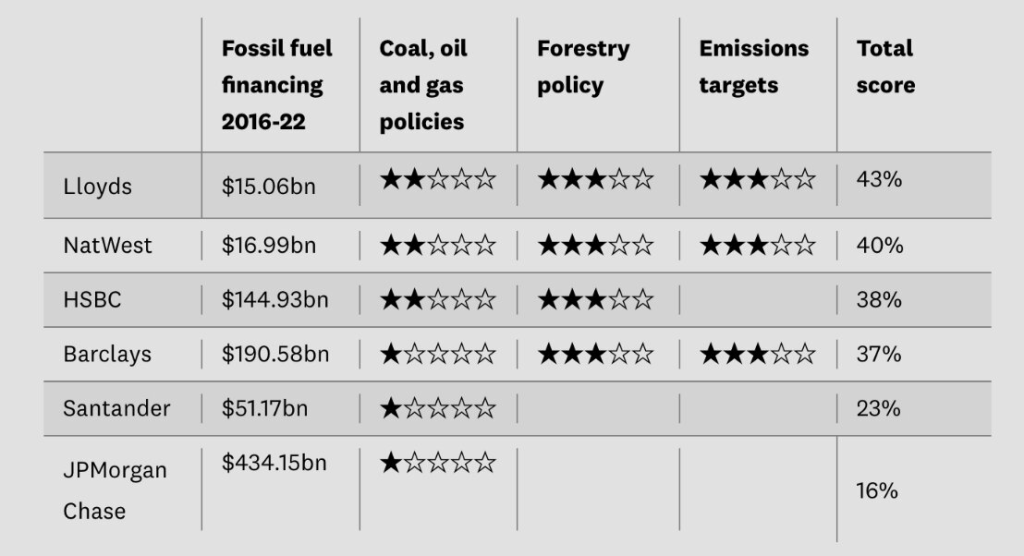
The worst banks include the big household names:

(Source: Which)

High Street banks have been around for hundreds of years, and have been able to get away with unethical practice. Until recently there were no new banks to challenge them – the film “Bank of Dave” describes someone who found a gap in the banking market to help his community! Since then there have been a few other newcomers.

Which? Eco providers for current accounts:

  • Nationwide Building Society – only one to have a branch in/near Cambridge. A mutual, investing money in houses via mortgages
  • The Co-operative Bank – has long had ethical principles, eco considerations were then added
  • Triodos Bank – does not simply exclude eg fossil fuels but seeks out positive causes to lend to

Pensions & Investments

Unscreened investments will use your money to fund whatever makes the most profit. But there are funds which have a small or large degree of ethical screening. (A fund is a collection of investments in different companies which is managed by one fund manager, according to pre-defined criteria.)

“Ethical” considerations are wider than just environmental, eg. avoid alcohol, gambling, arms trade, animal testing. But ideally you’d want to be able to choose what matters to you, eg investing in village-scale artisan alcohol producers OK, investing in BP not OK

“ESG” = Environmental, Social & Governance. You’ll hear this phrase. Many providers now consider ESG risks/performance. (Examples of Environmental: Climate change policies​, waste & pollution; of Social: Human rights​, labour standards, data protection & privacy; of Governance: Board diversity​, Anti-corruption policies​, Corporate behaviour​.) ESG is positive but does not go very far. Eg. can have tobacco, armaments, and fossil-fuel companies that manage their ESG – publishing annual reports about protecting biodiversity or providing apprenticeships, and some companies “greenwash” – talk about their ESG but don’t actually do much.

“Light green” or “dark green”. Dark green funds are very strongly ethical, avoiding the bad and seeking out positive companies to invest in. Light green funds still have an ethical focus but might not, for example, avoid an oil company altogether, if it was aiming to move over to greener energy. Types of company invested in by most ethical funds also include “neutral” or “helpful” areas of business like medical and food retail.

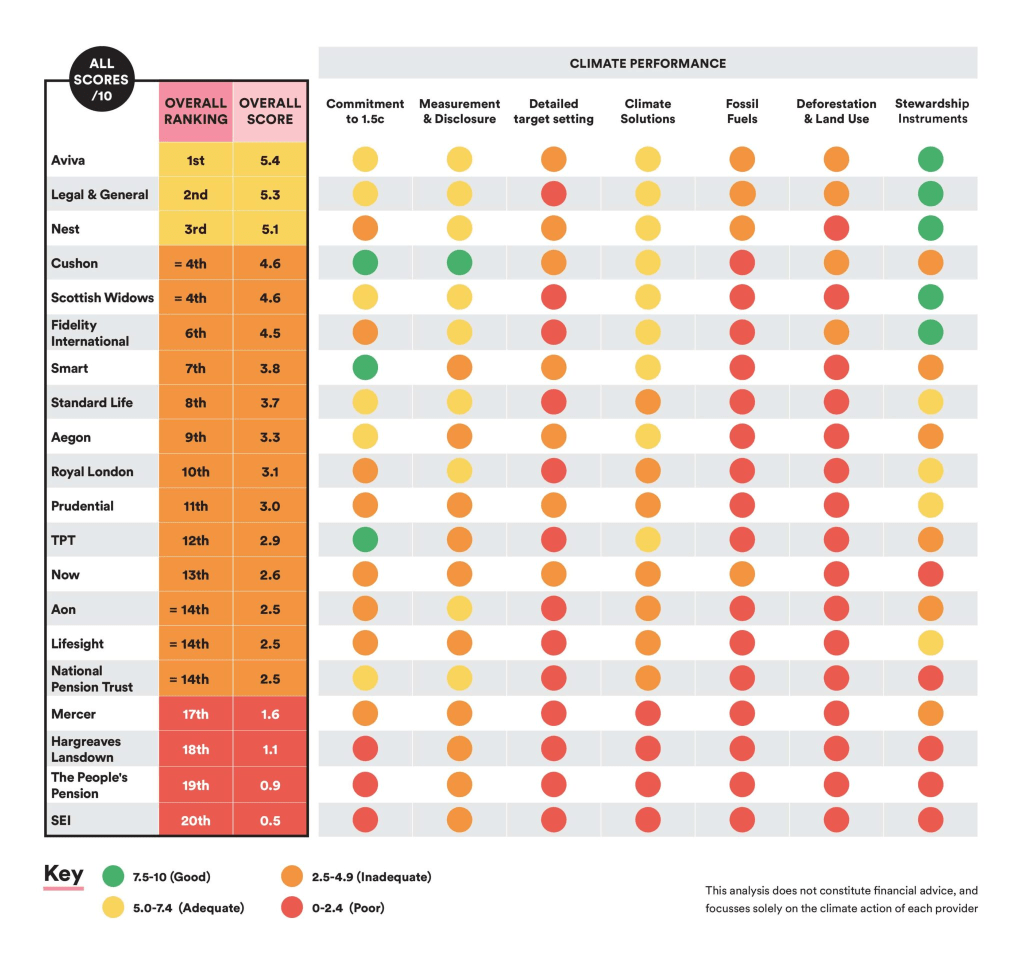
Source: Make My Money Matter. Note that these scores are averaged over all the pension company’s funds. Individual pension funds can be more ethical/sustainable, eg. Aviva will have a sustainable fund.


Performance?

Well-chosen eco funds can perform as well as unscreened. Investing against climate change makes long-term business sense!

Sustainable funds can fluctuate more over the short term. In tougher times the market favours old-school stocks like oil. In times of growth new technologies do better.


What to do?
  • May be possible to change funds within pension company. Don’t always have a choice about your workplace pension, but might be possible to change funds within it.
  • Or change pension company. This may well cost a fee.
  • Specialist IFAs (Independent Financial Advisers). A IFA who specialises in environmental/ethical investment can make sure the new provider both fits your ethics/eco goals and will make also a good return for you. Ethical Consumer has a list and SOW members have personal experience with one of these.

Find Out More

www.ethicalconsumer.org
‘All the information and inspiration you need to revolutionise the way you spend, save and live.’ A consumer organisation a bit like Which? With purchasing advice and a magazine subscription available.

www.makemymoneymatter.co.uk
A movement calling for the trillions of pounds invested in UK pensions to build a better world.

www.which.co.uk/money
The consumer organisation’s Money section, who have information on ethical banks and pension.

Deeper dive into financial skulduggery

As an example, Paul played part of Mark Thomas’s podcast which reveals that all of us until 2015 were effectively paying off the government compensation awarded to slave owners (you read that right, owners, not slaves!) in 1834 when slavery was banned in this country.

Bank of Dave (a film)
Dave in Burnley wants to open a bank, but a new banking licence hasn’t been issued in over 100 years.

Tax Justice Network (website and podcast)
www.taxjustice.net
Taking on a system that fuels inequality, fosters corruption and undermines democracy.

They publish The Financial Secrecy Index and The Corporate Tax Haven Index every two years, which makes for interesting reading, and also produce a very informative podcast.

arbdn Financial Fairness Trust (website and podcast)
www.financialfairness.org.uk

Research, campaigning and policy work to improve life for people on low to middle incomes. Also produce a podcast.

The Dark Money Files (blog and podcast)
thedarkmoneyfiles.com

A blog and podcast with more information than you will ever likely need on money laundering, bribery, corruption, fraud and trafficking.

Treasure Islands (a book)

A book about, amongst other things, how billionaire Warren Buffet, currently the third wealthiest man in the world, paid the lowest rate of tax among his office staff, including his receptionist.

The Spider’s Web: Britain’s Second Empire (a film)

Britain’s transition from colonial power to global financial power

The Things About Us: Slavery (a podcast episode)

Listen to the full podcast, ‘Slavery’ through your podcast provider.

Dates & Notices

  • March meeting (27th March) – Leo will re-run the popular fruit tree grafting workshop
  • April meeting (24th April) – Alana from Cambridge Carbion Footprint is coming to give a talk about communicating climate change
  • May meeting (29th May) – maybe the garden wildlife session, or will people be away because it’s half term?
  • Plant swap will be 18th and 19th May
  • Eco Club litter pick this Sunday (we think)
  • The Repair Cafe on 10 February went well.
  • The Green Library was open at the meeting for loans and returns!

Cottenham Swish

Sustainable Cottenham have asked us to let people know about their event in March:

Cottenham Swish: swap your way to a new wardrobe

SWISH at Cottenham Village Hall on Saturday 16 March from 2.15-3.45


Swishes, or clothes swap parties are a fun, free way to refresh your wardrobe without buying new clothes. The fashion industry has a huge environmental footprint accounting for more carbon emissions than aviation and shipping combined, and is often exploitative of workers too. Meanwhile, an average Briton’s wardrobe contains
a whopping 57 unworn items!*

It’s those under-worn clothes you’ve fallen out of love with that we want you to dig out from your wardrobe and swap with others. Bring women’s, men’s and children’s clothes, shoes and accessories in good, clean condition. You can bring and take as much as you like*.

Drop your items off at 1:45 and whilst we sort your clothes there will be refreshments and stalls from local groups. Swishing will start at 2:15pm and end at 3:45pm.

All leftover clothes will be donated to charity.

This is a free event organised by Sustainable Cottenham. Donations gratefully received towards our costs (please bring some cash!), all welcome.

*Figures from this BBC article on Fast Fashion
**No underwear, please.
***Please only take what you/your family will personally use – not to sell on. We reserve the right to challenge anyone not acting in the spirit of the event.