
Composting for Sustainability and Wildlife
Notes from the SOW talk on 26/6/24 by Lou Ellis. Here is a link to her slides.
23 people present.
Lou started by saying she has changed how she gardens in the last few years. She started gardening at the age of six, helping her grandfather. Having witnessed the “Percy Thrower” era of peat and pesticides she’s seeing gardening practice come full circle to some of her grandfather’s old-school methods.
Why is composting important?
Composting is a way growers mimic natural processes to sustain or improve production.
It increases biodiversity – Lou had noticed a drop-off in bugs over the years but has seen an improvement since using new practices. Soil ecology is overlooked – above ground we only see 40% of the biodiversity around us. Soil life underpins the food web.
It enables closed-circle sustainable gardening by reducing resource use – she does not buy bagged compost any more
It also increases your awareness of garden ecology and helps adapt to changing conditions resulting from climate change
Soil
Soil is a mixture of inorganic molecules (eg sand, silt) and organic matter: bacteria, fungi, animals, decomposed plants plus water which binds to the minerals to create soil crumb. The soil crumb can persist for 50 years but is damaged by walking over it and by agricultural machinery. The organic matter is important to prevent soil erosion, which is a serious problem globally.
What is compost?
- Biomass:
- Carbon/Brown: dry leaves, woody material, cardboard
- Nitrogen/Green: grass, soft materials, food (?!), eggshells, coffee grounds
- ideally 1 part N: 2 parts C but don’t worry too much
- Fungi and moulds
- Bacteria, nematodes and other micro-organisms
- Macro-organisms such as woodlice and red branding worms (not the same as earthworms. Like a richer environment. They will just come up from the soil by themselves provided the compost bin is open directly on the ground.)
The composting process needs water and air. Fungi and moulds need it damper, cooler and dark; once the biomass has started to break down, the bacteria like it drier and a little warmer. We just need to create the conditions to help them “do their thing”.
How can we make compost?
“Ambient” bins
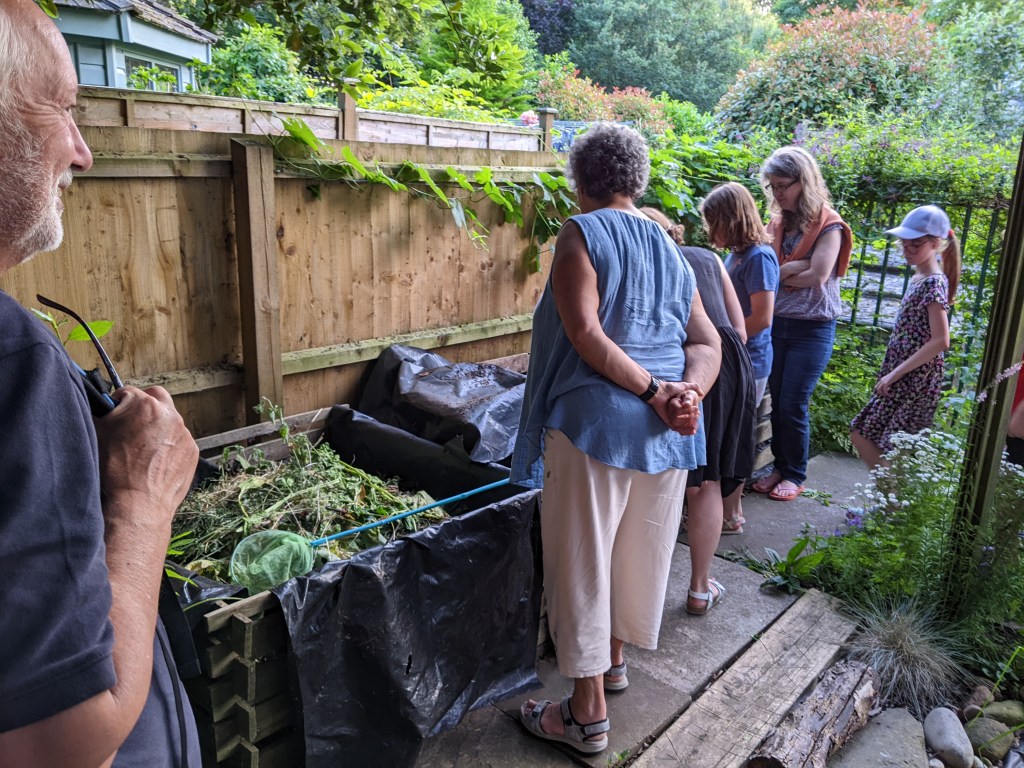
For this you just need a container, eg one made of pallets, or a commercial plastic bin. Create warm and dry conditions by covering the top and sides (eg with old compost bags; Lou re-used some black plastic sheeting.) The bigger the bin the better (but you need at least two.) To aerate, start the bin with large woody material in the base. Traditionally you speed up the process by turning the compost but this is time-consuming and not great for the wildlife in it so Lou doesn’t do it.
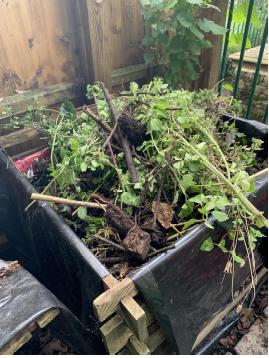
After being closed for 12-18 months:
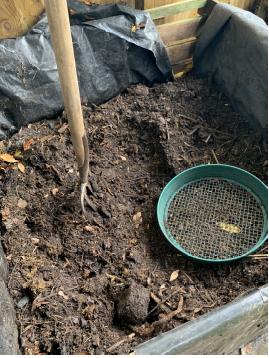
Lou then sieves it. What goes through she uses instead of bought compost, and what doesn’t she uses as mulch.
Hot bins
An ambient bin on steroids! Lou had hers as a Christmas present. It composts more efficiently (90 days in summer) and you include food and kitchen leftovers (“it chomps chicken bones and beef ribs”) in a mixture with other green biomass, shredded unprinted paper, thin cardboard packaging and hollow woody stems (instead of woodchip), adding material three times a week. Some guinea pig bedding. Not grass clippings as these block air flow. She’s kept hers going two years (it runs down a bit in winter.) It smells faintly cabbagy when working aerobically as it should be, if it goes anaerobic it smells more.
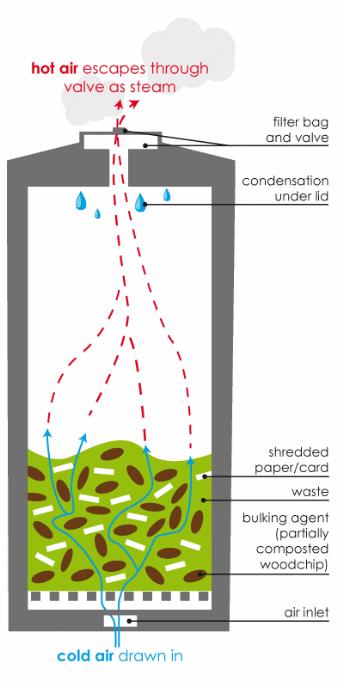
This is what it looks like at the end:
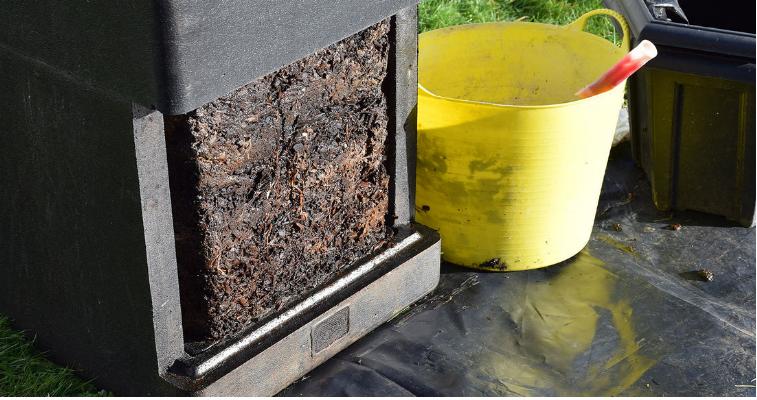
Lou uses the results as rich compost, eg instead of growbags for tomatoes.
It also produces a leachate (a “compost tea”) – about a litre a week – which can be diluted 1:10 to use as a liquid fertiliser. It’s best used immediately and can be hard to get just right, but you can tell by the smell -will be OK if it smells OK!
What can compost be used for?
Some examples of how Lou uses compost:
- sieved spent compost – seed mix
- sieved green compost – potting mix (add gravel, perlite etc)
- large bits re-composted or added to vegetable garden
- sieved vegetable plot soil – lawn regeneration
- Hot bin compost – rich spot fertilisation & tomatoes
Wildlife value
Adding compost increases soil biodiversity. The compost heap itself contains lots of wildlife (eg Lou has seen bumblebees nesting in it) so Lou advocates leaving bins/heaps untouched until Autumn – as you would hedging and ponds.
Other sustainable gardening practices
Mulching: Lou says this has been the single most impactful change in her gardening. It’s essentially direct composting by putting leaves, moss, twigs, and broken-up dry material directly on the ground. It benefits wildlife, retains moisture, adds nutrients, warms and protects soil and is less work too! (But if you want to grow wildflowers you need bare soil for the seed to germinate.)
No dig versus low dig (ie digging as little as possible): Traditionally vegetable plots were double digged but this is not good for soil or wildlife. Instead with a fork just turn the top layers (spades chop earthworms.) But her front garden is no-dig and is working well.
Another example of reduced-resource sustainable gardening is bedding: a lot of things sold by garden centres as annual bedding are actually perennials which can be kept going for years and propagated on by cuttings.
Lou has ongoing experiments testing other improvements, “it’s really fun.” Eg. which tomato varieties are best outside, discovering that French beans tolerate hot, dry conditions better than runners.
As a result of her improved practices Lou has seen more wildlife in her garden including foxes, hedgehogs and grass snakes.
Lou showed this video about using compost and trench composting and recommends GrowVeg generally for good straightforward advice if anyone wants more information.
Garden Tour
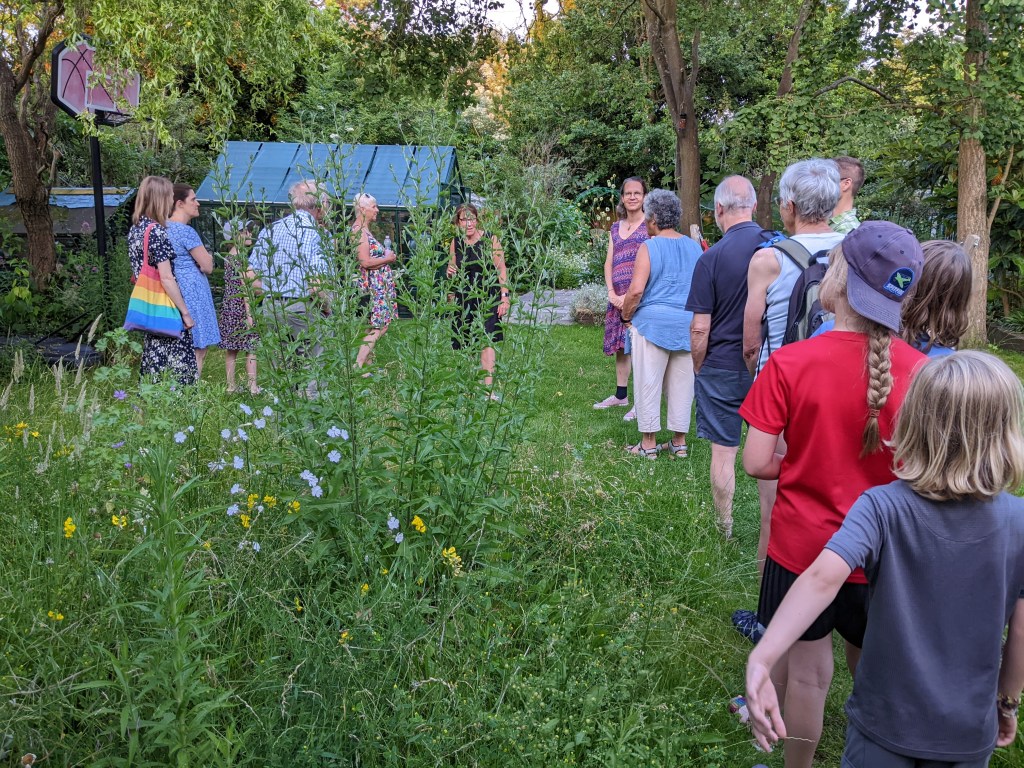
Lou showed us round her lovely and interesting garden where we could see for ourselves ambient and hotbins in action.
 Sustainable Oakington and Westwick