
APollOW
A Pollinator survey of Oakington and Westwick

Quick links to:
- how to do an APollOW count
- where to download the app
- and the downloadable form (for if you aren’t using the app.)
This page describes the background and objective of this project and why we are doing it, but you can also skip straight to training sessions, the map and FAQs. There is also a section on how to improve your garden for pollinators.
Read the results of the first year of the pollinator survey.
Background
A desire to monitor wildlife has been expressed in Oakington & Westwick (hereafter ‘Oakington’). There are a number of ways to do this and these were presented at a meeting of SOW early in 2024. They included options to monitor birds, reptiles, pollinators, plants and other taxa. Over 2024, a small number of pollinator surveys were undertaken on a semi-formal basis, some of which were in partnership with Mansell Farm, who were undertaking their own surveys as part of a Cambs County Farms project.
It has been decided that the best option for ongoing wildlife monitoring in Oakingon is to use the Flower-Insect-Timed (FIT) count method used by the UK Pollinator Monitoring Scheme (UKPoMS) to measure pollinator abundance change over time. These surveys are:
- Relatively simple (the ID skill level required is relatively low, or can easily be learned),
- Quick (from start to finish they take about 15 minutes of time for each session.
- Can be done anywhere (though we will imparting a ‘structured’ element to our own programme.
- As well as contributing information locally, we are contributing to a national monitoring scheme and so providing important information to decision-makers in government.
Objective
To undertake a programme of FIT (Flower-Insect-Timed) counts on a combination of set ‘stations’, or self-selected sites throughout the village. The aspiration is to have counts on a weekly basis from April to September inclusive. Participants will be encouraged to visit set stations (defined as approximate areas, rather than point locations) to complete FIT counts, as well as selecting sites of their own. The set station element ensures there is an element of ‘unbiased’ recording – we don’t just want to select areas which people will perceive as ‘the best’, and there should be a mixture of private and public access sites.
Training
If you are interested in taking part, or just want to know more about pollinators, join one of the following free training events:
- Wednesday 15th April, 7:30pm at St Andrew’s Church Hall, Oakington
- APollOW training in Oakington community orchard, date TBA – please get in touch if you are interested.
Or watch one of these videos (some from the organisation which runs the national UKPoMS scheme):
- FIT Counts in 2 minutes (2 mins)
- How to do a FIT Count (Royal Parks) (2 mins)
- FIT Counts – learning the insect groups (8 mins)
- Beginner’s Guide to Planting For Pollinators (Biological Recording Company) (23 mins)
- Monitoring Pollinators with FIT Counts (UK Centre for Ecology & Hydrology) (26 mins)
- The UK Pollinator Monitoring Scheme (45 mins)
- Polling Pollinators (75 mins)
How to do it
*** Step by step instructions – click here. ***
FIT Counts are quick and simple. The data can be collected and recorded using a mobile device whilst in the field or recorded on a standard recording form and entered online later.
Volunteers will:
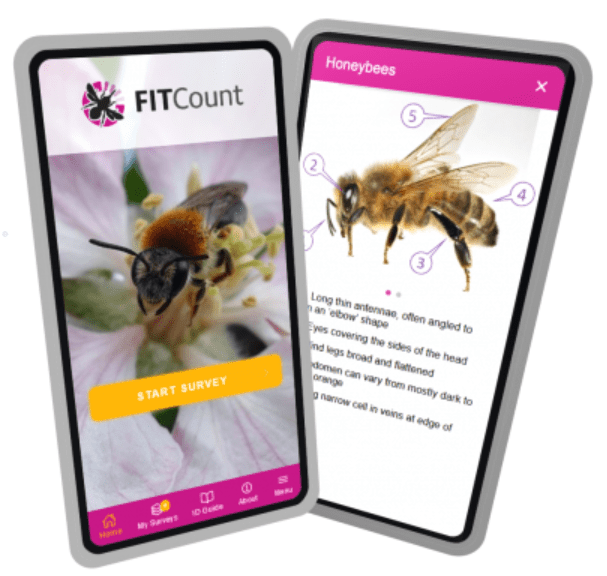
- If using a mobile device, download the latest version of the FIT Count app:
- If not using a mobile device, view or download a form. It is important to have the questions and options to hand before going into the field – there are questions about the weather and vegetation that need to be completed, as well as the count itself.
- Pick a good weather day (avoiding rain and strong wind)
- Visit one of the predetermined sites in the village – see the map below – for the 2025 proposed sites or pick their own.
- Find a location with one of the target flower species (there is a list). If not available, choose an area with another species that is attractive to pollinators, but only one species.
- Measure out a 50cm x 50cm square (quadrat) over your patch of flowers.
- Count the pollinators that land on the target flower in your square within a 10 minute period, trying to avoid double counting.
- You only need to know the pollinators by the group they belong to, not the species. This guide will help.
- When 10 minutes is up (the mobile app will tell you, otherwise take a timer):
- Complete the recording on the weather and vegetation,
- Tag the count to the Oakington & Westwick project
- Upload.
- Repeat as many times as you like. For each station or location, we’d love at least one count each week.
Why are we doing this?
The evidence is clear that pollinator numbers are decreasing, but we need to know more to discover how best to arrest this decline.
There are many reasons for the APOllOW project.
- Observing and counting wildlife can be an enjoyable activity in its own right, and lead to opening up of a whole new hobby.
- Many people in Oakington are concerned about wildlife. In time, we may wish to start programmes of habitat management and conservation around the village (e.g., along the Longstanton Road) so monitoring it is a necessary step to figuring out whether the changes we make actually make any difference.
- This particular type of monitoring is great because it requires relatively little skill, relatively little time and can be done anywhere.
- And, if nothing else, you are contributing to a national recording scheme, the results of which are taken into account when it comes to national and local government decision making on biodiversity.
The Map
Below is an image of the proposed locations of the formal stations. They aim to capture a variety of habitats and potential for there to either be changes made in the future, or none at all. For example, if we want to show that a change to a cutting regime is having positive impacts for plants and then pollinators, we’d need to show that other places are doing too, otherwise we can’t directly attribute the change in pollinator numbers to the change in management. Here are some of the locations and their reason for selection.
- Longstanton road: Potentially an area that O&W may have the capacity to manage ourselves.
- Orchards. Already areas that we manage and undertake plant monitoring.
- S/W of busway. An area under extensive management by CCC; monitoring by us can contribute to CCC’s programme.
- Road verges. Potentially beneficial habitat, but are subject to many pressures.
- Recreation ground – flower rich areas. An area that was deliberately created for pollinators.
- Recreation ground – shorter sward. Amenity areas typically support white clover, an important resource for pollinators.
- Field margins.
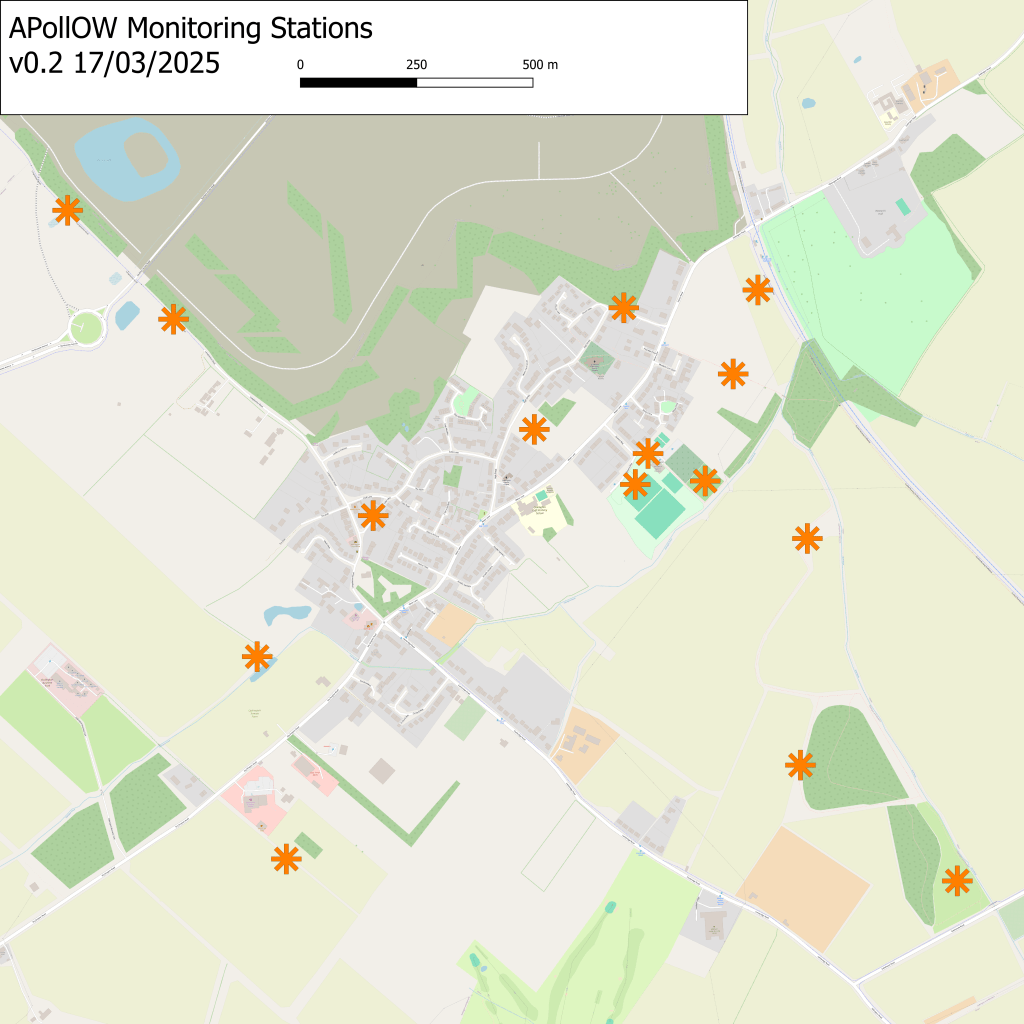
Proposed locations of set recording stations within Oakington. The stars refer to approximate areas, rather than specific points, for example, anywhere along the Longstanton Road verge where ragwort or other flowers are growing would be acceptable. As well as these ‘stations’, we want records from any place of your choice, especially gardens.
FAQS
- Aren’t insects really difficult to identify?
- Some are not, but many are, especially to species level. However, FIT counts are brilliant, in that you only need to be able to recognise the broad groups. So if you can tell the difference between a bumblebee, a honey bee, a hoverfly, any other sort of fly, butterflies and beetles, then you can take part. And even if you can’t, there’s training available….
- Some are not, but many are, especially to species level. However, FIT counts are brilliant, in that you only need to be able to recognise the broad groups. So if you can tell the difference between a bumblebee, a honey bee, a hoverfly, any other sort of fly, butterflies and beetles, then you can take part. And even if you can’t, there’s training available….
- Is there training available?
- Yes, see above!
- There are also these online resources available via UKPoMS
- If there aren’t any pollinators after a minute or so, should I give up? What’s the point of a zero count anyway?
- No! Zero counts are just as useful as any other. Some schemes refer to recorders who go to areas without the target species as ‘zero heroes’, for the very fact that, for a thankless task, it is just as important to record instances where there is nothing, compared to when there are plenty. Remember, it is 15 minutes outside, so it should hopefully still be good for you.
- No! Zero counts are just as useful as any other. Some schemes refer to recorders who go to areas without the target species as ‘zero heroes’, for the very fact that, for a thankless task, it is just as important to record instances where there is nothing, compared to when there are plenty. Remember, it is 15 minutes outside, so it should hopefully still be good for you.
- Why can’t we just pick our own sites?
- You can pick your own sites, but we’d really like volunteers to go to some preset stations. If we relied purely on self-selected sites, we might not be able to tell if changes in pollinator numbers are because there are real changes, or just because of the locations that people choose, which might tend to be ‘the best ones’. There are going to be some sites that we always want to measure, like the orchards, Longstanton Road and field margins of Mansell Farm, so we can get an ‘unbiased’ picture.
- You can pick your own sites, but we’d really like volunteers to go to some preset stations. If we relied purely on self-selected sites, we might not be able to tell if changes in pollinator numbers are because there are real changes, or just because of the locations that people choose, which might tend to be ‘the best ones’. There are going to be some sites that we always want to measure, like the orchards, Longstanton Road and field margins of Mansell Farm, so we can get an ‘unbiased’ picture.
- The stations don’t have any flowers?
- The stations should all have some flowers at certain times of the year, but not all year. The UK PoMS scheme FIT count scheme asks you to target any one of 14 target species. Some of those will only be flowering early in the season, some late. So a station with hawthorn flowers will only be available to sample in April and May. If there are no flowers, go to a different station.
- The stations should all have some flowers at certain times of the year, but not all year. The UK PoMS scheme FIT count scheme asks you to target any one of 14 target species. Some of those will only be flowering early in the season, some late. So a station with hawthorn flowers will only be available to sample in April and May. If there are no flowers, go to a different station.
- Can I propose a station?
- Yes, please. 2025 is something of a pilot study. This year, we will learn how easy it is to conduct the survey, plus fine tune locations and flower combinations. Some might not work, so we will drop them, others may be better. If you’ve got an idea for a public station, we’d like to hear it. Sites should have public access.
- Yes, please. 2025 is something of a pilot study. This year, we will learn how easy it is to conduct the survey, plus fine tune locations and flower combinations. Some might not work, so we will drop them, others may be better. If you’ve got an idea for a public station, we’d like to hear it. Sites should have public access.
- I’m not much good at identifying plants, so how do I know which flower I am supposed to look at?
- Don’t worry – the pre-selected species in UK PoMS are really familiar ones. Even if you don’t know the names, you will probably recognise them. As will any scheme like this, there is some time needed to get to grips with things, but don’t worry, just have a go. By collecting lots of counts, any mistakes you make at the start will quickly ‘come out in the wash. UKPoMS provides lots of resources to help, including this guide.
- Don’t worry – the pre-selected species in UK PoMS are really familiar ones. Even if you don’t know the names, you will probably recognise them. As will any scheme like this, there is some time needed to get to grips with things, but don’t worry, just have a go. By collecting lots of counts, any mistakes you make at the start will quickly ‘come out in the wash. UKPoMS provides lots of resources to help, including this guide.
- Are there any easy ways to measure the 50cm x 50cm quadrat – I don’t have a ruler with me?
- If you know your shoe size, then you can easily convert it into a measure and pace out your quadrat. At size 10.5, I know that my quadrat is 2.5 x 2.5 shoes.
- Or, if you are going to be recording on your phone, how many phone lengths equals 50cm. We are not looking for outright precision here – just make sure your quadrat is about right within the nearest few cm.
- If you are measuring a quadrat vertically, say if you have a vertical face of a hawthorn hedge, then you might need some other method.
How to improve your garden for pollinators
(Tips from Patricia Sadler, Oakington Garden Centre, and James Heywood, Nature Recovery Project.)
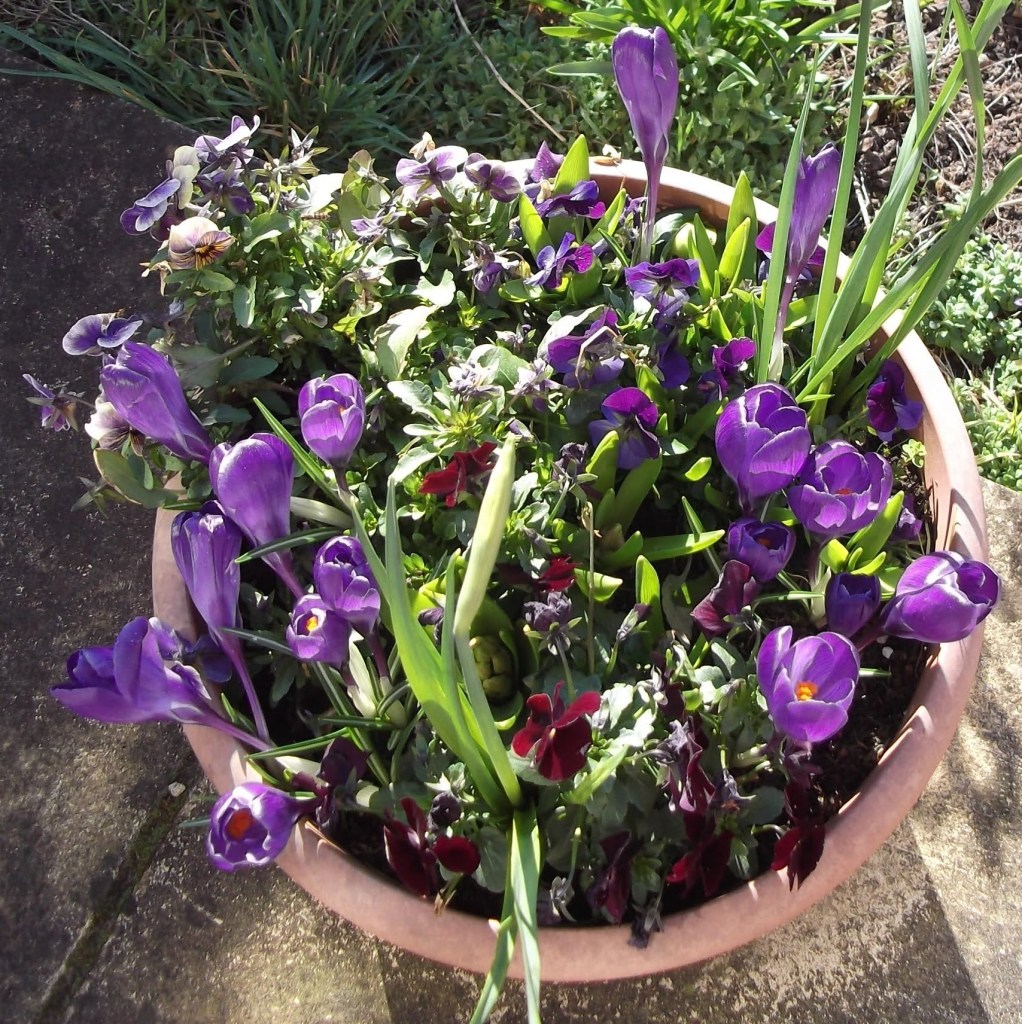
Plan to have something in flower for as much of the year as possible. Eg hellebores, crocuses and muscari early in the year, and ivy, asters, sedums and dahlias to provide late food. Other examples are winter flowering honeysuckle and edworthia.
Don’t tidy up too much. Eg ivy, often the last plant to flower, helps get pollinators through the winter, and yellow brimstone butterflies hibernate in dead ivy leaves. Pristine gardens are no longer fashionable!
Messy gardens help insects with other parts of their lifecycle (which might be much longer than their pollinating, adult stage.) Eg build a log pile or stumpery where larvae can live.
Extend No Mow May to June or August. Meadows are cut in August/September.
Have a bee lawn with low growth flowers such as white clover, and yarrow. Or a bee bank made out of sandy agegate or soil, south facing.
A lot of pollinators need water so a pond will help a lot. Eg hoverflies need water to complete their lifecycle. You can make a “hoverfly lagoon” out of a rotting stump.
If you have a verge beside your property, put signs up to prevent Council contractors from cutting it (and explain to others why it’s being left “weedy”!)
 Sustainable Oakington and Westwick