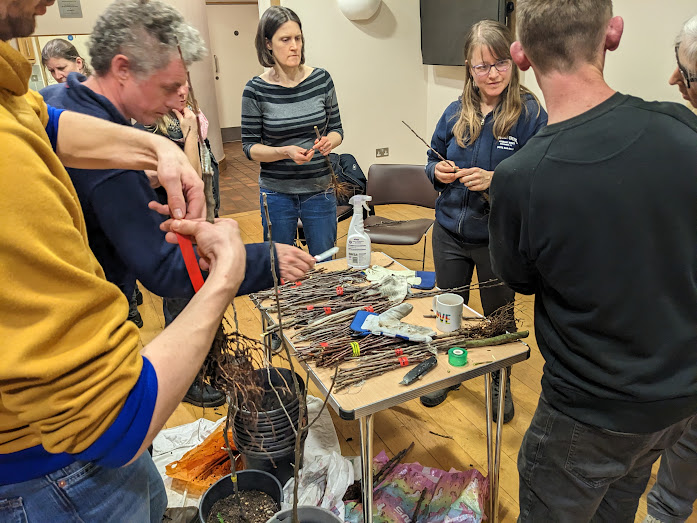
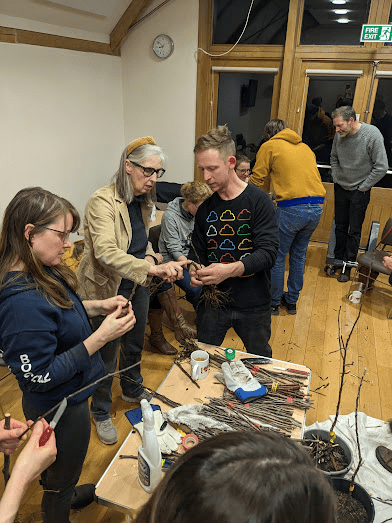
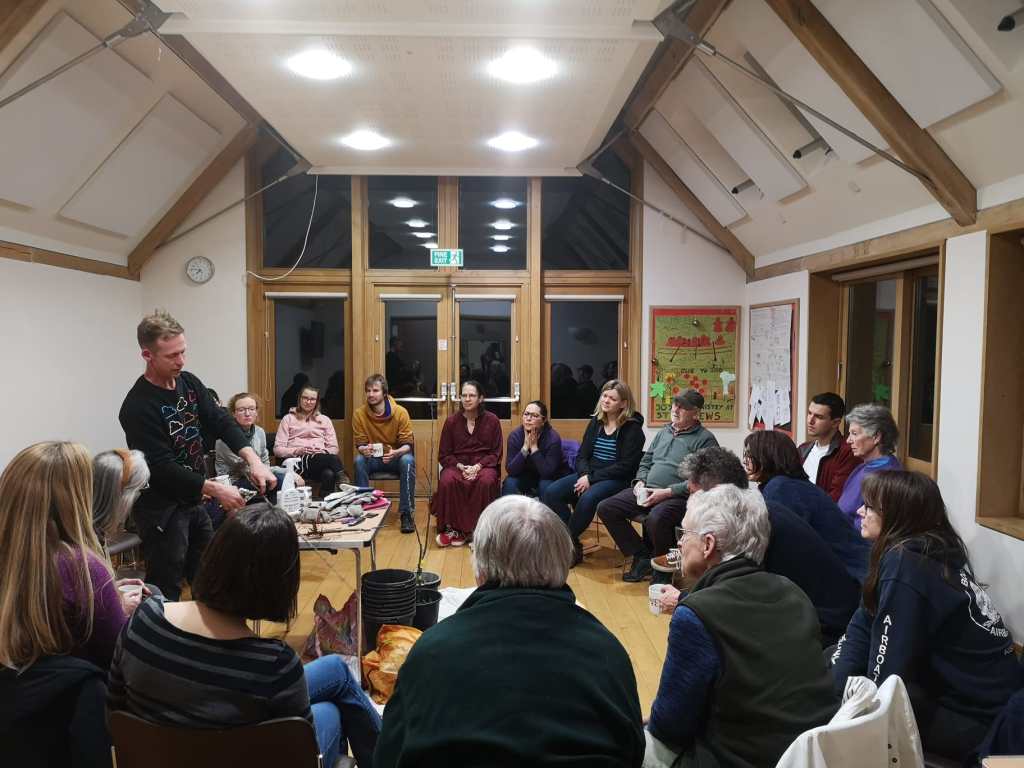
Next SOW meeting: Fruit Tree Grafting Workshop on 22 March
Please note that this meeting and workshop will now be held on Wednesday 22 March (not 29th as previously advertised.)

Please note that this meeting and workshop will now be held on Wednesday 22 March (not 29th as previously advertised.)

Joint SOW/EAG talk on 22/2/23 by Natalie Lambert of Cambridge Nature Network with 17 attendees.
The UK is one of the most nature deprived countries in the world and Cambridgeshire is one of its most nature deprived counties. The Cambridge Nature Network was set up in 2021 to help nature recover and improve access to it.
Clusters of natural habitat have been identified within a 10km area of Cambridge as five Priority Areas, including the chalk grassland of the Gog Magog hills, the River Cam corridor, and the south of Wicken Fen. The aim is to make these areas bigger, better and more joined up.

A further “Opportunity Area”, Fen-edge Orchards & Droves, has been identified to the north of Cambridge (light brown in the map above), and it’s this area we are in – strictly, Westwick is in it and its western boundary is the guided busway but projects in Oakington would be included. (“Opportunity” rather than “priority” because of lack of funding at the time for surveys.) This area could form a stepping stone for wildlife towards the richer nature of the Ouse valley/washes and the Great Fen further north.
Cambridge Nature Network involves farming and other landowners, local planning authorities, businesses, parishes and individuals. It has pressed for nature-supportive policies to be included in the Local Plan, encouraged nature friendly farming, and has secured funding for 25 nature recovery projects. The most local to us was organised by Histon & Impington Green Spaces and included hedge laying and habitat creation such as insect boxes and reptile refuges.
Natalie encouraged us to use the Nature Recovery Toolkit to map the existing quality of habitats in Oakington & Westwick, which can lead into a project to improve them – we could then apply for funding from Cambridge Nature Network. We have decided we will look at this toolkit in the May SOW meeting (31st May).
There were lots of questions and discussions following the talk – here are some of the points raised:
It was suggested that EAG/SOW have a joint stall at the Village Day showing the mapping and inviting participation.

Join SOW and the village Environment Action Group (EAG) for a meeting focussed on local biodiversity. We will be welcoming Natalie Lambert from the Cambridge Nature Network to describe the work of that organisation and what funding and tools might be available.
Wednesday 22 February, 7:30pm at the church hall.
Also at the meeting: seed swap/share – bring along any veg/flower/etc seed you have spare – and the opportunity to order wild flower seed.
SOW talk on 25/1/23 by Paul, Philip and Jim. Here are links to Philip’s slides and Paul’s case study handout. Below are some notes from the talk and the long and far-ranging discussion!
See the slides!

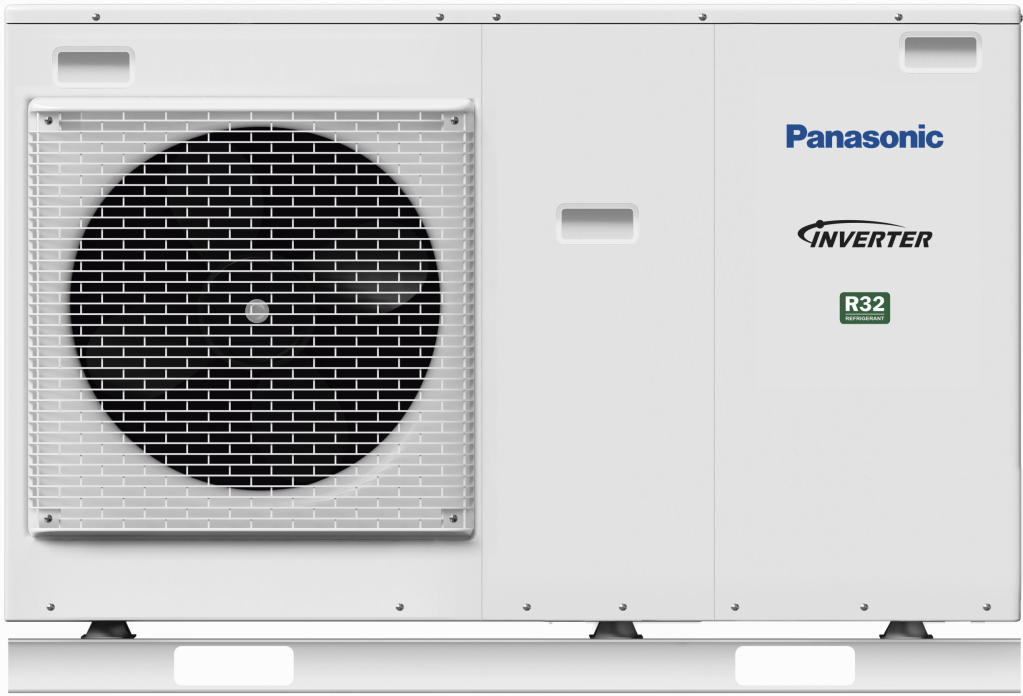
Most other heating systems essentially burn fuel so are less than 100% efficient. A heat pump’s “efficiency” (energy out over electricity in) is almost always more than 100%, ideally at least 300%. Worse for bigger temperature differences, eg. 700% on a hot summer’s day (heating hot water), but 150% on a freezing winter’s day. (It still works if it’s freezing outside – it can still make cold air colder.)
Won’t necessarily save you money – see slides. Currently costs about the same as a modern gas boiler to run. (Note that wood burning – in the chart on the slides – is low carbon but an emitter of polluting particles.)
Insulate and draughtproof first – for Philip’s house this was responsible for 93% of energy savings.
Jim has one of these – uses heat from the soil surrounding a 100m borehole (NOT geothermal energy), instead of heat from the air. More efficient although more expensive than air source pumps (his was £15K 10 years ago. There is a £6K grant) and better when it’s cold. (Although new air source heat pumps may be on a par with ground source.) Jim’s unit is about the size of a large fridge freezer.
Underfloor heating goes well with heat pumps because it’s effective at lower temperatures. But big radiators can heat well at 35º-45º. If have decent modern radiators they may not need changing. You can get tall upright radiators.
You can hear the compressor when it’s working slowly, but mostly the fan is the loudest part. The fan is a constant low white noise. Next to a hard surface will be noisier, and noisiest in winter (when windows tend to be closed.) Best sited away from bedrooms.
Paul currently getting a lot of noise (rattly from the compressor, so needs looking at) – it’s near bedrooms and echoes off a brick wall. Philip: it depends. From 4m away, his is overpowered by road traffic noise.
Where to locate beside house – ideally a sunny position, but needs to be next to tanks/relevant plumbing inside. If it’s in front of the house and visible from the road, need planning application.
Cost about £10K to install. A government grant of £5K is available if you get rid of your gas boiler. Octopus are installing heat pumps cheaply by picking the easiest properties. NB heat pumps are more expensive than gas boilers (£1.5K) but are designed to last 20 years instead of 10-15. We are at an inflection point, like there was with electric cars – costs will come down over the next few years.
Paul: don’t do things just because a grant is available – you might end up paying more.
Shortage of well trained competent installers. Paul: Recommend someone who has been on a Heat Geek training course, not just a gas plumber who’s been on a two-day course. (Closest such installer is in Bedford.) Philip: do a lot of research, best if you know as much as they do.
The air “used” is not polluted, just cooled. The electricity, if non-renewable, is polluting. Older heat pumps use a fluid which is a greenhouse gas much more potent than carbon dioxide if it escapes.
Air source heat pumps can in theory run backwards but not recommended because condensation would cause problems. Some new ones may be purpose built to cool as well as heat.
Freezing fog would cause ice to form where the air source heat pump blows cold air, but they are designed to reverse cycle or have a small heater to prevent this. But performance drops as you get within a few degrees of zero. NB Scandinavia has lots of heat pumps but winters are dryer as well as colder there.
Too big – inefficient. Too small – can’t heat well enough when it’s cold.
Philip: a slightly bigger heat pump would heat up faster and might possibly be less noisy? Paul: never oversize!
You could intentionally undersize and accept that you would need extra electric heaters to top up in the coldest weather – this approach is taken in Scandinavia. (Paul showed us some infra-red heating wallpaper!)
This is when you install a small air source heat pump to run alongside the existing gas boiler, to take over the heating needs for the majority of the year. Then over the years you can insulate, improve glazing etc until the heat pump can cope on its own.
Philip: no (especially now battery costs have gone up) – store excess heat in the floor mass. Get insulation first!
Paul: yes – use a timed tariff to charge them with cheap, low-carbon overnight electricity in winter. Even without very good insulation, because heat pumps are so efficient.
Octopus have a heat pump time-of-use tariff, and others will follow suit.

Heat pumps are a low-carbon alternative to gas boilers, but are a new and unfamiliar technology to a lot of us. Come to the SOW talk on Wednesday 25th January to find out more about air source and ground source heat pumps from three village residents who have installed them.
Hear how they work – what to consider before getting one – what the advantages and disadvantages are – where to start if you want to install one.
7:30pm at the church hall, Wednesday 25th January, all welcome, just turn up.

Boost Biodiversity, with or without the kids!
Kate began by showing us the introduction from Dave Goulson’s book, “Silent Earth” (full talk available on YouTube and book on Audible.)
In the UK, we have lost 97% of our flower-rich grassland over the last 100 years, mostly due to monoculture farming, and with pesticides in the mix, insects are in serious decline. Being at the bottom of the food chain, we need to help EVERYTHING connected to insects to mitigate collapsing populations of wildlife.
Here are some simple ideas, most of which are nice little projects that you could do with children (or not!):
The debate about native vs non-native persists… just be aware of what you buy to plant. In particular, a huge proportion of plants in garden centres that claim to be bee friendly, are actually laced with pesticides! D Goulson recommends seeds from Emorsgate. As a group we may be buying some in bulk to save £. More to follow on that.
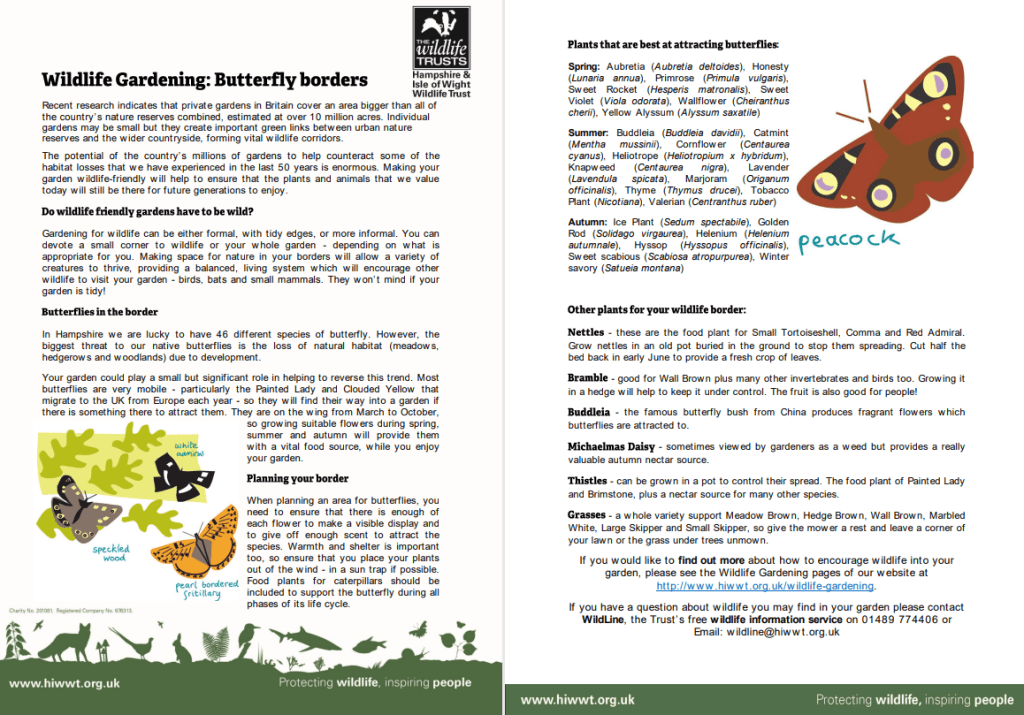
They were scarce this summer
. Here’s a list of what to plant to encourage butterflies.

There are LOT of ideas online and kids can get really creative with these. (I have an old bookcase I my garden stuffed with bug-friendly things!) Put them in a damp, shady spot.
Drilling holes into a log is simple! 2-10mm wide, 2cm apart, 7-15cm deep. Place it in the sun, keep it dry and at eye-level. Using natural stems is nice too – see the Wildlife Trusts website.
These beauties are endangered. Build them a simple log pile! See People’s Trust for Endangered Species page or this video.
Can roam up to 2km a night! Put a hole in your fence 13 x 13cm. Make (or buy) a house for them out of solid material, not sticks/willow (they can get stuck in those).

If you are swimming, use reef-safe suncream. Avoid putting pollutants in water that kill fish and other wildlife – use eco washing liquid etc.
Flea treatments for dogs (and cats) are a neonicotinoid insecticide – 1 dose kills 60,000,000 honey bees! – avoid prophylactic treatment and waterways after treatment.
Where there’s water, there’s life! Even a tiny pond will bring wildlife to you. (I think this needs to be another talk on it’s own… )
How to build a hibernaculum.
This can be a life-saver. A shallow dish with pebbles in is also great for insects.
They should be controlled (and they taste good!) Grey squirrel, muntjac deer, signal crayfish (we have LOTS of these in the brook
), for example, are all damaging to native wildlife.
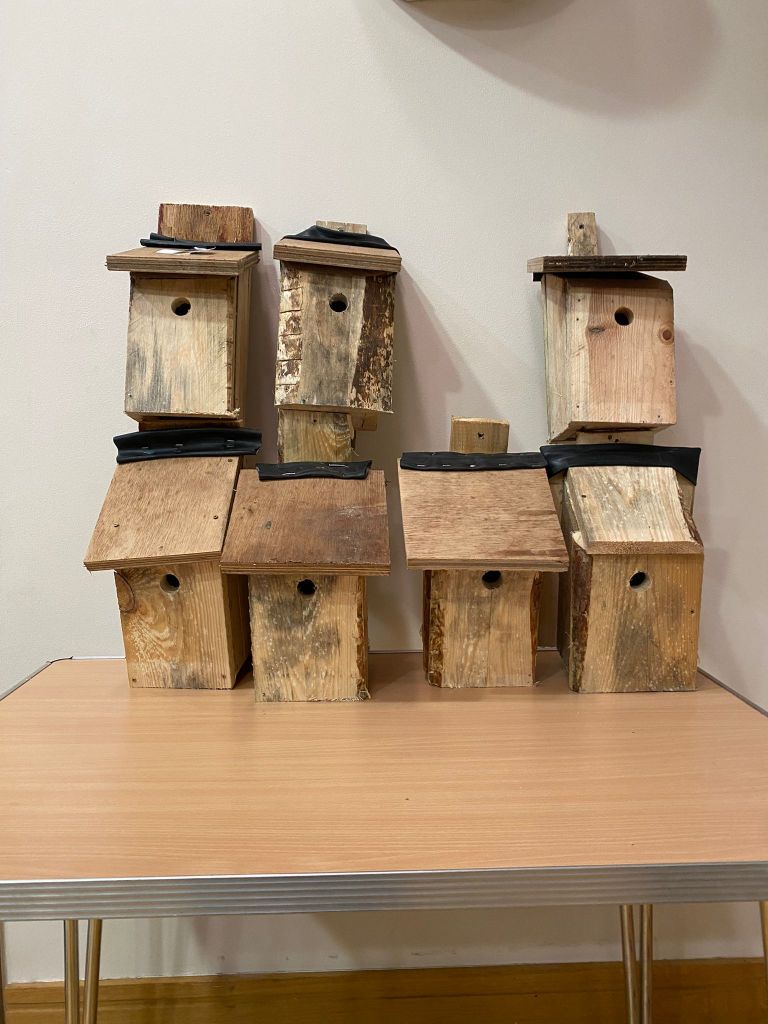
Feed them and give them somewhere to live!
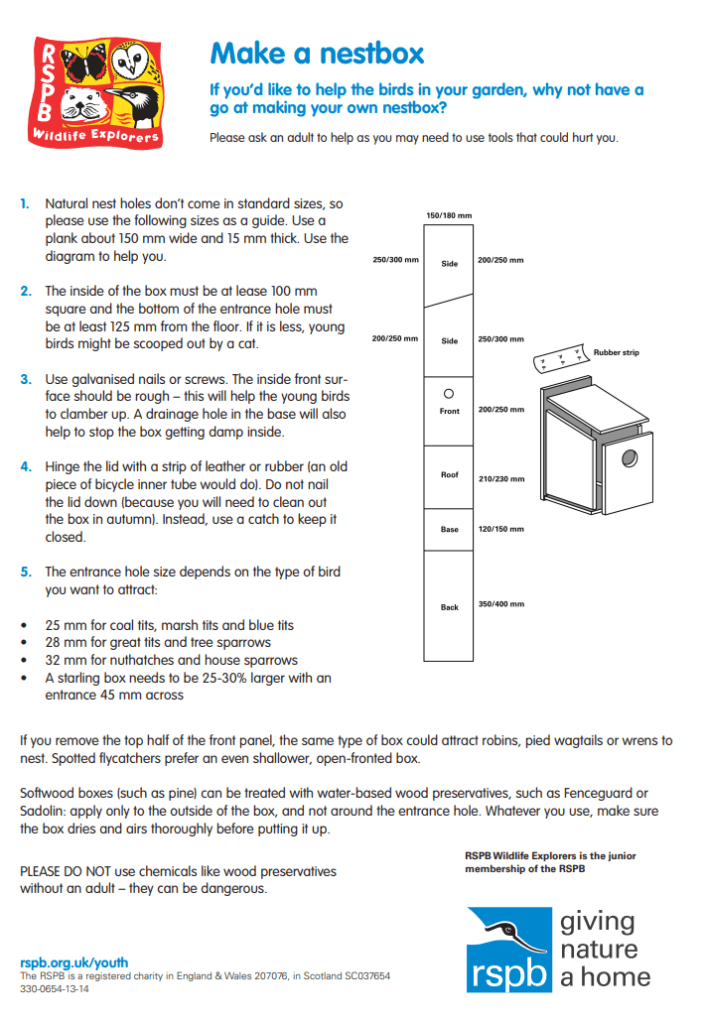
There are countless templates online for boxes, so lots of fun can be had with that. Put your box about 2m high, facing N or E. More information on the BTO site.
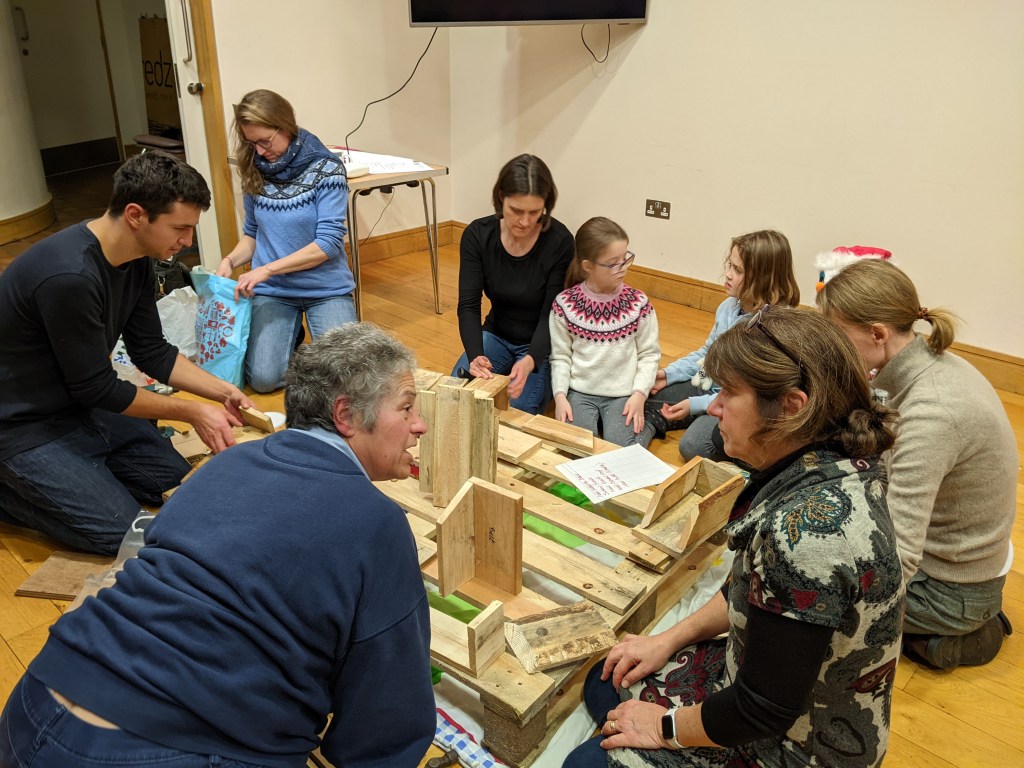
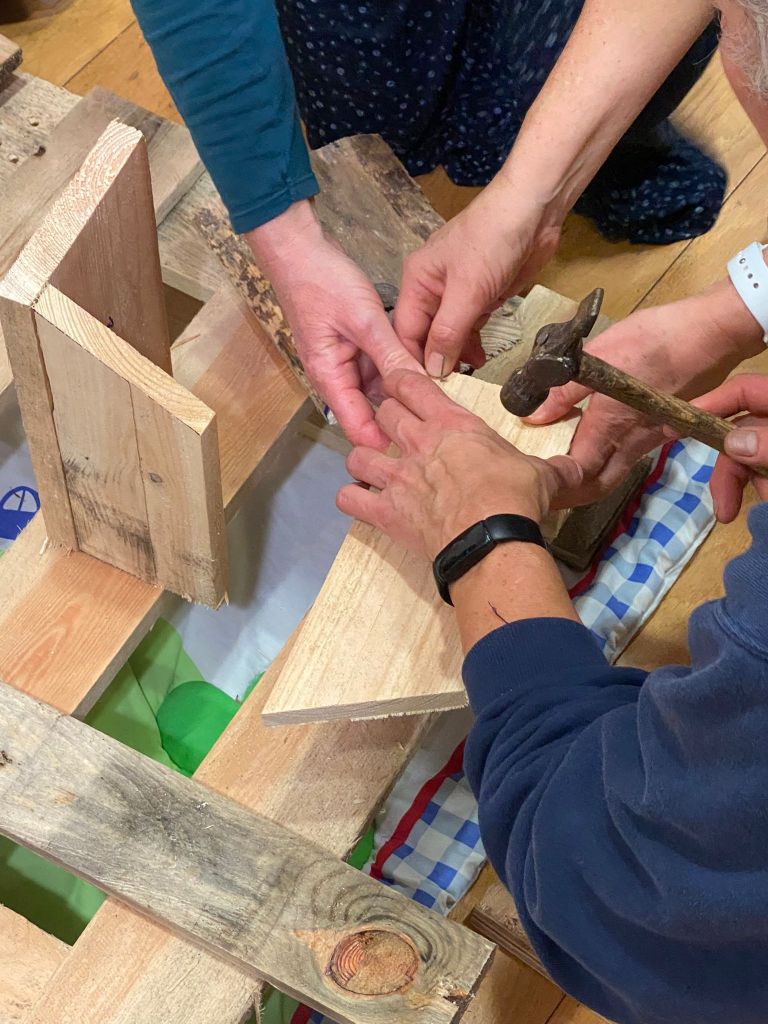
We had fun making some in the session, re-using pallet wood (pre-cut by Kate!)

Boost biodiversity, with or without the kids!
Watch bird-box and bee-hotel building demonstrations, with templates to take home and make your own. Plus videos and discussion on what we can do to boost biodiversity – bring your ideas, questions and tips! (And kids!)
Wednesday 30th November, 7:30pm, St Andrew’s Church Hall, Oakington
Talk by Paul Kershaw and Philip Garsed about Retrofitting Eco Homes, 25th October 2022
Both Paul’s and Philip’s homes featured in this year’s Cambridge Eco Homes tours.
There are various paths to achieving an “eco home” – new-build or (in his and Philip’s case) retrofit, all at once or in stages. There are also various standards (eg Passivhaus, Enerphit Standard).
The two core principles of energy efficiency are insulation and ventilation. Helpful tools include the EPC certificate (not especially good), a thermal camera, an airtightness test, using an incense stick to detect draughts, existing energy bills and your own experience of living in a property.
Paul’s retrofitting project had as its aims: considered quality of living design, eco-friendly products, and energy efficiency. He explained how, by having an overall plan drawn up, he was able to take advantage of grants and trials when they arose. Considered quality of living design includes such aspects as wider doorways, ergonomic design, assisted bathing facilities by design not a bolted-on eyesore, and air quality through ventilation and lower VOCs. Eco-friendly materials included natural materials such as marmoleum flooring Materials were reused where possible. There is provision for a future grey water system; for the present, water-saving shower and taps. The gas (“methane”) supply has been cut off along with the standing charge!

There were some eco-friendly compromises which had to be made. Clay plaster was prohibitively expensive but clay paint has some of its advantages. A sedum carpet can form a green roof without having to structurally alter an existing flat roof. There are pros and cons to internal and external wall insulation and different materials for the latter. Cork was chosen for the rear but more visually appealing woodfibre boards and scotlarch cladding for the front.
Ventilation is necessary once a house is sufficiently air-tight to prevent a build-up of moisture, and options range from “natural” ventilation (windows and doors) through passive stack (chimney flue via fire heat or wind), mechanical ventilation and mechanical ventilation with heat recovery (MVHR).
Paul’s key pointers: educate yourself, plan, and stand firm to your ideals.
Philip says he is often asked what the payback time on his house improvements will be, but that question ignores the very tangible benefits of living in a much more comfortable house in the meantime. Eco-houses are comfortable: super insulation, air tightness and MVHR result in stable temperatures, constant humidity, fresh air and quiet homes.

What makes us feel cold? Draughts, cold feet, colder surfaces (eg windows), changes in temperature as we move from one room to another. An eco-home does not have these, so can feel warmer than the actual temperature. Plus they are cool in summer.
Homes which are too dry or too damp are bad for health – the optimum humidity is 40-60%, which the MVHR maintains. Other benefits are being able to dry washing indoors, cook without steam, no bathroom mould, and a nicer living environment.
A lot of discussion followed. One question was about steps you can take if you are not able to launch into a full retrofit. LED lights and, when replacing appliances, choosing ones with good energy ratings. There was debate about the merits of battery storage. On the one hand, they make solar panels more worthwhile because stored solar energy can be used at times of the day when electricity is expensive (time-of-use tariffs will become normal.) On the other, in summer you can’t use all you store and in winter you can’t make enough.
Talk by Ann Mitchell of Cambridge Sustainable Food on 28th September 2022
Key messages: our choices make a difference, and so does asking sellers about food.
Food’s environmental sustainability fits in the broader picture of health and fairness, and includes: carbon footprint, land use (& biodiversity), soil (1/3 of our arable land is degraded), animal welfare and working conditions.
We import at least 50% of our food. Food waste – up to 30% of the food produced globally is wasted. A lot of waste caused because we expect well-stocked supermarkets. The world does produce enough to feeds its population but it’s not fairly distributed. 8.8% of UK households suffered food insecurity (Jan 22). Obesity in the UK has doubled in the last 20 years.
Impact of our food choices. Not straightforward. Ann used the example of plant-based milk. 1 pint of cow’s milk results in 1.9kg of greenhouse gas emissions, plus concerns about animal welfare in the huge dairy industry. 1 pint soya milk causes 0.5kg, 1 pint oatmilk 0.5kg, 1 pint almond milk only 0.3kg, BUT almonds have become a huge monoculture in California, using precious water resources and requiring imported bees. Soya milk concerns are that the soya is grown in Europe, not on land cleared from rainforest. Oatmilk sludge can be eaten by local pigs but is instead sent to an anaerobic digester to keep the oatmilk completely vegan.
Lots of variation in carbon footprint. A lot of land is used to grow animal feed. Beef reared in the UK has a lower carbon footprint than some beef reared elsewhere, because mainly grass fed.

Where to get protein from? Lab grown meat is coming but not commercially viable yet. Mealworms are a low-impact source of protein and can supplement the diet of animals including in pet food. Wild meat (venison, rabbit, muntjac) from animals that have to be culled anyway (because we don’t have top predators roaming about) is another option. Ann brought examples of vegan alternatives: tinned beans (no soaking required), dried lentils and split peas of various types (ditto) – Hodmedod is a Suffolk grower of dried beans and peas; mushroom also contains protein and chopped up resembles mince; brocolli. Meat intake can be reduced by mixing minced meat and one of these alternatives in dishes like bolognese, shepherd’s pie.
Miscellaneous: British tomatoes in March/April (hothouse-grown) are at least as bad as green beans flown in from Ethiopia. Rice grown in paddy fields has a high carbon footprint, wild rice eg from Italy grown differently is better.
Tips for a Sustainable Diet
Recommendations: “Food and Climate Change without the Hot Air” by S.L. Bridle – free to download. Updated edition of “How Bad are Bananas” by Mile Berners-Lee. For website recommendations see below.
There will be a climate diet festival in Cambridge 15-22 October: Festival programme — Cambridge Sustainable Food
Useful web site links to find out more
Feeding Britain | Sustainable Food Trust
The most damaging farm products? Organic, pasture-fed beef and lamb | Food | The Guardian
Climate change: Do I need to stop eating meat? – BBC News
The simple formula to cut your diet’s carbon footprint – BBC Food
Useful web sites for tips, suggestions and recipes
Veganuary 2023 | Home | The Go Vegan 31 Day Challenge