
Foraging
Notes from a talk given at SOW on 21 May 2025.
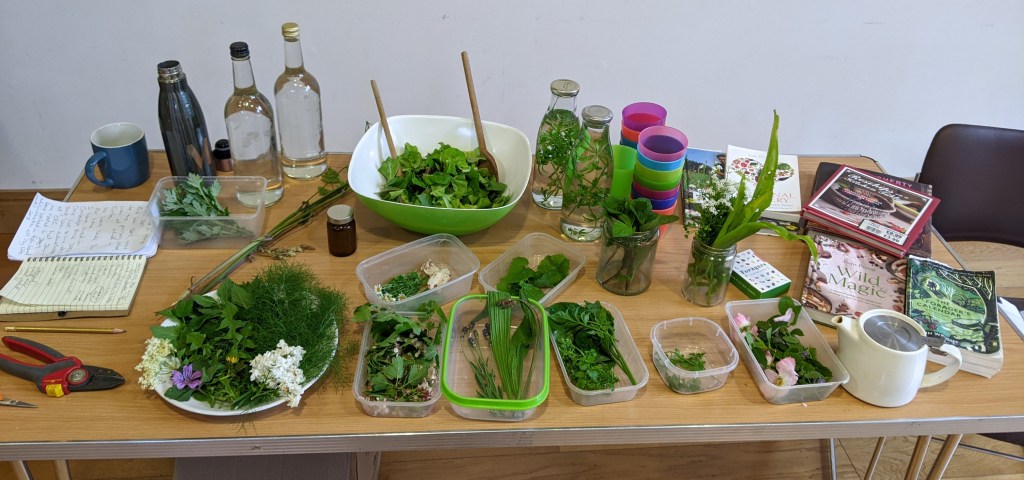
Miria explained that learning about foraging had been a lockdown project, something to do with her son out of doors. An extension of her interest in gardening, gardens and being a qualified aromatherapist. Various useful books came her way; she particularly recommends The Forager’s Calendar by John Wright.
Principles
Foraging can be seen as part of a wider approach to life. It’s about connecting to the land (and we’re all custodians of the land), to nature and to the old ways. It’s a truly seasonal activity, and one that is as old as time. Wild food is “more than organic.”
It’s practical and easy – you don’t have to go out into the wilderness, start in your own garden. And it’s natural and normal – not a new fad or something exotic.
Foraging includes fruit, flowers, foliage and fungi. Once everything we needed to live came from nature, including cleaning, fuels, decoration, medicines and more. The talk focused on food and drink, but foraging can also be for tonics, for example.
Tips
- You have to decide: What do you like, what do you need, what do you have time for and what can you cope with? For example, Miria currently draws the line at roadkill, mushrooms, ants and snails. (Paul said he’d once eaten citrus ants, in South America!) She also avoids anything like celery or parsley, because of the danger of confusion with hemlock, which is very poisonous.
- You have to actually use what you pick! And you might only end up with a small amount you can actually eat of some things.
- Have a wishlist – both things that are easy to find/identify and longer term desires. Learn in advance what things you seek look like, so that you recognise them at the “moment of abundance.”
- Avoid the “dog pee zone” (eg pineappleweed is delicious but often in this zone)
- Use a good (OS?) map, stick to paths, avoid cliff edges!
- If on the side of a road – consider how busy the road is, how low down
- Kit: long trousers, maybe wellies; scissors, secateurs, Swiss Army knife; plastic bags and boxes. Remember though that often you make your most significant finds when you aren’t expecting them and don’t have these with you!
Laws & codes
The countryside code says leave only footprints, take only litter. So this is modified by the foragers’ code and which includes some of the following.
- Take only what you need for your own personal use. (Foragers often won’t tell others where they found things.)
- Only pick something you’re 100% sure you’ve identified correctly
- Harvest only in abundant areas (which does depend on the season and weather)
- Don’t trample on other plants to get to the one you want
- Must have permission from landowner when relevant
- You may only take wild food; scrumping apples from a farm doesn’t count as foraging!
- Never carry a lockable blade or fixed knife – a small Swiss army knife is legal as it is under 3 inches and does not lock.
- It’s not food for free – there is no such thing. We need to give gratitude by treading lightly on the earth; eg composting, donating to nature charities
- Murphy’s Law – if you go looking for something you probably won’t find it!
Examples
Some of the foraged foods mentioned were:
- Jelly ear and scarlet elf cap – distinctive, identifiable edible fungi
- Dewberry – like a grey-blue blackberry, taste OK, but hard to pick enough
- Seaweed – but there are complexities
- Nettles – Miria hasn’t tried, but nettle soup is popular
- Wild garlic – one of the most rewarding and popular but (so far!) hard to find in quantity in Cambridgeshire
- Fat hen and marjoram are often found in the garden.
Miria’s top targets for foraging are: garlic mustard, ground ivy, three-cornered leek, wild garlic, and chickweed.

Tasting!
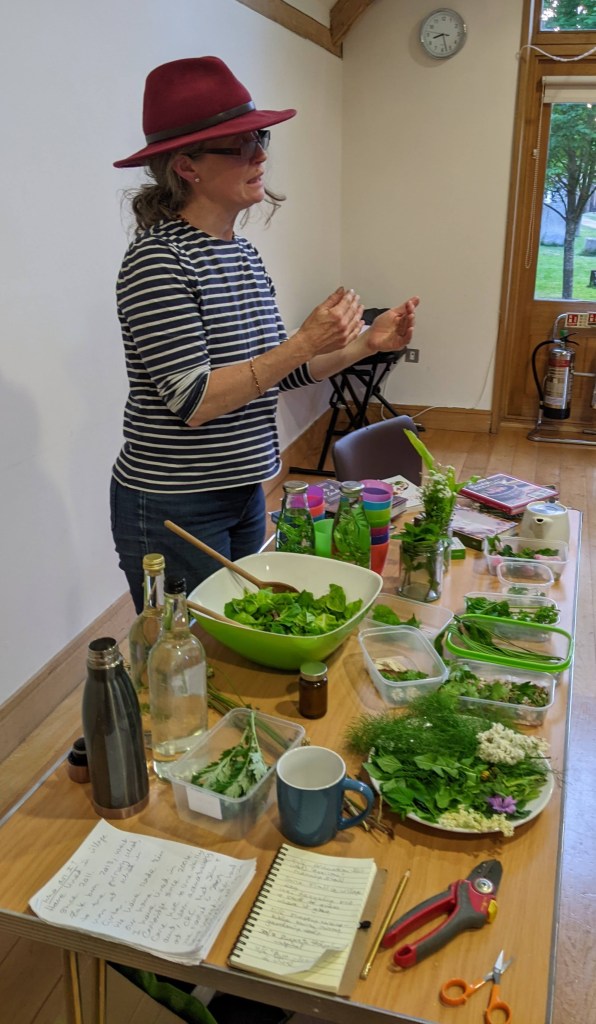
Miria had brought many examples, all but one from around the village and two-thirds from her own garden; including garlic mustard (aka Jack-in-the-hedge), dandelion, lilac flowers, mallow, feverfew, hawthorn (leaves and flowers), magnolia petals, chickweed, sweet woodruff, fennel, lemon balm, elder, dog rose, water mint and lavender. We sampled a lot of thes
We tried spring water with goosegrass (cleavers) steeped in it, and hawthorn flower tea.
She had made a salad which included some of these ingredients – salads are one of her favourite ways to use foraged food. Tear the leaves for a salad rather than using metal implements.
 Sustainable Oakington and Westwick
Nettle tea is ok, you make it like mint tea and using nettles in a quiche instead of spinach is good, you can eat the raw leaves as well if you are careful but they are a bit stringy. You need to pick new growth, just the top 2 or 4 leaves when they are fresh and pale green. Usually there are plenty down in the recreation orchard early in the year. I have cut them down now (sorry, but they were past their best).
Regards Graham
LikeLike