
Notes from the Sharpening Workshop
If you would like to borrow the SOW sharpening equipment, please email SOW (sustainableow@gmail.com) or put a message on the WhatsApp group.
Nikki who sharpens at Repair Cafes, including ours, led a workshop on 25 June. The focus was on sharpening unserrated blades.
SOW has used some of the surplus from the Repair Cafe to buy the tools asterisked below to share around the group (better for the environment and everyone’s wallets!)
How to tell if a blade is sharp
It’ll have no dinks and divots, and be very thin. It will catch at your fingernail stroked across the blade. Note that secateurs usually have a blade only on one side.
Kitchen knives and scissors
Foil – cutting through aluminium foil with scissors will sharpen them a bit – this trick works with pinking shears (serrated scissors) too.
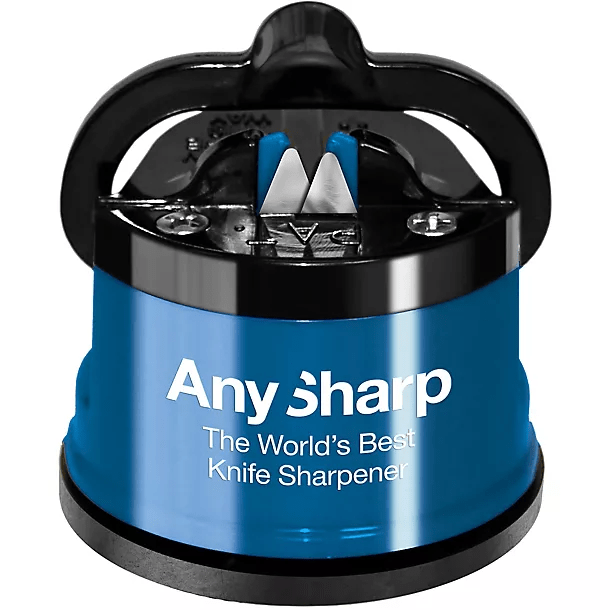
Anysharp – there are lots of kitchen knife sharpeners but this is the only brand/type Nikki has found that works. (Available from Lakeland.) You just pull the knife through. It will maintain an already mostly sharp knife but won’t rescue a blunt one.
For the rest of the sharpening tools you need to get the angle right: always sharpen at an angle of 22.5 degrees (half and half again a right angle). HOWEVER: consistency is more important than accuracy. Keep the angle the same. Pull/push the knife away from you, for safety. (Note: You will find sharper and blunter portions along a blade.)
If you want sharpening tools to last, use them wet.
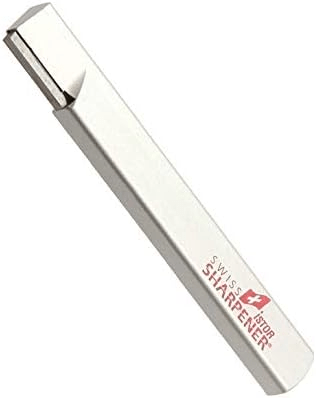
Swiss sharpener* – will work better on slightly blunter knives and on scissors, to knock off burrs.
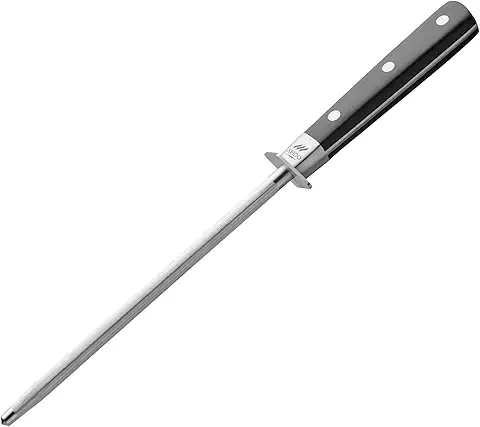
Kitchen steel – works well if you can get the angle right.
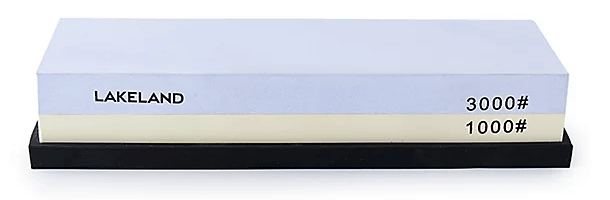
Sharpening stone (whetstone)* – Must soak in water first – won’t work if not wet. The numbers refer to the grit (like sandpaper) – the higher the number the finer the grit. Start with the coarser side. (Use the rubber foot to hold it to the table, and an old tea-towel to mop up splashes!) Push the knife along the stone – doesn’t need to be fast, but apply gentle pressure.
Care of knives
Kitchen knives – use a wooden or plastic chopping board (not glass, not a plate) and use the back of the knife to scrape pieces off the board.
Sheath knife – oil it before putting it away (wipe with a little sunflower or rapeseed oil on a kitchen towel.) Then it should stay sharp while stored.
Garden tools and draw knives
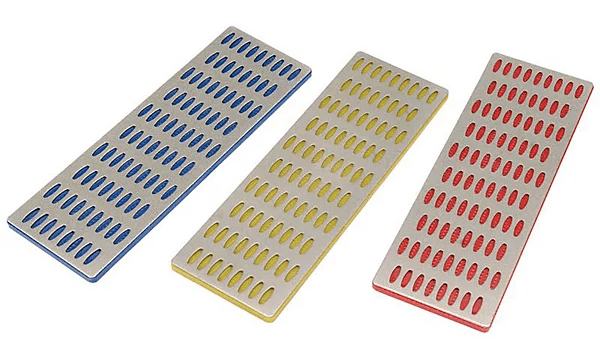
Diamond sharpeners* – Nikki’s mainstay at Repair Cafes. Wet first (they will work dry but won’t last as long.) They have grit numbers on the back, 150, 300, 400 – start with lowest and work up – when you see a silver edge on your blade you can go up from the lowest.
You can take secateurs apart to sharpen them (carefully keeping track of screws!). One or both sides of the cutting edge may be bevelled. Sharpen the bevelled edge first, then draw the tool flat across the flat edge to remove burrs.
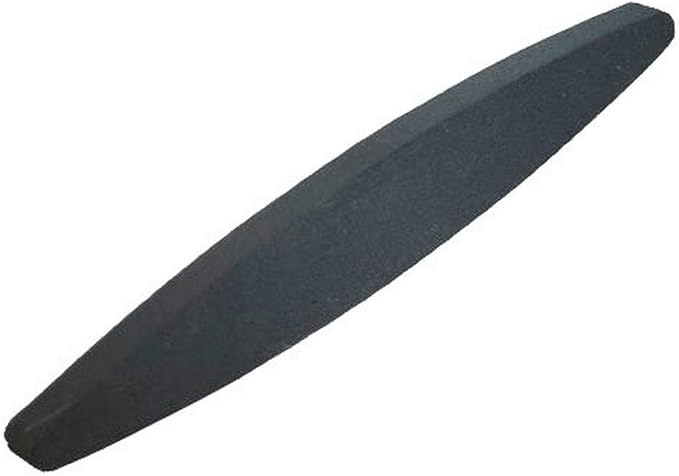
Boatstone – curved, very coarse stone, better for curved blades like lawnmower blades.
Care of gardening tools
Wipe off any plant material, dirt or moisture with a clean dry rag before storing in a dry place.
 Sustainable Oakington and Westwick