
Farming and Wildlife Walk
Led by John Terry, 31 July. Here are John’s notes for any who missed the walk or who would like a recap!
1. Introduction at Church Hall. You may be aware that the UK Government produce a ‘State of Nature‘ report every few years and the most recent describes a significant reduction in species abundance ( 41% ) and one of the main reasons is intensive agriculture. Over 70% of the UK if farmed or forested so the industry is significant in land use but only employs 300,000 workers including farmers. Most of the land we plan to walk on is farmed by Peter Freeman, who rents the land from the County Council. He obviously farms to sustain a living for his family, he is interested in wildlife and is also influenced by the County Estates, who are keen that their tenants farm in a sustainable way. Farming is a way of life but also a business, and the Government also grant aid sustainable approaches. The very wet winter and spring has meant that some fields were not cropped this year, which of course will not help economic performance.
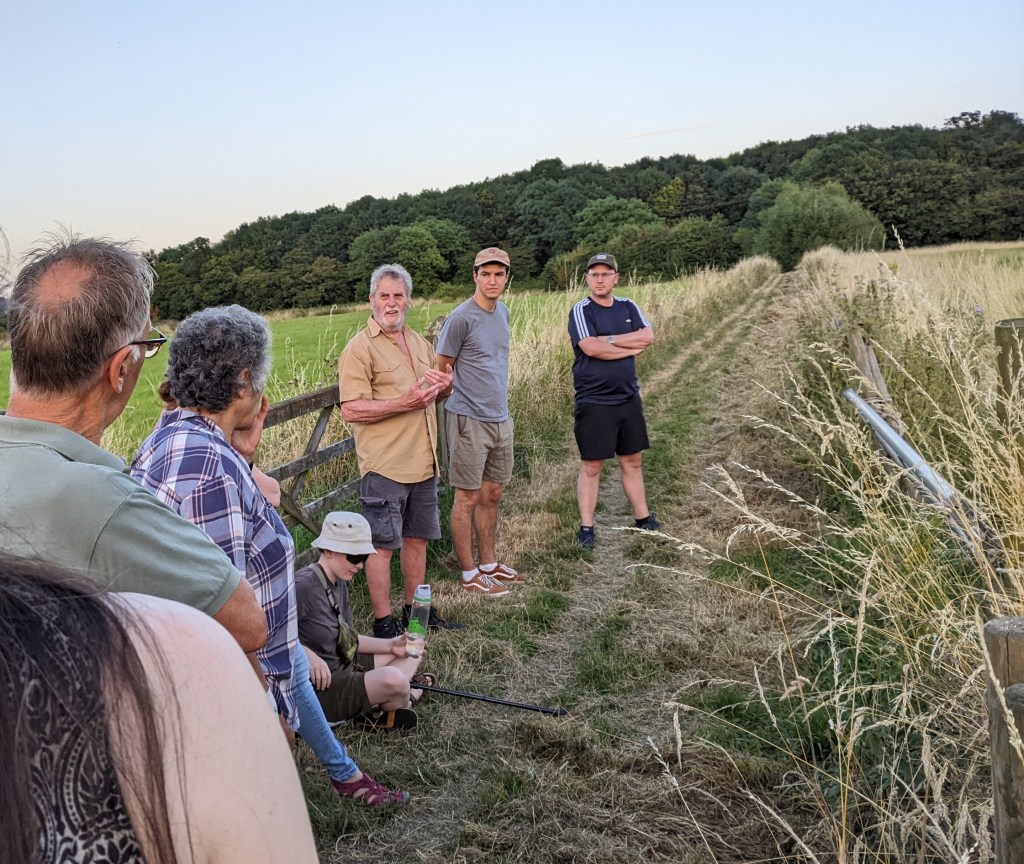
2. Ridge and Furrow land used for sheep grazing. Ridge and Furrow was used in the middle ages especially in the north and especially on heavy soil as part of the open field or strip system. Each strip was farmed by one family and the aim was to have a ridge which was well drained in wet conditions and a furrow which stayed moist in dry conditions. It was created by ploughing one way so the ridge built up over years. It was said that wheat did well in the furrow and peas and dredge (spring barley and oats) grew well in the ridge, i.e. a sort of insurance scheme. Much of ridge and furrow disappeared with the enclosures, and was ploughed out especially during the second World War but where the land was laid down to grass, it was sometimes retained, as here and at Westwick.
3. The concrete bridge carries water from Girton and Oakington, and from Histon a few yards downstream on its way to Rampton, Denver and beyond. This is where water vole was recorded some ten years ago and near to where Kate Spink spotted them this spring. As she explained in the recent Journal article, Water voles are classified as endangered, mainly because of heavy predation by American mink.
4. Mansell Wood. This wood was planted in 1990 by Cambridgeshire County Estates with oak, wild cherry, hazel and hawthorn being the main species. The one and a half- acre wood was thinned/managed about 10 years later but is probably due further thinning because of the lack of light reaching the ground, reducing growth at ground level.
5. A wooden bridge takes us over the Histon Brook. This is buffered by a wide grass margin to keep fertilizer and pesticides out of the water. Unfortunately, many water courses are not well buffered and as a result they can be polluted by nitrates, phosphates and pesticides. The water companies are not the only polluters. Meadowsweet grows well here where the soil is damp.
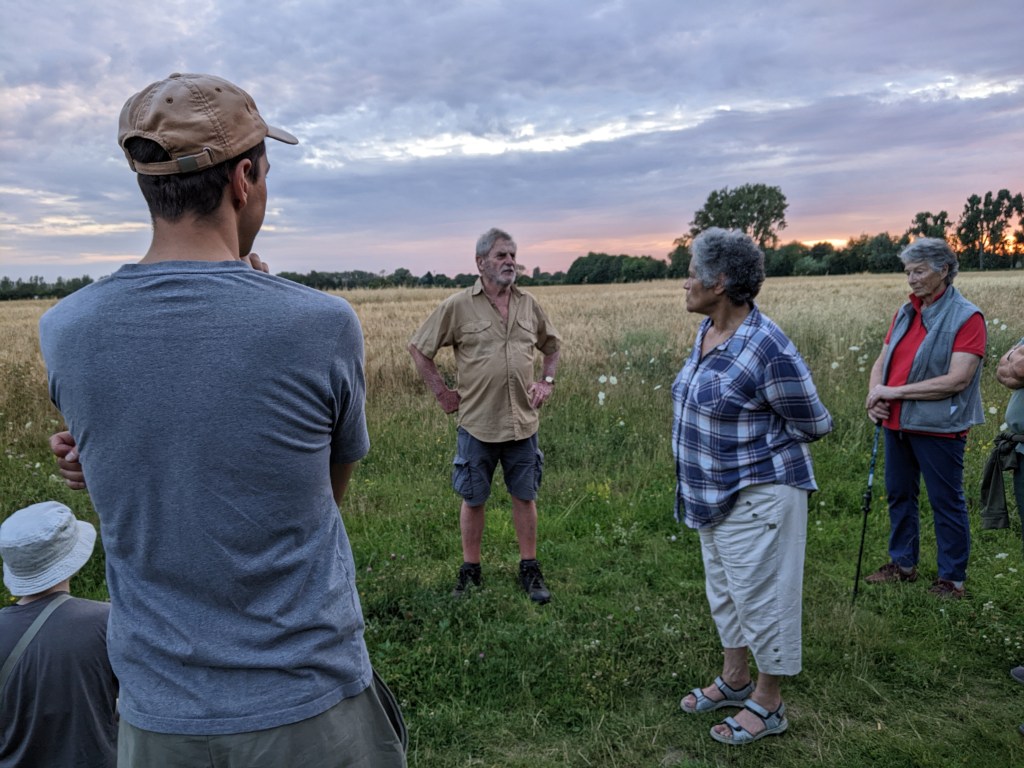
6. The arable fields. Many arable fields today are still wildlife deserts. They are sprayed with weedkillers, fungicides and insecticides to keep crop pests at bay to allow crops to grow close to their potential. Weedkillers kill weeds, some of which are important sources of food for birds and small mammals. Fungicides are relatively harmless but if they drift to neighbouring trees, they can damage lichens (fungus/bacteria). Fertilisers encourage dense crops and high yields. There is growing evidence that artificial fertilisers and pesticides do harm to soil invertebrates and fungi. All these imputs are very expensive so farmers use them more sparingly and in a very targeted way. In the fifties, many farms, especially smaller holdings were mixed farms with both arable and grass with livestock and arable crops followed well manured grass. Consultants the started to advise a more specialized approach with arable holdings tending to be in the drier east and more livestock specialization occurring in the wetter west. Arable farmers tended to grow winter sown crops, especially wheat which tended to be more profitable because they yield more, and a big national increase in winter crops over the last three decades has reduced numbers of some farmland birds, especially corn bunting, tree sparrow and linnet, all seed eaters. Peter Freeman grows a mix of winter and spring sown crops This is better for wildlife and allows a spread of workload. Skylark cannot easily nest in winter crops because they are too tall and dense by May, so prefer spring crops. Spring crops also allow overwintered stubble from the previous year, where a number of birds and small mammals benefit from weeds, seeds and cover. Peter grows winter wheat, spring barley and spring beans as well as special crops for birds. He also grows grass for cattle and sheep, so he continues as a mixed farmer.
7. The headlands around these fields are composed of grass margins and hedges. Given the fact that arable fields tend to discourage wildlife, these are vital for biodiversity. The tussocky grass and wild flowers in these margins encourage invertebrates such as spiders and beetles (ground and rove beetles), which in turn encourage birds to feed. These areas are also ideal for the breeding of grey partridge, yellow hammers and whitethroats. The plants in this headland area include vetch, cranesbill, musk mallow and knapweed. Where small mammals nest and live in grass margins, barn owls will hunt. Brown hares graze cereal leaves during the spring and summer, but when the crop is close to harvest, hares depend on grass in the field margins. Beetles, spiders and hoverflies in grass margins and beetle banks across fields predate aphid so farmers have reduced insecticide use in the last two decades.

8. The hedge. Hedges were largely developed in the 17th and 18th Centuries, when strip farming and common land were replaced by Enclosures (voted in by landowners who held parliamentary power in the Lords). Hedges were designed to mark boundaries of land ownership and to keep livestock in. Additionally, they are now recognized as important wildlife habitats and corridors, they can assist in flood protection and help store carbon. Wildlife have three key requirements: areas which offer protection from predators and weather, for feeding and for reproduction. Hedgerows provide all three. Hedgerows can also supply timber for man for firewood, thatching spurs and hurdles. This hedge contains a wide range of species including hawthorn, blackthorn, hazel, wayfaring tree, spindle, privet wild rose, Guelder rose and unusually laburnum. The more species, the wider range of wildlife is encouraged. Hedge plants provide flowers, berries and fruit, so attract birds, small mammals, butterflies and moths as well as many other invertebrates. Caterpillars attract birds and wasps; birds and small mammals nest in hedges, and the grassy areas at the hedge base are important nesting places birds. Hedgerow cutting should not endanger nesting birds, so should be avoided between March and October.
9. Hedgerow trees can add some additional habitat. Chaffinch may nest in hedgerow trees but for most, these areas do not provide much protection from the weather until the trees are quite mature. Some predators, like owls and magpies, may perch in these trees to search for prey. In this hedge, there are some elms, killed by Dutch elm disease. Young elms can survive until the bark is rough enough to attract the beetles which carry the fungus.
10. Centenary Wood. This is a community wood planted by local people from Histon, Girton and Oakington, in 2010 to commemorate the centenary of Cambridgeshire Estates. It was planted into grassland so there was no colonization of plants and animals from previous older woodland. It contains oak, wild-rose, alder, dogwood, wild privet, hazel, hawthorn, wild cherry and field maple. There is a ride through the wood to allow access and a glade to allow light in to encourage wild flowers, invertebrates, birds and mammals. The ride meanders to avoid creating a wind tunnel.
11. From Mansell Wood to the community Orchard is an avenue of field maple trees. The ground cover includes Lords and Ladies (Arum lily) a plant which captures its pollinators (midges) with a dilute sugar solution and holds them within its petals for some hours. To the right is the old port where limestone stones for St. Andrew’ Church were unloaded after their river trip from Barnock, near Peterborough.
12. Community Orchard. Planted in two periods (2012 and 2014) with a mix of traditional varieties of fruit trees including apples, pears, cherries, plums and gages. In one half the grass is cut regularly and in the other, is cut at the end of the year. The orchard is likely to become better for wildlife as it gets older, and because it is not sprayed, it already attracts invertebrates and other wildlife. The 5 habitats that orchards provide are: well-spaced trees: rotting timber with lichens, moss and nest holes; unimproved grassland; pollen and nectar for pollinators; and hedges.
Appendix 1. Sustainable Farming Initiative. This new Government Scheme has been launched, enabling farmers to be paid for good soil management, habitat creation and management and crops to help wildlife. Peter Freeman is involved in some of these options, plus the older Countryside Stewardship. Grants are also available for Nature Recovery and Landscape Recovery.
 Sustainable Oakington and Westwick