
Communicating Climate Change
Notes from the SOW meeting on 24 April 2024. 15 people present including 3 children.

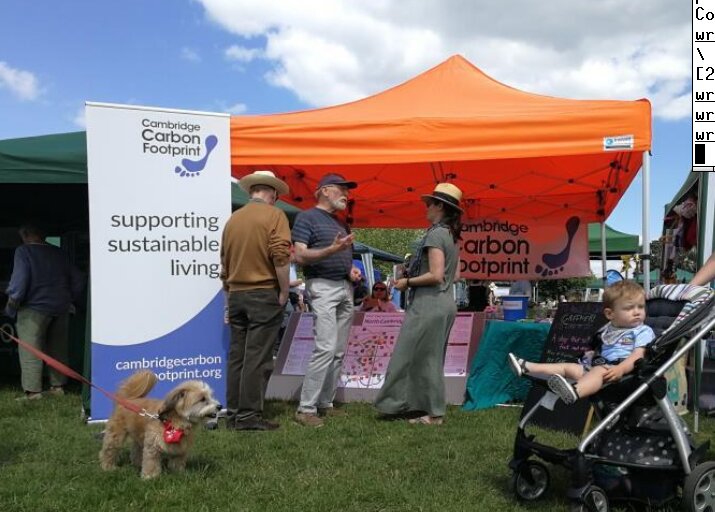
The speaker was Alana Sinclair of Cambridge Carbon Footprint, whose activities include Open Eco Homes, supporting Repair Cafes, and the Net Zero Now training course which inspired SOW.
She told us about some techniques to use when discussing Climate Change, following lots of research and her own experience. People often feel uncomfortable about the subject because they can feel judged.
Do people care?
She began by asking: In general how concerned about climate change do you think people in the UK are? And how about in Oakington and Westwick specifically?
The answers surprised some of us. 74% adults reported feeling (very or somewhat) worried about climate change. When asked about a range of issues, climate change was the second biggest concern facing adults in Great Britain (74%), with the rising cost of living being the main concern (79%). (ONS 2022).
Globally, 89% would like their governments to do more to tackle warming, and 69% say they would be willing to contribute 1% of their income to addressing climate change.
But, Alana explained, humans are “conditional co-operators” who are more likely to contribute to public good if they see that others are doing the same. So one important motivating message is to let people know that most of the population, like them, cares about climate change and wants something to be done to stop it.
Britain Talks Climate 2024 is research which reveals what people think about climate policy. It shows that only 15% want to see a slow down in Net Zero efforts. Most people think that reaching Net Zero will be good for the UK – even those in the lowest income groups. There is near universal support for protecting nature and wildlife, and reducing pollution and increasing renewables are next highest priorities.
In rural areas like ours, climate change is a concern to 87% of people – ie higher than the national average, and rural citizens are more engaged with environmental concerns in general than urban citizens (although the actions they take may be different.)
Nationally, 75% said they made a lot or some lifestyle changes to help tackle climate change. So a useful engagement strategy is to recognise the efforts people are already making.
How to be effective when speaking to others about Climate Change
Alana had lots of tips, including:
- Know your audience (their values and attitudes) and connect with what matters to them. (Eg locally this might be reducing waste, community pulling together, a sense of stewardship and shared responsibility to protect the environment)
- Help your audience realise what they can do, and what are the key, most important actions. People don’t always realise what are the next steps
- Recognise the scale of the problems we face, but emphasise how to overcome them. A sense of desperation will be counter-productive. Need to bridge the gap between anxiety and action. Avoid fear, doom and gloom.
- Use captivating visuals, stories, narrative, humour and other creative forms of engagement.
- Avoid the information trap. Facts and figures won’t change people’s minds. And avoid preaching. Instead, ask people for their tips, quiz them on what they already know. A smattering of facts will make things tangible however.
- Listen and show empathy. The more people feel understood and respected, the more open they are to changing their behaviour. Even if you don’t agree, find common ground. Learn from one another.
- Speak personally. Use stories and case studies (and don’t gloss over difficult bits.)
- You have to roll with resistance. Don’t argue/retaliate or oppose directly – you won’t get very far. Sometimes it’s best to just walk away; or it may be a signal to ask more questions, show more empathy.
- Climate change can feel distant so use anything that connects it to everyday life – eg weather (have they noticed any changes), gardening, the future for our children/grandchildren
- Don’t talk in terms of radical change, hardship and sacrifice, or use language which evokes political divide eg left/right
- Ask people what they are already doing for nature.
- Maybe talk in terms of “reducing carbon emissions” rather than “net zero” which can mean different things to different people?
- Trust that others are already concerned and taking action. We’re not in a place where we have to get a mandate for climate change action. We just need to convince people that we have that mandate and give them the tools to crack on.
- Encourage people to consider climate change when they vote.
Alana gave some specific examples of engagements:
- Imaginarium – a lecture theatre that was gradually transformed into a rainforest over a day with all comers joining in writing/drawing/crafts. Including sound effects! CCF are producing (maybe in June.=) a toolkit to support people.
- World War ration books – showing that the diet of the past is also a sustainable diet for the future. (Used in Cottenham Sustainable Food Festival.)
- Cambridge Climate Map – a map of local shops/businesses/other resources that can help people reduce their footprint. CCF have done a stall in which people added their own suggestions to this.
What next?
We had a lively discussion, and the conclusion at the end was that we would postpone the planned May 29th meeting (“Composing for Sustainability and Wildlife” followed by a visit to Lou’s garden) until June (26th) and use the May meeting to discuss what we learned tonight and use those insights to prepare a stall for the Village Day (29th June) – in collaboration with the village Environment Action Group.
Here’s a link to the results of the survey we did last Village Day which may be useful in our discussions.
Email us if you’d like to ask to see the slides for the full presentation, which included a lot more than in these notes.
(Thank you to John whose notes these are based on.)
Notices
Don’t forget the Plant Swap on Sat 18 May 10-12 and Sun 19 May 2-4pm, in Coles Lane.
Cambridge Nature Festival runs 25th May – 30th June. Events and activities for all ages, abilities and interests – creative activities, nature walks, live music, bat punt safaris, BioBlitzes and much more. Visit www.cambridgenaturenetwork.org/cambridge-nature-festival for a full list.
SOW will be represented at the Pollination Festival at the Garden Centre on 22nd June and at Village Day 29th June – help on the stalls very welcome.
 Sustainable Oakington and Westwick
Pingback: Communicating Climate Change & Village Day Planning | Sustainable Oakington and Westwick
Pingback: SOW meeting 0n 29 May | Sustainable Oakington and Westwick