
Eco-Homes Talk
Talk by Paul Kershaw and Philip Garsed about Retrofitting Eco Homes, 25th October 2022
Both Paul’s and Philip’s homes featured in this year’s Cambridge Eco Homes tours.
There are various paths to achieving an “eco home” – new-build or (in his and Philip’s case) retrofit, all at once or in stages. There are also various standards (eg Passivhaus, Enerphit Standard).
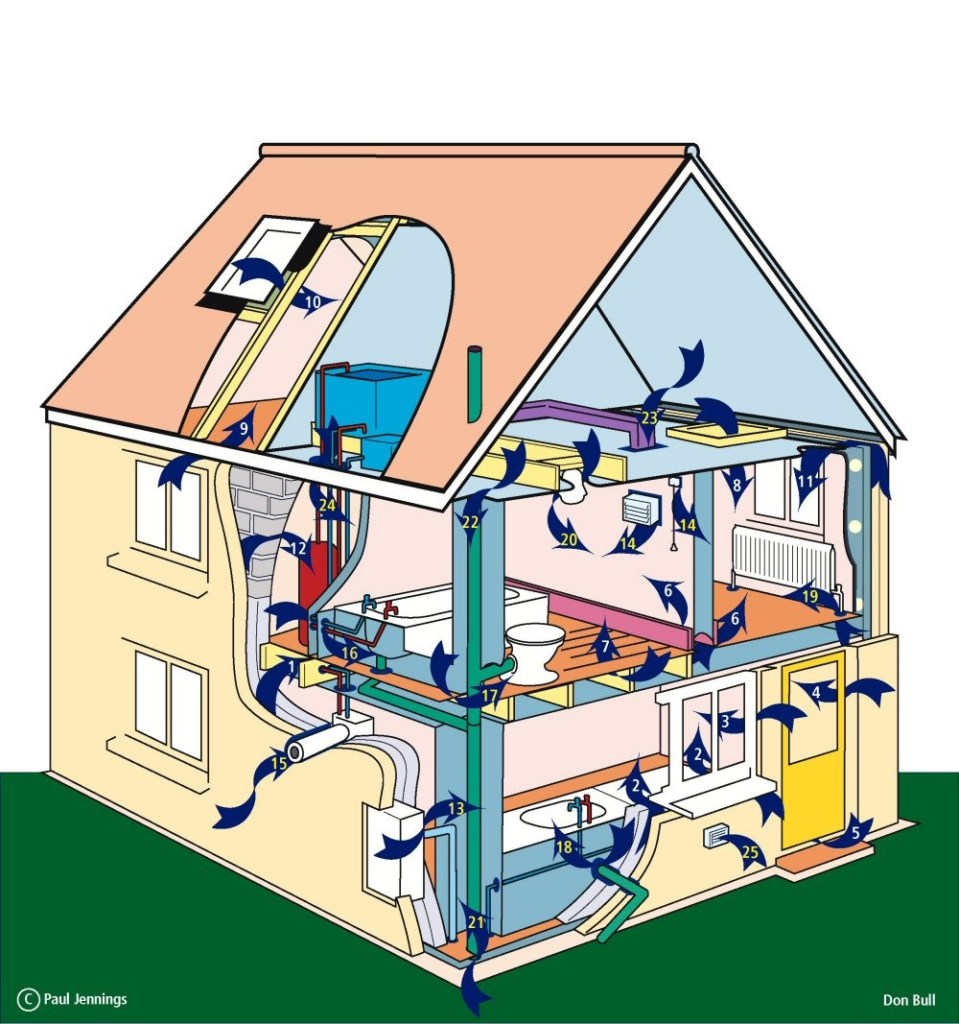
The two core principles of energy efficiency are insulation and ventilation. Helpful tools include the EPC certificate (not especially good), a thermal camera, an airtightness test, using an incense stick to detect draughts, existing energy bills and your own experience of living in a property.
Paul’s retrofitting project had as its aims: considered quality of living design, eco-friendly products, and energy efficiency. He explained how, by having an overall plan drawn up, he was able to take advantage of grants and trials when they arose. Considered quality of living design includes such aspects as wider doorways, ergonomic design, assisted bathing facilities by design not a bolted-on eyesore, and air quality through ventilation and lower VOCs. Eco-friendly materials included natural materials such as marmoleum flooring Materials were reused where possible. There is provision for a future grey water system; for the present, water-saving shower and taps. The gas (“methane”) supply has been cut off along with the standing charge!
There were some eco-friendly compromises which had to be made. Clay plaster was prohibitively expensive but clay paint has some of its advantages. A sedum carpet can form a green roof without having to structurally alter an existing flat roof. There are pros and cons to internal and external wall insulation and different materials for the latter. Cork was chosen for the rear but more visually appealing woodfibre boards and scotlarch cladding for the front.
Ventilation is necessary once a house is sufficiently air-tight to prevent a build-up of moisture, and options range from “natural” ventilation (windows and doors) through passive stack (chimney flue via fire heat or wind), mechanical ventilation and mechanical ventilation with heat recovery (MVHR).
Paul’s key pointers: educate yourself, plan, and stand firm to your ideals.
Philip says he is often asked what the payback time on his house improvements will be, but that question ignores the very tangible benefits of living in a much more comfortable house in the meantime. Eco-houses are comfortable: super insulation, air tightness and MVHR result in stable temperatures, constant humidity, fresh air and quiet homes.

What makes us feel cold? Draughts, cold feet, colder surfaces (eg windows), changes in temperature as we move from one room to another. An eco-home does not have these, so can feel warmer than the actual temperature. Plus they are cool in summer.
Homes which are too dry or too damp are bad for health – the optimum humidity is 40-60%, which the MVHR maintains. Other benefits are being able to dry washing indoors, cook without steam, no bathroom mould, and a nicer living environment.
A lot of discussion followed. One question was about steps you can take if you are not able to launch into a full retrofit. LED lights and, when replacing appliances, choosing ones with good energy ratings. There was debate about the merits of battery storage. On the one hand, they make solar panels more worthwhile because stored solar energy can be used at times of the day when electricity is expensive (time-of-use tariffs will become normal.) On the other, in summer you can’t use all you store and in winter you can’t make enough.
 Sustainable Oakington and Westwick