
The Most Effective Actions We Can Take?
The most wide-ranging and systematic assessment to date (at least that I’ve heard of) of community lead initiatives (CLIs) for climate change mitigation was conducted by TESS (Towards European Societal
Sustainability), an EU funded research project. Based on case study research on the social, political, economic, technological and environmental impacts of 63 community led initiatives (CLIs) in six European countries (Spain, Italy, Romania, Germany, Scotland and Finland), TESS calculated carbon emissions savings compared with national baselines in each country.
This included a calculation of greenhouse gas (GHG) emissions, compared with a baseline figure based on national per capita average emissions in the domain/s in question. This provides an estimate of the emissions avoided by each CLI, based on average consumption levels in each country, rather than a direct calculation.
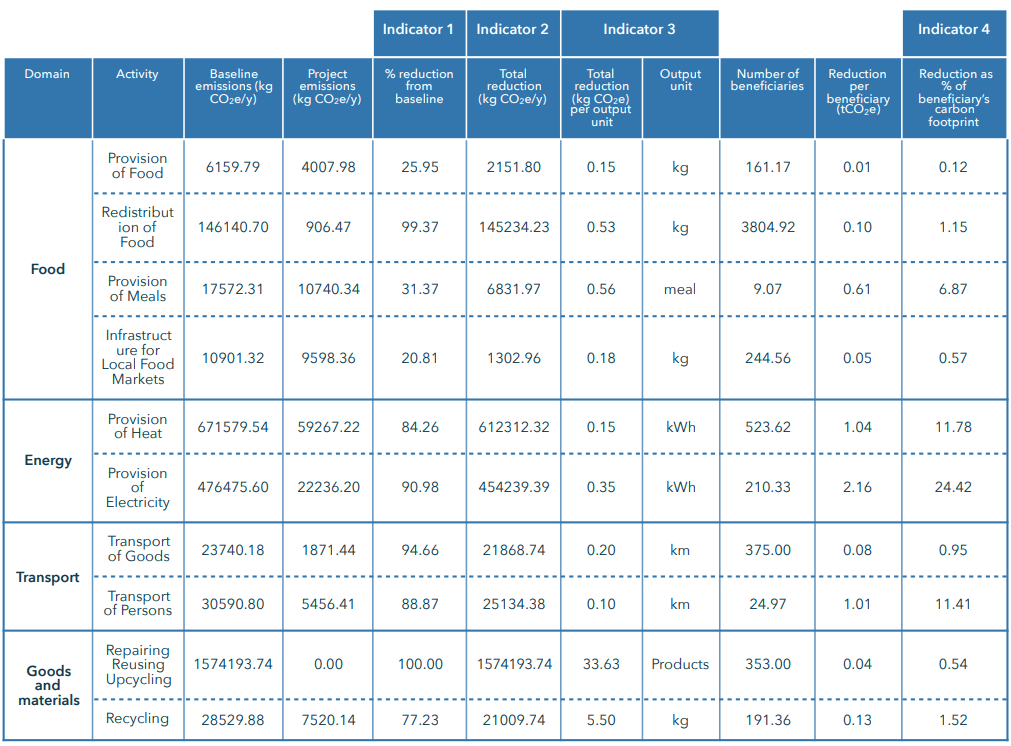
Results indicated that CLIs achieve the highest reductions in GHG emissions through heat and electricity
generation, personal transportation and promoting / providing vegan and vegetarian diets (with provision of meals being a star performer rather than worrying about where the food comes from)). In terms of absolute total reductions, some headline figures are as follows:
In relation to total reductions, some headline figures are as follows:
• energy: average absolute reductions are 612 tCO2e/year (84.3% below baseline),
ranging from 40 to 2367 tCO2e/year across CLIs
• food: numbers of members and beneficiaries significantly influence figures. On
average, redistribution of food leads to a reduction of nearly 145 tCO2e/year per CLI
• transport: transportation of goods leads to an average 94.7% reduction of GHG
emissions compared with baseline figures, with absolute figures ranging from 1.8 to
43 tCO2e/year for different CLIs
• waste: the average absolute emissions reduction resulting from the activity “Repairing,
Reusing, Upcycling” is very high (1,574 tCO2e/year, with an average saving of 34 kg
CO2e per unit product)
Full report on this link – its chapter 5 that discusses the results and analyzes for the most effective activities
 Sustainable Oakington and Westwick